
Spalangiidae
Haliday, 1833
Genus Guides
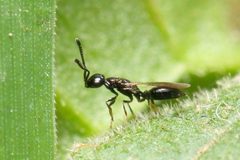
1Spalangiidae is a of chalcid wasps (Hymenoptera: Chalcidoidea) elevated from former of Pteromalidae in 2022. Members are of flies, with two recognized subfamilies: Spalangiinae and Erotolepsiinae. The family is now classified within the planidial clade, more closely related to Eucharitidae, Perilampidae, Chrysolampidae, and Eutrichosomatidae than to core Pteromalidae. The Spalangia has a distribution, while other genera show restricted geographic ranges.
Pronunciation
How to pronounce Spalangiidae: //spəˌlænˈdʒiːəˌdeɪ//
These audio files are automatically generated. While they are not always 100% accurate, they are a good starting point.
Identification
typically with 8 flagellomeres including a single-segment clava; antennal toruli positioned very low on the in most . usually with 2 or 3 teeth. All legs with 5 tarsomeres; protibial spur stout and curved. In Spalangiinae, toruli are placed on lobes that overhang the and , combined with a head (mouthparts projecting forward). Eunotopsia differs in having 11 flagellomeres with 3 clavomeres, higher toruli placement, and undivided mandibles.
Images
Distribution
Spalangiinae: (Spalangia); Mexico and Sri Lanka (Playaspalangia). Erotolepsiinae: Brazil (Balrogia); Grenada, St. Vincent and the Grenadines (Erotolepsia); New South Wales, Australia (Eunotopsia); Papua New Guinea, Kerala (India), and Sri Lanka (Papuopsia).
Host Associations
- Oscinella frit - frit-fly; of Spalangia drosophilae
Ecological Role
of dipteran flies. Some have been evaluated for of agricultural pests.
Human Relevance
Spalangia drosophilae has been mass-reared as a agent against the frit-fly (), a pest of cereal crops.
Similar Taxa
- PteromalidaeFormerly classified within Pteromalidae; separated in 2022 based on phylogenetic position in the planidial clade and distinct morphological features including antennal placement and structure.
- EucharitidaePart of the same planidial clade; Spalangiidae is more closely related to this than to core Pteromalidae.
Sources and further reading
- BugGuide
- Wikipedia
- GBIF taxonomy match
- iNaturalist taxon
- NCBI Taxonomy
- Catalogue of Life
- Comparative cytogenetics of the families Pteromalidae and Spalangiidae – a review
- Studies of the Families Cleonymidae, Coelocybidae, Epichrysomallidae, Eunotidae, Heydeniidae, Megastigmidae, Neanastatidae, Pirenidae, Spalangiidae and Systasidae (Hymenoptera: Chalcidoidea)
- Observations on the Biology and Mass-breeding of Spalangia drosophilae Ashm. (Hymenoptera, Spalangiidae), a Parasite of the Frit-fly, Oscinella frit (L.)