
Perilampidae
Förster, 1856
perilampid wasps
Genus Guides
3is a of small chalcidoid wasps comprising approximately 270 described across 15 . Most species are hyperparasitoids, parasitizing other larvae within insects, though some function as primary parasitoids. The family is characterized by brilliant metallic coloration, robust body form, and a unique involving mobile first-instar larvae called . Perilampidae is closely related to Eucharitidae, with which it shares the planidial larval stage and multidigitate .
Pronunciation
How to pronounce Perilampidae: //ˌpɛrɪˈlæmpɪdiː//
These audio files are automatically generated. While they are not always 100% accurate, they are a good starting point.
Identification
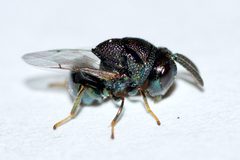
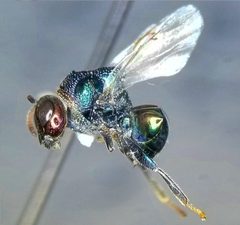
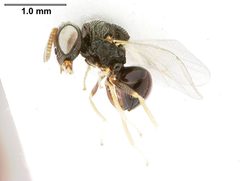
Distinguished from similar small metallic , particularly Chrysididae (cuckoo wasps), by the triangular or pyramid-shaped with sharp corners; cuckoo wasps have oval or rounded abdomens. The short, strongly elbowed and broad, disc-like prothorax are additional key features. The combination of brilliant metallic coloration with robust, heavily sculptured mesosoma separates from most other Chalcidoidea. Forewing venation and antennal segment counts provide definitive characters for and generic identification.
Images
Appearance
Small ranging from 1.3 to 5.5 millimeters in length. Body typically brilliant metallic blue or green, though some are entirely black. Mesosoma robust and strongly sculptured. Metasoma small and triangular or pyramid-shaped, resembling an inverted pyramid. Prothorax broad and disc-like. short and strongly elbowed. Wings with distinctive venation patterns; forewing stigma with characteristic arrangement of uncal .
Habitat
Found in diverse terrestrial where insects occur. frequently observed on vegetation, particularly around colonies and extrafloral of plants such as sunflowers. Some associated with forest environments where wood-boring hosts are present. Habitats range from temperate forests to tropical regions, with distribution tied to availability of primary and secondary host organisms.
Distribution
distribution with records from all major biogeographic regions. Approximately 36 documented in North America north of Mexico. Significant diversity in the Neotropical region with about 30 species across four . European fauna includes at least 20 species of Perilampus. Fossil representatives known from Eocene Baltic amber (34–55 million years ago), indicating long evolutionary history in the Northern Hemisphere.
Seasonality
activity patterns vary by and region. In temperate zones, adults most commonly observed during summer months when are abundant. Specific timing correlates with of host insects; for example, species parasitizing are active when sawfly larvae are present. Some species exhibit extended activity periods associated with multiple host .
Diet
Larvae are , feeding on tissues. Hyperparasitoid consume larvae of other parasitoids (primarily tachinid flies, ichneumonoid , or braconid wasps) within secondary hosts. Primary parasitoid species feed directly on larvae, larvae, larvae, or other insects. feed on nectar, honeydew, and from extrafloral .
Host Associations
- Tachinidae (Diptera) - hyperparasitoidlarvae of tachinid flies within lepidopteran or other
- Ichneumonidae (Hymenoptera) - hyperparasitoidichneumonoid larvae within insects
- Braconidae (Hymenoptera) - hyperparasitoidbraconid larvae within insects
- Diprionidae (Hymenoptera) - primary or hyperparasitoid larvae; some facultatively hyperparasitic via dipteran
- Platypodidae (Coleoptera) - primary ambrosia beetle pupae, particularly in tropical regions
- Anobiidae (Coleoptera) - primary larvae
- Chrysopidae (Neuroptera) - primary larvae
- Acrididae (Orthoptera) - hyperparasitoid nymphs via flesh fly (Sarcophagidae)
Life Cycle
Development is hypermetamorphic with distinct larval instars. are deposited on vegetation, bark, or other substrates near potential , not directly on or in hosts. First-instar larvae are —flattened, highly sclerotized, mobile larvae with prominent . Planidia actively seek hosts by attaching to moving insects with their mandibles. Upon locating appropriate secondary host, planidia penetrate host and search for primary host within. Successful planidia enter primary host and remain until host pupates. then emerges, into -like ectoparasitic larva, and passes through two or three additional instars before pupating within host cocoon or . Some can complete development as primary parasitoids if hyperparasitoid unavailable.
Behavior
Females broadcast in large numbers (up to 500) across vegetation and other substrates rather than targeting specific . Planidial larvae exhibit active host-seeking , using to attach to any passing insect in attempt to locate suitable host. Within host, demonstrate remarkable navigation to locate and enter primary larvae. Later instars actively search host body for competing larvae and destroy them. Some show flexible strategies, capable of adjusting developmental based on host availability.
Ecological Role
Function as tertiary consumers in , predominantly as hyperparasitoids that regulate of other . This hyperparasitoid role can disrupt efforts when primary parasitoids of pest insects are targeted. Some species serve as primary parasitoids of beetles and , contributing directly to regulation of herbivore populations. The unique planidial stage represents an evolutionary for locating concealed in complex environments.
Human Relevance
Generally of minimal direct economic importance. Some have been investigated for potential, though hyperparasitoid habit complicates application. Species parasitizing ambrosia beetles (Monacon) have been evaluated for forestry pest management but judged poor control agents due to low rates and synchronization with mating rather than full reproductive output. Occasionally encountered by entomologists and naturalists due to striking metallic appearance. One species, Brachyelatus marthae, described from Eocene Baltic amber, represents significant fossil discovery.
Similar Taxa
- ChrysididaeSimilar small size and brilliant metallic coloration; distinguished by rounded or oval without triangular shape, and different wing venation
- EucharitidaeClosely related sharing planidial larval stage and multidigitate ; eucharitids are specialized of ants with modified
- PteromalidaeSometimes confused due to historical taxonomic lumping; pteromalids lack planidial larvae and typically have different body proportions and reduced wing venation
- ChrysolampidaeRelated within the planidial clade; historically treated as Chrysolampinae within but now often recognized as separate family
More Details
Taxonomic complexity
Classification of has been historically unstable. The has been variously treated as distinct from or lumped with Pteromalidae. The Chrysolampinae, sometimes included in Perilampidae, is now frequently elevated to family rank (Chrysolampidae). The number of recognized ranges from 6 to 30 depending on taxonomic authority, reflecting ongoing debate about generic limits. The family's relationship with Eucharitidae is particularly close, with some evidence suggesting Eucharitidae evolved from within Perilampidae, which would render Perilampidae .
Evolutionary significance
The planidial larval stage represents a remarkable evolutionary innovation within Chalcidoidea. This mobile first instar, responsible for location rather than the ovipositing female, has persisted for at least 40 million years based on fossil evidence from Baltic amber. Despite high mortality rates associated with this risky strategy, no lineage within the planidial clade has evolved away from it, suggesting a stable evolutionary optimum for exploiting concealed hosts.
Host location mechanism
The planidial stage's strategy of attaching to any moving object with results in extremely high mortality, with the vast majority of failing to locate appropriate . Successful host location requires attachment to correct secondary host , penetration of host , and navigation to locate primary within. This multi-step process filters planidial severely, with only a tiny fraction reaching reproductive maturity.
Sources and further reading
- BugGuide
- Wikipedia
- GBIF taxonomy match
- iNaturalist taxon
- NCBI Taxonomy
- Catalogue of Life
- Bug Eric: Wasp Wednesday: Perilampid Wasps
- Treasures in Gemstones: Previously Unknown Wasps Found in Prehistoric Amber
- Chrysolampine Wasps (Chalcidoidea: Perilampidae sensu lato) From Baltic Amber
- FIRST RECORD OF A LARVAL PARASITOID PERILAMPIDAE (HYMENOPTERA)
- New Host Records for Perilampus hyalinus (Hymenoptera: Perilampidae) and Phasmophaga antennalis (Diptera: Tachinidae)
- Biology of the Hyperparasitic Wasp <i>Perilampus Similis</i> (Hymenoptera: Perilampidae)
- Family Perilampidae (Insecta: Hymenoptera) as Parasitoids of Ants (Hymenoptera: Formicidae) and Other Insects
- Taxonomic revision of the Perilampus carolinensis species complex (Hymenoptera: Chalcidoidea: Perilampidae), and the description of five new species
- Nouvelles données de Perilampidae, Chalcididae et Leucospidae pour la faune de Belgique (Hymenoptera, Chalcidoidea)
- The Species of <I>Monacon</I> (Hymenoptera: Chalcidoidea: Perilampidae) from India and Adjacent Countries
- Perilampus neglectus and other neglected species: new records of Palaearctic Perilampidae (Hymenoptera, Chalcidoidea), with a key to European species of Perilampus
- The life history of Pseudometagea schwarzii, with a discussion of the evolution of endoparasitism and koinobiosis in Eucharitidae and Perilampidae (Chalcidoidea)
- Life history and larval morphology of <i>Monacon</i> (Hymenoptera: Perilampidae), parasitoids of ambrosia beetles (Coleoptera: Platypodidae)
- Life history and larval morphology of Monacon (Hymenoptera: Perilampidae), parasitoids of ambrosia beetles (Coleoptera: Platypodidae)
- OBSERVATIONS ON LARVAL BEHAVIOUR AND AVOIDANCE OF ENCAPSULATION OF PERILAMPUS HYALINUS (HYMENOPTERA: PERILAMPIDAE) PARASITIC IN NEODIPRION LECONTEI (HYMENOPTERA: DIPRIONIDAE)
- Integrative taxonomic revision of the Nearctic Perilampus hyalinus species complex (Hymenoptera, Chalcidoidea, Perilampidae) resolves 100 years of confusion about the host associations of P. hyalinus Say
- The Biology ofPerilampus hyalinusSay (Hymenoptera: Perilampidae), a Primary Parasite ofNeodiprion swaineiMidd. (Hymenoptera: Diprionidae) in Quebec, with Descriptions of the Egg and Larval Stages