
Diprionidae
Conifer Sawflies
Genus Guides
5- Diprion(conifer sawflies)
- Gilpinia(conifer sawflies)
- Monoctenus
- Neodiprion
- Zadiprion
is a of conifer-feeding comprising approximately 90-140 across 11-13 . Larvae feed gregariously on conifer needles and can cause major forest . are stingless with distinctive : males possess pectinate (comb-like) antennae while females have serrate (saw-like) antennae with about 20 flagellomeres. The family is restricted to the Northern Hemisphere and includes significant forest pests such as Neodiprion sertifer and N. abietis.
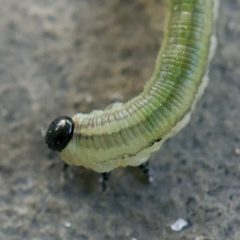
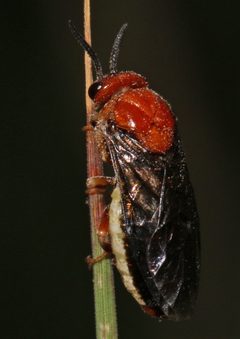
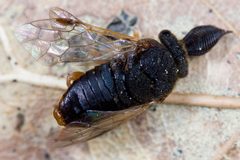
Pronunciation
How to pronounce Diprionidae: //daɪˈpɹiːənaɪdiː//
These audio files are automatically generated. While they are not always 100% accurate, they are a good starting point.
Identification
Distinguished from other by the combination of: (1) with approximately 20 flagellomeres showing strong (pectinate in males, serrate in females), and (2) exclusive association with conifer plants. Larvae can be separated from caterpillars (Lepidoptera) by the presence of on all abdominal segments; Lepidoptera lack prolegs on the first abdominal segment. Within , identification relies on larval coloration patterns and morphological characters; Davis et al. (2023) provides the first in-color larval key for eastern North American species.
Images
Appearance
are small to medium-sized with distinctive containing approximately 20 flagellomeres. in antennae is pronounced: males have pectinate (feathery, comb-like) antennae while females have serrate (saw-edged) antennae. The saw-like ovipositor gives the group its . Larvae resemble caterpillars with on all abdominal segments (distinguishing them from Lepidoptera caterpillars, which lack prolegs on the first abdominal segment). Larval coloration varies by and includes green, yellow, and black patterning useful for identification.
Habitat
Coniferous forests, plantations, and urban/suburban areas with conifer trees. Found wherever conifers occur including Pinus, Abies, Larix, Tsuga, Juniperus, and other . develop in stands with favorable environmental conditions.
Distribution
Northern Hemisphere only. Documented from North America (including USA, Canada), Europe, and Asia (Japan, Korea, Eurasia). GBIF records confirm presence in Scandinavia (Denmark, Norway, Sweden) and northeastern North America (Vermont).
Seasonality
Activity patterns tied to conifer plant . Larval feeding occurs during growing season when needles are available. Specific timing varies by and latitude; N. sertifer studied at 25°C with 16L:8D in laboratory conditions.
Diet
Larvae are folivores feeding exclusively on conifer needles. Young larvae feed from the edge of needles, consuming approximately half and leaving a dry sliver; older larvae consume entire needles from base to tip, leaving only a stub. do not feed on plant material.
Host Associations
- Pinus spp. - plantprimary for many including Neodiprion sertifer, N. virginianus complex, N. lecontei, N. compar, N. maurus, N. pinetum, N. fabricii, N. excitans
- Abies spp. - plantN. abietis; N. kojimai on Abies veitchii
- Larix kaempferi - plantNesodiprion kagaensis
- Tsuga diversifolia - plantNesodiprion flavipes
- Juniperus rigida - plantMonoctenus kondoi
- Juniperus communis var. montana - plantMonoctenus obscuratus hokkaidonis
- Torymidae - Diprion hani
- Bracon hebetor - idiobiont of Neodiprion sertifer larvae
- Lophyroplectus luteator - ichneumonid of Neodiprion sertifer in Ontario
- Lespesia postica - tachinid of Monoctenus sanchezi
- Vibrissina mexicana - tachinid of Monoctenus sanchezi
- Perilampus hyalinus - hyperparasitoid or primary can complete as of larvae when primary absent
Life Cycle
Females use saw-like ovipositor to insert into conifer foliage. Larvae hatch and develop through multiple instars, feeding gregariously on needles. Young larvae feed on needle edges; older larvae consume entire needles. occurs in soil or leaf litter. Some have extended . Development studied at 25°C, 60-70% RH, 16L:8D for N. sertifer.
Behavior
Larvae are gregarious, feeding in groups on conifer foliage throughout most of their development. This grouping contributes to rapid defoliation during . characterized by periodic outbreaks followed by collapse due to natural enemies, depletion, or other factors. N. virginianus complex shows abrupt termination of .
Ecological Role
Primary folivore on conifers—one of few insect groups adapted to feed on conifer needles. Serve as food for birds and support diverse including ichneumonid wasps, braconid wasps, tachinid flies, and . can cause extensive defoliation, compromising forest health and creating opportunities for secondary pests such as bark beetles.
Human Relevance
Major forest pests capable of defoliating thousands of acres. Neodiprion sertifer is a major pest on Pinus in Europe; N. abietis impacts Abies; multiple Neodiprion affect pines in eastern North America. Management includes hand removal or water spraying for small , applications for large , and using fungi ( bassiana), (, spinosad), or . Chemical treatments rarely required as natural enemies typically moderate .
Similar Taxa
- TenthredinidaeOther with some conifer-feeding ; distinguished by structure and specificity patterns
- PamphiliidaeOther conifer-feeding in ; distinguished by with ~20 flagellomeres and
- Lepidoptera caterpillarsLarvae visually similar but distinguished by count: have prolegs on all abdominal segments, Lepidoptera lack prolegs on first abdominal segment
More Details
Taxonomic scope
counts vary between sources: Wikipedia cites ~90 species in 11 ; other sources indicate 140 species in 13 genera. Discrepancy reflects ongoing taxonomic revision.
Chemical defense
plant chemistry influences larval chemical defense strategies; larvae sequester or process conifer defensive compounds.
Research gaps
Despite ecological and economic importance, relatively little research conducted on conifer sawflies; Davis et al. (2023) noted only 25 in eastern U.S. forests but limited prior synthesis.
Sources and further reading
- BugGuide
- Wikipedia
- GBIF taxonomy match
- iNaturalist taxon
- NCBI Taxonomy
- Catalogue of Life
- Bug Eric: Wasp Wednesday: Perilampid Wasps
- What's Eating Your Pine Needles? Sawflies, Probably
- The Japanese species of Monoctenus (Hymenoptera: Diprionidae)
- Japanese species of the sawfly genus Nesodiprion (Hymenoptera, Diprionidae)
- Characteristics of the Outbreak Area of Diprion hani (Hymenoptera: Diprionidae) and a Report of its Torymid Parasitoid
- First Records of Lespesia postica and Vibrissina mexicana (Tachinidae) as Parasitoids of Monoctenus sanchezi (Diprionidae)
- AN INFESTATION OF NEODIPRION VIRGINIANUS COMPLEX (HYMENOPTERA: DIPRIONIDAE) IN NORTHEASTERN NEW BRUNSWICK
- Ecological Niche Modelling to Assessment of Potential Distribution of Neodiprion Abietis (Harris, 1841) (Insecta, Hymenoptera, Diprionidae) in Eurasia
- The biology ofLophyroplectus luteator [Hym.: Ichneumonidae] onNeodiprion sertifer [Hym.: Diprionidae] in Ontario
- New approaches to the control of Neodiprion sertifer (Geoffroy, 1785) (Hymenoptera: Diprionidae)
- Chronic Defoliation Impacts Pine Sawfly (Hymenoptera: Diprionidae) Performance and Host Plant Quality
- Host plant influence on chemical defense in conifer sawflies (Hymenoptera: Diprionidae)
- Ecology of the Pine Sawfly, Neodiprion excitans (Rohwer) (Hymenoptera, Diprionidae)