
Perilampus
Latreille, 1809
Species Guides
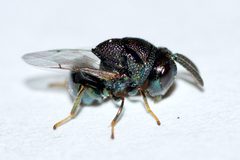
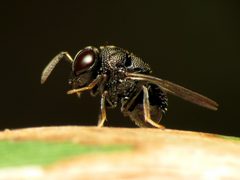
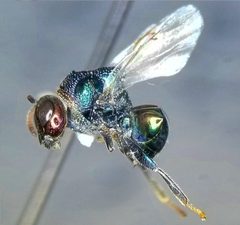
9Perilampus is a of minute parasitic in the Perilampidae, ranging from 1.3–5.5 mm in length. Many exhibit brilliant metallic green or blue coloration, though some are entirely black. The genus is notable for its complex hyperparasitic , involving a mobile larva that actively seeks . Approximately 260–277 species are recognized worldwide, with 36 species recorded from North America north of Mexico.
Pronunciation
How to pronounce Perilampus: //ˌpɛrɪˈlæmpəs//
These audio files are automatically generated. While they are not always 100% accurate, they are a good starting point.
Identification
Distinguished from similar small metallic , particularly cuckoo wasps (Chrysididae), by the triangular or inverted pyramid-shaped with sharp corners versus the oval or rounded abdomen of chrysidids. Short, strongly elbowed also characteristic. Separation from other Perilampidae and from Pteromalidae requires microscopic examination and taxonomic keys.
Images
Habitat
Found in diverse environments including vegetation with colonies, extrafloral of plants such as sunflowers, and locations where occur. deposited on leaves, buds, bark cracks, and under lichens.
Distribution
Worldwide distribution with records from Nearctic, Neotropical, Palaearctic, and Australian regions. North America: 36 north of Mexico. Europe: multiple species including new records from Greece, Romania, Turkey, Austria, Sweden, Cyprus, and Spain. Asia: South Korea, with Euperilampus recorded for first time. Australia: at least P. franzmanni described. Neotropical region: P. carolinensis primarily distributed here.
Seasonality
active during warmer months; specific seasonal patterns vary by and region. One source notes presence "in summer" for at least one .
Host Associations
- Tachinidae (Diptera) - hyperparasitelarvae parasitized
- Ichneumonidae (Hymenoptera) - hyperparasitelarvae parasitized
- Braconidae (Hymenoptera) - hyperparasitelarvae parasitized, including Orgilus lepidus
- Diprionidae (Hymenoptera) - P. hyalinus can complete as primary of larvae
- Tenthredinidae (Hymenoptera) - P. hyalinus can complete as primary of larvae
- Acrididae (Orthoptera) - hyperparasite grasshoppers via flesh fly (Sarcophagidae)
- Chrysopidae (Neuroptera) - larvae recorded as primary for some Perilampinae
- Sphecidae (Hymenoptera) - larvae recorded as
- Curculionidae (Coleoptera) - weevil larvae recorded as
- Lycidae (Coleoptera) - larvae recorded for Chrysolampinae
- Anobiidae (Coleoptera) - Steffanolampus salicetum associated with several anobiid beetles
- Nitidulidae (Coleoptera) - larvae recorded for Chrysolampinae
- Phthorimaea operculella (Lepidoptera: Gelechiidae) - unsuccessful of P. franzmanni fail to develop in unparasitized potato larvae
Life Cycle
Females broadcast in large numbers (up to ~500) on vegetation and substrates. Mobile larva hatches and actively attaches to moving objects with . Successful planidia penetrate secondary , then locate and enter primary host (a of the secondary host). Larva waits until primary host pupates, then exits and into -like external-feeding parasite. Two to three additional instars follow before inside host cocoon or . Some can adjust : P. hyalinus can develop as primary parasite on larvae if no primary host present.
Behavior
observed feeding on honeydew and extrafloral nectar, including from sunflower stems. larvae exhibit active -seeking , attaching to any moving object. Hyperparasitic lifestyle involves sequential host penetration and location behaviors.
Ecological Role
Hyperparasitoid, primarily attacking larvae within herbivorous insects; some function as primary parasitoids. This dual role creates complex trophic cascades in . May influence of both primary parasitoids and their herbivore .
Human Relevance
Potential for , though hyperparasitic habit complicates applications. P. franzmanni studied in context of potato biological control programs. One unverified report suggests possible biting or stinging in summer-active . Taxonomic complexity has created classification challenges for applied entomology.
Similar Taxa
- Chrysididae (cuckoo wasps)Similar small size and metallic coloration; distinguished by oval or rounded without sharp corners versus triangular abdomen in Perilampus
- PteromalidaeTaxonomically related and sometimes lumped with Perilampidae; separation requires detailed morphological examination
- Other Chalcidoidea families (Cynipidae, Eulophidae, Trichogrammatidae)Similar minute size and reduced wing venation; distinguished by combination of abdominal shape, structure, and microscopic characters
More Details
Taxonomic instability
Classification has varied: treated as Perilampidae or lumped with Pteromalidae. Chrysolampinae sometimes placed in Pteromalidae. Number of recognized disputed: 15 versus ~30. Approximately 260–277 recognized worldwide, with many awaiting description.
Planidium biology
The larval form represents an unusual for location among , with high mortality due to attachment to inappropriate hosts.
Host flexibility
Some in Perilampinae demonstrate developmental plasticity, able to complete as either hyperparasitoids or primary depending on availability.
Sources and further reading
- BugGuide
- iNaturalist taxon
- NCBI Taxonomy
- Catalogue of Life
- Bug Eric: Wasp Wednesday: Perilampid Wasps
- Perilampus neglectus and other neglected species: new records of Palaearctic Perilampidae (Hymenoptera, Chalcidoidea), with a key to European species of Perilampus
- New Host Records for Perilampus hyalinus (Hymenoptera: Perilampidae) and Phasmophaga antennalis (Diptera: Tachinidae)
- A NEW SPECIES OF PERILAMPUS LATREILLE (HYMENOPTERA: PTEROMALIDAE) FROM AUSTRALIA WITH NOTES ON ITS BIOLOGY
- Supplementary material 6 from: Yoo JJ, Darling DC (2024) Integrative taxonomic revision of the Nearctic Perilampus hyalinus species complex (Hymenoptera, Chalcidoidea, Perilampidae) resolves 100 years of confusion about the host associations of P. hyalinus Say. Journal of Hymenoptera Research 97: 1301-1383. https://doi.org/10.3897/jhr.97.133255
- Supplementary material 4 from: Yoo JJ, Darling DC (2024) Integrative taxonomic revision of the Nearctic Perilampus hyalinus species complex (Hymenoptera, Chalcidoidea, Perilampidae) resolves 100 years of confusion about the host associations of P. hyalinus Say. Journal of Hymenoptera Research 97: 1301-1383. https://doi.org/10.3897/jhr.97.133255
- Supplementary material 3 from: Yoo JJ, Darling DC (2024) Integrative taxonomic revision of the Nearctic Perilampus hyalinus species complex (Hymenoptera, Chalcidoidea, Perilampidae) resolves 100 years of confusion about the host associations of P. hyalinus Say. Journal of Hymenoptera Research 97: 1301-1383. https://doi.org/10.3897/jhr.97.133255
- Taxonomic revision of the Perilampus carolinensis species complex (Hymenoptera: Chalcidoidea: Perilampidae), and the description of five new species
- Figure 26 from: Yoo JJ, Darling DC (2024) Integrative taxonomic revision of the Nearctic Perilampus hyalinus species complex (Hymenoptera, Chalcidoidea, Perilampidae) resolves 100 years of confusion about the host associations of P. hyalinus Say. Journal of Hymenoptera Research 97: 1301-1383. https://doi.org/10.3897/jhr.97.133255
- Supplementary material 5 from: Yoo JJ, Darling DC (2024) Integrative taxonomic revision of the Nearctic Perilampus hyalinus species complex (Hymenoptera, Chalcidoidea, Perilampidae) resolves 100 years of confusion about the host associations of P. hyalinus Say. Journal of Hymenoptera Research 97: 1301-1383. https://doi.org/10.3897/jhr.97.133255
- Figure 2 from: Yoo JJ, Darling DC (2024) Integrative taxonomic revision of the Nearctic Perilampus hyalinus species complex (Hymenoptera, Chalcidoidea, Perilampidae) resolves 100 years of confusion about the host associations of P. hyalinus Say. Journal of Hymenoptera Research 97: 1301-1383. https://doi.org/10.3897/jhr.97.133255
- Biology of the Hyperparasitic Wasp <i>Perilampus Similis</i> (Hymenoptera: Perilampidae)
- Supplementary material 1 from: Yoo JJ, Darling DC (2024) Integrative taxonomic revision of the Nearctic Perilampus hyalinus species complex (Hymenoptera, Chalcidoidea, Perilampidae) resolves 100 years of confusion about the host associations of P. hyalinus Say. Journal of Hymenoptera Research 97: 1301-1383. https://doi.org/10.3897/jhr.97.133255
- STEFFANOLAMPUS, A NEW GENUS FORPERILAMPUS SALICETUM(CHALCIDOIDEA) AND ITS NEARCTIC DISTRIBUTION