
Phthorimaea operculella
(Zeller, 1873)
potato tuber moth, tobacco splitworm
, commonly known as the potato tuber or tobacco splitworm, is a gelechiid moth and major agricultural pest of Solanaceae crops worldwide. The is oligophagous, feeding primarily on potato tubers and foliage, but also attacks tomato, tobacco, eggplant, and pepper plants. Larval mining of tubers and leaves causes substantial economic damage, rendering potatoes unmarketable. The species has achieved near-global distribution, particularly in subtropical, tropical, and Mediterranean climates, and is subject to extensive efforts including , cultural practices, and chemical interventions.

Pronunciation
How to pronounce Phthorimaea operculella: /θɔːrɪˈmaɪə ˌɒpɚkjʊˈlɛlə/
These audio files are automatically generated. While they are not always 100% accurate, they are a good starting point.
Identification
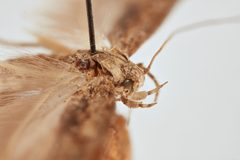
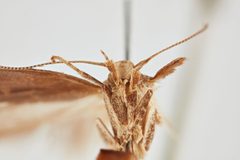
Distinguished from similar gelechiid moths by the combination of small size (10–12 mm), grayish-brown spotted forewings with frayed margins, and in females, the characteristic black 'X' pattern on closed forewings. Larvae are identified by their leaf-mining producing blotch mines on Solanaceae foliage, and by body coloration changing from white/yellow to pink/green with brown capsule. The may be confused with Phthorimaea absoluta (South American tomato leafminer), which is larger, has more pronounced dark spots on forewings, and shows different preferences and geographic distribution.
Images
Appearance
are small with a body length of approximately 10 mm and wingspan of about 12 mm. The body is narrow and light brown, with grayish-brown forewings bearing small dark spots and frayed edges on both wing pairs. Females are distinguished from males by a black 'X' pattern visible on the forewings when at rest. Larvae are 12–15 mm long, initially white or yellow with a brown and prothorax, maturing to pink or green with small black spots and bristles on thoracic segments.
Habitat
Agricultural systems and storage facilities in proximity to Solanaceae plants. Field occur in potato crops where tubers are exposed or within 1 cm of the soil surface. The prefers warm climates—subtropical, tropical, and Mediterranean zones—with temperature strongly influencing survival and development rates. favor shaded, dry microhabitats for oviposition, avoiding moist surfaces and bright light.
Distribution
Reported from more than 90 countries across all continents except Antarctica. Present in Europe (Mediterranean regions, Atlantic islands), Asia (South, Southeast, East, and West Asia), Africa (sub-Saharan and North Africa), North America (at least 25 U.S. states, Mexico, Canada), Central America and Caribbean, South America, and Oceania (Australia, New Zealand, Pacific islands). In the United States, concentrated along Atlantic and Pacific coasts and in potato-growing regions including Idaho and the Pacific Northwest.
Seasonality
are , becoming active 1–2 hours after sunset. Activity and development rates are temperature-dependent, with faster development in warmer conditions. In favorable climates, multiple per year occur. Peak female oviposition occurs 2–5 days after adult , declining substantially by day 7.
Diet
Larvae feed on tubers, roots, and foliage of Solanaceae plants. On foliage, larvae are leafminers, consuming mesophyll and creating blotch mines. Tubers are attacked only when exposed or near the soil surface; larvae do not burrow deeply to locate tubers. Documented include potato (Solanum tuberosum), tomato (Solanum lycopersicum), tobacco (Nicotiana tabacum), eggplant (Solanum melongena), and bell pepper (Capsicum annuum).
Host Associations
- Solanum tuberosum - primary tubers and foliage attacked; major economic impact
- Solanum lycopersicum - foliage and fruit attacked
- Nicotiana tabacum - foliage attacked; alternate 'tobacco splitworm' derives from this association
- Solanum melongena - foliage attacked
- Capsicum annuum - foliage attacked
Life Cycle
Holometabolous with four stages: , larva, pupa, . Females lay over 200 eggs in a lifetime, depositing them in surface depressions (0.2–0.5 mm² cracks) on plants, soil near hosts, leaf , or stem joints. Eggs are oval, smooth, pearly white to yellowish, and hatch in approximately five days. Larvae feed for up to two weeks, initially and testing leaf surfaces with silk threads and test bites before committing to mine formation. Pupae are narrow, white, approximately 0.5 inches long, with development taking 10–30 days depending on temperature. Adults live 1–2 weeks, with mating beginning ~24 hours after .
Behavior
are and capable of sustained —laboratory studies demonstrate flights exceeding 5 hours and 10 kilometers non-stop, contradicting earlier assumptions of poor flight ability. Females use a specialized oviposition strategy: the ovipositor contains mechano- and chemosensory receptors that detect chemical signals (including L-glutamic acid) from plants, allowing -laying without direct contact with the plant surface. Females strongly prefer dry, shaded, hairy or textured surfaces over moist, bright, smooth, or waxy ones. Larvae exhibit host-acceptance involving 5–15 minutes of , silk deposition, and test biting before initiating mines; on non-host plants, larvae walk faster, make fewer test bites, and depart if reaching leaf edges.
Ecological Role
Agricultural pest with no documented native role outside of cultivated systems. Serves as for larval including Apanteles subandinus, Orgilus lepidus, and Diadegma mollipla, and for parasitoids in the Trichogramma. by the spider Selenops radiatus has been documented in South Africa. The drives substantial research in , breeding, and .
Human Relevance
Major economic pest of potato production worldwide, causing damage to both foliage and tubers. Tuber damage renders potatoes unmarketable for fresh consumption or seed. Management relies on combining: (1) cultural control—sprinkler irrigation to deter oviposition, proper hilling to bury tubers, and harvest timing; (2) —release of effective against foliar but not tuber ; (3) chemical control— effective against foliar stages but not tuber-infesting larvae; and (4) monitoring— traps and selected leaf sampling. The is a significant research subject for understanding insect-plant chemical signaling, location mechanisms, and pest management.
Similar Taxa
- Phthorimaea absolutaSimilar size, coloration, and range (Solanaceae), but larger with more pronounced dark forewing spots, different geographic distribution (originally South American, expanding globally), and preference for tomato over potato. P. absoluta larvae create deeper mines and show different feeding patterns.
- Tecia solanivoraAnother potato-associated gelechiid pest in South America, distinguished by different larval and geographic restriction.
Misconceptions
Early literature incorrectly described as poor fliers; subsequent research demonstrated sustained capability exceeding 10 km. are often assumed to provide complete control, but they are ineffective against larvae within tubers—cultural practices such as irrigation management and proper hilling are essential for tuber protection.
Sources and further reading
- BugGuide
- Wikipedia
- GBIF taxonomy match
- iNaturalist taxon
- NCBI Taxonomy
- Catalogue of Life
- Erika Bueno, Ph.D. - Entomology Today
- Phthorimaea absoluta Archives - Entomology Today
- How One Entomologist Puts a Childhood Love of Insects to Work in IPM
- Phthorimaea operculella . [Distribution map].
- Phthorimaea operculella . [Distribution map].
- Potato Tuberworm Phthorimaea operculella (Zeller) (Lepidoptera: Gelechiidae)
- Interactions between the potato moth (Phthorimaea operculella (Zeller)) and its main host the potato (Solanum tuberosum L.) in laboratory and field
- Sampling for the potato moth (Phthorimaea operculella) and its parasitoids
- Alternate hosts of the potato tuber moth, Phthorimaea operculella (Zeller)
- Insecticidal potential of Lantana camara L. ethanol and nano-silver extracts against the potato tuber moth (Phthorimaea operculella [Zeller]).