
Orgilus
Haliday, 1833
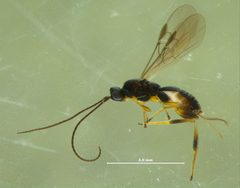
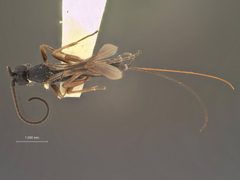
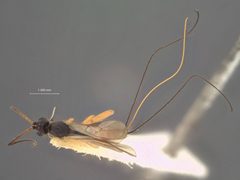
Orgilus is a of in the Braconidae with nearly distribution. within this genus are internal parasitoids of lepidopteran larvae, with documented including pyralid and gelechiid pests. Several species have been studied as agents for agricultural pests.
Pronunciation
How to pronounce Orgilus: /ˈɔrɡɪləs/
These audio files are automatically generated. While they are not always 100% accurate, they are a good starting point.
Images
Habitat
Associated with of lepidopteran larvae; agricultural systems where host pests occur, including potato fields and pine forests.
Distribution
Near distribution; recorded from Denmark, Norway, Sweden, and the United States (Vermont).
Diet
Internal nutrition derived from larvae; develops within living lepidopteran hosts.
Host Associations
- Phthorimaea operculella - (Gelechiidae)
- Elasmopalpus lignosellus - lesser cornstalk borer (Pyralidae)
- Rhyacionia buoliana - European pine shoot moth (Olethreutidae)
- Nothris verbascella - Gelechiidae
Life Cycle
Development occurs internally within larvae; parasitized hosts initially gain weight similarly to unparasitized larvae but eventually attain smaller maximum size before declining. larvae increase in weight during second to fourth instars, eventually comprising up to 80% of combined host- weight. Host moulting appears unaffected, though parasitized larvae remain in state and do not develop reproductive organs.
Behavior
Females use for location, including volatile compounds (heptanoic acid identified in ) that elicit searching and contact chemicals that stimulate ovipositor probing. Host discrimination allows females to distinguish between parasitized and unparasitized hosts, and between hosts containing versus heterospecific larvae, reducing and multiparasitism. Parasitized hosts maintain feeding and activity for approximately one week longer than unparasitized hosts.
Ecological Role
Internal of lepidopteran larvae; agent of agricultural and forestry pests. interactions include competition and discrimination with other parasitoids such as Hyssopus thymus and Temelucha interruptor.
Human Relevance
Used in programs for pest ; susceptible to broad-spectrum including , , and carbamates, which are generally more toxic to the than to its .
Sources and further reading
- BugGuide
- Wikipedia
- GBIF taxonomy match
- iNaturalist taxon
- NCBI Taxonomy
- Catalogue of Life
- Analysis of Host Discrimination in the Parasite Orgilus lepidus (Hymenoptera: Braconidae)
- Biology of Orgilus elasmopalpi [Hym.: Braconidae] with Elasmopalpus lignosellus [Lep.: Pyralidae] as Host1
- Sources of Host-Location Cues for the Parasitic Wasp Orgilus-Lepidus (Braconidae)
- Demonstration of Host Discrimination in the Parasite Orgilus lepidus (Hymenoptera: Braconidae)
- The Biology of Orgilus lepidus (Hymenoptera: Braconidae), a Primary Parasite of the Potato Tuberworm
- KAIROMONE MEDIATED HOST‐FINDING BEHAVIOR IN THE PARASITIC WASP ORGILUS LEPIDUS
- THE EFFECT OF ORGILUS OBSCURATOR (HYMENOPTERA: BRACONIDAE) ON THE DEVELOPMENT OF THE EUROPEAN PINE SHOOT MOTH (LEPIDOPTERA: OLETHREUTIDAE)
- Lethal and sublethal effects of pesticides on the potato tuber moth, Phthorimaea operculella (Zeller) (Lepidoptera: Gelechiidae) and its parasitoid Orgilus lepidus Muesebeck (Hymenoptera: Braconidae)
- Laboratory studies on the biology ofOrgilus jenniae(Hymenoptera: Braconidae), a parasitoid of the potato tuberworm,Phthotimaea operculetta(Lepidoptera: Gelechiidae)
- DISCRIMINATION BY HYSSOPUS THYMUS (HYMENOPTERA: EULOPHIDAE) AGAINST ORGILUS OBSCURATOR (HYMENOPTERA: BRACONIDAE), AN INTERNAL PARASITE OF THE EUROPEAN PINE SHOOT MOTH, RHYACIONIA BUOLIANA (LEPIDOPTERA: OLETHREUTIDAE)
- The Interaction Between Orgilus obscurator (Nees) (Hymenoptera: Braconidae) and Temelucha interruptor (Grav.) (Hymenoptera: Ichneumonidae), Parasites of the Pine Shoot Moth, Rhyacionia buoliana (Schiff.) (Lepidoptera: Olethreutidae)
- Nothris verbascella ([Denis & Schiffermüller], 1775) (Lepidoptera, Gelechiidae) y su asociación con el parasitoide Orgilus sp. (Hymenoptera, Braconidae) y el saprófago Anthomyia procellaris Rondani, 1866 (Diptera, Anthomyiidae) en Cantabria (España)
- THE COMPARATIVE TOXICITY OF SOME INSECTICIDES TO THE POTATO MOTH PHTHORIMAEA OPERCULELLA (ZELLER) (LEPIDOPTERA: GELECHIIDAE) AND TWO OF ITS PARASITES ORGILUS LEPIDUS MUESEBECK AND COPIDOSOMA DESANTISJ ANNECKE AND MYNHARDT