
Rhyacionia buoliana
(Denis & Schiffermüller, 1775)
pine shoot moth, European Pine Shoot Moth
Rhyacionia buoliana is a tortricid known as the pine shoot moth. Native to North Africa, North Asia, and Europe, it has become in North and South America. The is a significant pest of pine trees, with larvae feeding on shoots of Pinus species. are active during summer months in temperate regions.
Pronunciation
How to pronounce Rhyacionia buoliana: /rhaɪəˈkoʊniə buːˈliːɑːnə/
These audio files are automatically generated. While they are not always 100% accurate, they are a good starting point.
Identification
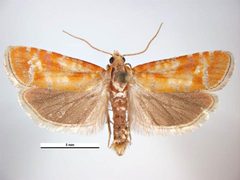
Distinguished from similar Rhyacionia by the combination of ferruginous-orange forewings with metallic grey-whitish and strigulae, and the specific larval association with pine shoots. The black and segment 2 plate on larvae aid identification.
Images
Appearance
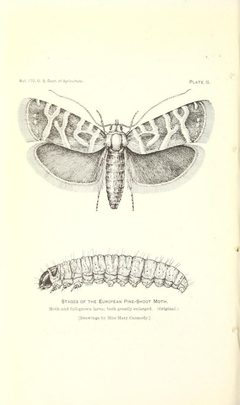
Wingspan 16–24 mm. Forewings ferruginous-orange, often partly suffused with dark red, with several irregular variable anastomosing metallic grey-whitish and costal strigulae. Hindwings light grey. Larva brown-reddish with black and black plate on segment 2.
Habitat
Pine forests and plantations; associated with trees Pinus sylvestris and Pinus nigra in native range, and other Pinus in invaded areas.
Distribution
Native to North Africa, North Asia, and Europe. in North America and South America. Established recorded in Belgium and other European countries.
Seasonality
on wing June to August in western Europe; with single per year.
Diet
Larvae feed on pine (Pinus). Original plants are Pinus sylvestris and Pinus nigra.
Host Associations
- Pinus sylvestris - native
- Pinus nigra - native
Life Cycle
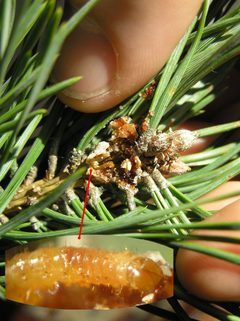
Larvae feed within pine shoots, causing characteristic damage. occurs in feeding tunnels or soil. emerge in summer.
Behavior
Larvae tunnel into pine shoots, disrupting terminal growth and causing shoot dieback. This feeding results in deformed growth and reduced timber quality.
Ecological Role
As a shoot-boring herbivore, larvae alter pine growth form. Larvae are attacked by the tachinid fly Actia nudibasis, indicating regulation in some .
Human Relevance
Significant forestry pest causing economic damage to pine plantations through shoot deformation and growth reduction. Subject of management efforts in invaded regions.
Similar Taxa
- Other Rhyacionia speciesSimilar size and coloration; distinguished by specific wing pattern details and association
More Details
Subspecies
Rhyacionia buoliana thurificana (Lederer, 1855)