
Tortricidae
Latreille, 1803
tortrix moths, leafroller moths, tortricid moths
Subfamily Guides
3- Chlidanotinae
- Olethreutinae(Olethreutine Leafroller Moths)
- Tortricinae(Tortricine Leafroller Moths)
is a large of small with over 11,000 described , constituting the sole member of the superfamily Tortricoidea. Members are commonly known as tortrix moths or leafroller moths due to the larval of rolling leaves to form shelters. The family includes numerous economically significant agricultural and forestry pests, notably the codling moth (Cydia pomonella) and spruce budworm (Choristoneura species). The typical resting posture features wings folded back, creating a rounded profile.

Pronunciation
How to pronounce Tortricidae: /tɔːrˈtrɪsɪdiː/
These audio files are automatically generated. While they are not always 100% accurate, they are a good starting point.
Identification
Distinguished from other small by the characteristic resting posture with wings folded back, producing a rounded rather than flattened or tented profile. Separated from Geometridae by more compact body and different wing folding pattern. Distinguished from Pyralidae by lack of prominent labial palps forming a snout. Larval shelters of rolled or folded leaves are diagnostic when present.
Images
Appearance
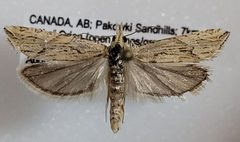
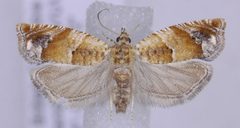
Small with wingspans generally 3 cm or less. Resting posture distinctive: wings folded back over the , producing a bell-shaped or rounded silhouette. Coloration predominantly drab—mottled and marbled browns—though some exhibit bright colors and mimic Geometridae or Pyralidae moths. , tapering to fine points. Forewings typically rectangular to triangular with slightly curved outer margins.
Habitat
Extremely diverse; occupy virtually all terrestrial supporting their plants. Agricultural and orchard habitats frequently host pest species. Forests, particularly coniferous forests, support significant pest including spruce budworm. Alpine meadows host specialized species such as Dichrorampha velata. Arctic regions support Olethreutinae species.
Distribution
distribution with on all continents except Antarctica. Particularly well-documented in North America, Europe, and Asia. Croatia alone 417 documented species across Alpine, Mediterranean, and Continental biogeographical regions. Arctic regions support specialized fauna including Olethreutes inquietana and O. mengelana.
Seasonality
Activity patterns vary by and latitude. Temperate species typically show multiple per year; Grapholita molesta in Korean apple orchards exhibits four peaks annually. occurs as , larvae, or pupae depending on species. Many species synchronize with plant .
Diet
Herbivorous. Larvae in Tortricinae feed externally on leaves, buds, and fruits, often constructing leaf rolls. Larvae in subfamilies Chlidanotinae and Olethreutinae typically bore into stems, roots, buds, or seeds. Many are ; some are highly specialized.
Host Associations
- Malus domestica - larval food plantapple; major pest
- Pyrus spp. - larval food plantpear
- Prunus persica - larval food plantpeach
- Prunus domestica - larval food plantplum
- Picea spp. - larval food plantspruce; spruce budworm
- Pedicularis - larval food plant of Arctic Olethreutes inquietana
- Dryas - larval food plant of Arctic Olethreutes mengelana
- Achillea/Chrysanthemum - probable larval food plantspeculative for Dichrorampha velata based on congeneric
Life Cycle
Complete . often flattened and -like. Larval feeding strategy varies by : Tortricinae feed externally and construct leaf rolls, often with an anal fork for flicking excrement; Chlidanotinae and Olethreutinae typically bore into plant tissues. usually occurs within the larval shelter or in soil. stage variable: eggs, larvae, or pupae depending on .
Behavior
Larvae of Tortricinae construct characteristic leaf rolls or folds, binding leaves with silk to create shelters from which they feed. This is the source of the "leafroller ." Larvae may be gregarious in some . are primarily and attracted to light, though some species are . Adults show random movement patterns in response to plumes, with limited active attraction range.
Ecological Role
Significant herbivores in terrestrial . Major economic pests in agriculture and forestry, causing substantial damage to fruit crops, nuts, and forest trees. Serve as food resources for , , and other . Some may contribute to pollination as , though this is poorly documented.
Human Relevance
Among the most economically important insect worldwide. Major pests of apple, pear, peach, plum, grape, citrus, and other crops. Codling moth (Cydia pomonella) is particularly destructive to apples globally. Spruce budworm (Choristoneura ) causes extensive defoliation and timber loss in North American forests. Management relies heavily on applications, monitoring traps, and . Some species used as food sources or in silk production in various cultures.
Similar Taxa
- PyralidaeSimilar small size and drab coloration; distinguished by Pyralidae's prominent labial palps forming a snout and different resting posture
- GeometridaeSome mimic Geometridae; distinguished by Geometridae's more slender bodies, different wing posture at rest, and typically more triangular wing shape
- CrambidaeOverlapping size range and ; distinguished by Crambidae's more elongated body and often more pointed wing tips
Misconceptions
The "worm" in apples is frequently misidentified; it is typically the larva of a tortricid (codling moth), not a true worm. The "leafroller" applies specifically to Tortricinae larvae and does not describe the boring of Chlidanotinae and Olethreutinae larvae.
More Details
Pest Management
Line-trapping with multiple traps in close proximity has been developed to improve monitoring for codling moth, reducing variability compared to single-trap methods.
Research Significance
contains some of the most intensively studied insects due to economic importance, with extensive research on communication, resistance, and .
Sources and further reading
- BugGuide
- Wikipedia
- GBIF taxonomy match
- iNaturalist taxon
- NCBI Taxonomy
- Catalogue of Life
- Oh, What a (Moth) Night! | Bug Squad
- Blacklighting at the Bohart: They Saw the Light | Bug Squad
- Oh, What a (Moth) Night This Will Be! A Conversation With Bohart's Lepidoptera Curator Jeff Smith | Bug Squad
- Line Trapping: A Promising Method for More Accurate Pest Monitoring
- New alpine moth solves a 180-year-old mystery | Blog
- Catch a Glimpse of Caterpillars During National Moth Week
- Leptiri savijači Hrvatske (Lepidoptera: Tortricidae) Tortricid moths of Croatia (Lepidoptera: Tortricidae)
- ARCTIC OLETHREUTINAE (LEPIDOPTERA: TORTRICIDAE)
- Forecasting model of Grapholita molesta (Lepidoptera: Tortricidae) in apple orchards.