
Rhyacionia
Hübner, [1825], 1816
Pine Tip Moths
Species Guides
20- Rhyacionia adana(Adana tip moth)
- Rhyacionia aktita
- Rhyacionia blanchardi
- Rhyacionia buoliana(pine shoot moth)
- Rhyacionia busckana(Red Pine Tip Moth)
- Rhyacionia bushnelli(western pine tip moth)
- Rhyacionia duplana(summer shoot moth)
- Rhyacionia frustrana(Nantucket Pine Tip Moth)
- Rhyacionia fumosana
is a of tortricid moths in the Olethreutinae, commonly known as pine tip . The genus comprises approximately 45 described distributed across the Holarctic region and parts of South America, Africa, and Asia. Multiple species are significant forestry pests, with larvae that tunnel into pine shoots, buds, and conelets, causing growth loss and stem deformity. The most economically important species include R. buoliana (European pine shoot moth), R. frustrana (Nantucket pine tip moth), and R. neomexicana, all of which attack various Pinus species in commercial plantations, Christmas tree farms, and seed orchards.
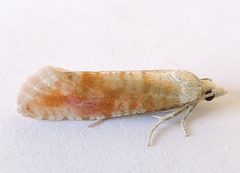
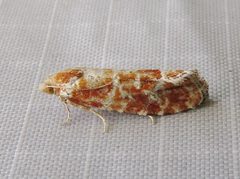
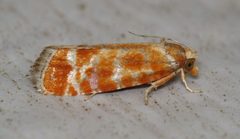
Pronunciation
How to pronounce Rhyacionia: /raɪəˈsaɪəniə/
These audio files are automatically generated. While they are not always 100% accurate, they are a good starting point.
Identification
-level identification within requires examination of genitalia, particularly the configuration of valvae, , and female sterigma. R. miniatana and R. pinivorana are distinguished by subtle differences in male genitalic structures and adult forewing pattern. R. maritimana is distinguished from related species by characteristic genitalic . External appearance alone is unreliable for species differentiation; dissection and comparison with illustrated redescriptions is necessary.
Images
Habitat
Associated with Pinus-dominated including commercial plantations, natural pine forests, Christmas tree plantings, seed orchards, and ornamental pine stands. occupy a range of climatic zones from temperate to subtropical regions.
Distribution
Holarctic distribution with extensions into South America, Africa, and Asia. R. buoliana is native to Europe, introduced to North America (USA, Canada), South America (Argentina, Chile, Uruguay), and parts of Asia. R. frustrana is native to eastern North America. R. miniatana and R. maritimana are western Mediterranean in distribution; R. pinivorana has a Eurosiberian distribution. R. neomexicana occurs in western North America.
Diet
Larval stages feed internally on tissues of pine shoots, buds, and conelets. Specific feeding habits have been documented for several : R. buoliana larvae consume bud and shoot tissues of Pinus species; R. frustrana larvae feed inside growing shoots, buds, and conelets of young pines; R. neomexicana larvae attack ponderosa pine .
Host Associations
- Pinus - plant-level association documented for multiple ; specific ranges vary by species
- Pinus taeda - plantpreferred of R. frustrana in Florida
- Pinus ponderosa - plant of R. neomexicana and R. buoliana
- Pinus radiata - plant of R. buoliana in Argentina and Chile
- Coccygomimus fuscipes - endoparasitoid of R. buoliana and pupae; native agent in Chile and Argentina
- Ophionine ichneumonids - multiple parasitize R. buoliana larvae
Life Cycle
details vary by . R. buoliana is in Patagonian Argentina, with larval development in shoots and occurring during part of the year. R. frustrana damage is concentrated in the first five years of tree growth, suggesting overlapping or extended period in warmer climates. accumulation has been used to predict adult in R. buoliana.
Behavior
Female R. buoliana exhibit preference based on prior larval experience: females preferentially oviposit on the Pinus from which they developed when given a choice, but will accept alternative Pinus species when no other option is available. This indicates learned host preference rather than strict host specificity.
Ecological Role
As primary consumers of pine shoot tissues, larvae influence tree growth form and competitive dynamics. Several function as significant pests in managed forests, causing economic losses through growth reduction and stem deformity. The supports diverse complexes, including native ichneumonid and braconid wasps that contribute to .
Human Relevance
Multiple are major forestry pests. R. buoliana, introduced to the Southern Hemisphere, damages pine plantations in Argentina and Chile, prompting research into using native . R. frustrana is a serious pest of young pine in US plantations, Christmas tree farms, and seed orchards, causing growth loss and stem deformity. R. neomexicana affects height and radial growth in ponderosa pine . Management strategies include silvicultural modifications, chemical control, and conservation of natural enemies.
Similar Taxa
- EvetriaFormerly used as name for some ; R. buoliana was previously classified as Evetria buoliana
- Other Olethreutinaerequire genitalic dissection for separation; associated with pines can be distinguished by association and larval in combination with
More Details
Genetic studies
genetic structure of R. buoliana has been analyzed using isoenzyme , comparing Argentine populations on different with a reference population from Germany (native range).
Parasitoid research
Native complexes associated with R. buoliana in South America have been investigated as potential agents, with Coccygomimus fuscipes identified as a significant endoparasitoid.
Taxonomic complexity
The contains cryptic ; R. miniatana was reinstated as valid from synonymy with R. pinivorana based on genitalic , indicating that may be underestimated.
Sources and further reading
- BugGuide
- Wikipedia
- GBIF taxonomy match
- iNaturalist taxon
- NCBI Taxonomy
- Catalogue of Life
- Rhyacionia buoliana . [Distribution map].
- Morphology and Distribution of Rhyacionia miniatana, an Unappreciated Sibling species of the Spotted pine shoot moth, Rhyacionia pinivorana (Lepidoptera: Tortricidae)
- Coccygomimus fuscipes (HYM. : ICHNEUMONIDAE): UN PARASITOIDE NATIVO DE LA POLILLA DEL BROTE, Rhyacionia buoliana (LEP.: TORTRICIDAE)
- Nantucket Pine Tip Moth, Rhyacionia frustrana (Comstock) (Insecta: Lepidoptera: Tortricidae)
- Parasitoides nativos en el control de la polilla del brote del pino (Rhyacionia buoliana): ¿Un complejo funcional?
- Biología y control de la mariposa europea del brote del pino (Rhyacionia buoliana Den.& Schiff.) en la Patagonia argentina
- PRIMARY HYMENOPTEROUS PARASITES OF NANTUCKET PINE TIP MOTH, RHYACIONIA FRUSTRANA (COMSTOCK)1
- Distribution of Rhyacionia neomexicana1 Eggs within Ponderosa Pine Trees2
- Effects of Rhyacionia neomexicana on Height and Radial Growth in Ponderosa Pine Reproduction1
- The Primary Larvae of Three Ophionine Ichneumonids, Parasitic On Rhyacionia buoliana
- Parasitoides nativos en el control de la polilla del brote del pino (Rhyacionia buoliana): avances en la identificación del complejo y de sus estrategias de desarrollo