
Rhyacionia bushnelli
(Busck, 1914)
western pine tip moth
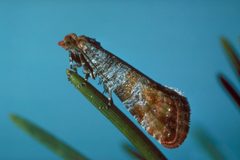
Rhyacionia bushnelli, the western pine tip , is a small tortricid moth with a wingspan of approximately 13 mm. The has one per year. Its larvae are specialized feeders on pine tips, particularly Pinus ponderosa, causing damage to new growth in young plantations. patterns vary with tree height, position, and seed source geography.
Pronunciation
How to pronounce Rhyacionia bushnelli: /raɪˈækoʊniə ˈbʊʃnɛli/
These audio files are automatically generated. While they are not always 100% accurate, they are a good starting point.
Identification
Distinguished from other Rhyacionia by geographic range and association with Pinus ponderosa. Larval damage to pine tips is characteristic: larvae bore into and kill new shoot tips, causing stunted, bushy growth or dead terminal leaders. Specific morphological differences from are not documented in available sources.
Images
Appearance
Small with wingspan approximately 13 mm. As a member of Tortricidae, likely have characteristic bell-shaped wings at rest and relatively broad, squared-off forewings, though specific coloration and pattern details are not documented in available sources.
Habitat
Ponderosa pine (Pinus ponderosa) stands, particularly young plantations. In central Nebraska, has been studied in 8-year-old provenance plantings. intensity varies with tree height and vertical position within the crown.
Distribution
United States: documented from Alabama, Nebraska, North Dakota, and Montana.
Seasonality
One per year. Specific period not documented in available sources.
Diet
Larvae feed on and damage the tips of Pinus , specifically Pinus ponderosa (including var. scopulorum).
Host Associations
- Pinus ponderosa - larval food plantincluding var. scopulorum
Life Cycle
One per year. Complete details (, larval instars, site, stage) are not documented in available sources.
Behavior
Larval attack is concentrated in tree tips and shows vertical stratification: decreases with increasing tree height and varies by position within the crown. In young plantations, whorls 3–7 are primary zones.
Ecological Role
Pest of young ponderosa pine plantations. Tip damage can cause growth deformation, stunting, and multiple leader development, potentially affecting timber quality and tree form.
Human Relevance
Forestry pest of economic concern in ponderosa pine . Research has established sampling protocols: examining 3–6, 4–6, or 4–7 provides accurate estimates of damage for trees ≤3.0 m tall.
Similar Taxa
- Rhyacionia frustranaAlso a pine tip ; distinguished by geographic range (frustrana occurs in eastern and southern US, bushnelli in central/western regions) and preferences
- Rhyacionia rigidanaAnother congeneric pine tip ; specific distinguishing features not documented in available sources
More Details
Sampling Methodology
Research in central Nebraska established that sampling pine tips from 3 through 6, 4 through 6, or 4 through 7 yields accurate estimates of R. bushnelli damage per tree for trees up to 3.0 meters in height. Trees from Eastern Plains seed sources showed lower rates despite greater height compared to trees from three other geographic regions.
Research Limitations
Available documentation derives primarily from a single study in an 8-year-old Nebraska plantation. Broader ecological and behavioral data, including complete , natural enemies, and range-wide , remain undocumented.