
Eucosmini
Meyrick, 1909
Genus Guides
25- Barbara
- Catastega
- Chimoptesis
- Crocidosema
- Epiblema
- Epinotia
- Eucopina(Pine Coneborer and Shoot-Borer Moths)
- Eucosma
- Gretchena
Eucosmini is a tribe of tortricid moths within the Olethreutinae, comprising approximately 26 and over 50 in Taiwan alone, with global diversity much higher. The tribe includes economically important agricultural and forestry pests, such as species that bore into pine needles and buds or feed on cotton and other crops. Members are primarily Holarctic and eastern Asian in distribution, though some species have achieved nearly ranges through human activity. The tribe was established by Meyrick in 1909 and is characterized by specific morphological features of the genitalia and wing venation that distinguish it from other tortricid tribes.
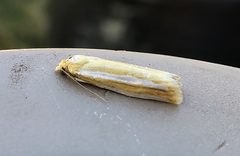
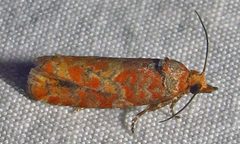
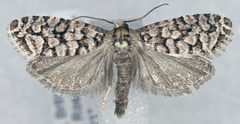
Pronunciation
How to pronounce Eucosmini: /juːˈkɒzmɪnaɪ/
These audio files are automatically generated. While they are not always 100% accurate, they are a good starting point.
Identification
Eucosmini can be distinguished from other Olethreutinae tribes by genitalia , particularly the structure of the male valva and female sterigma, and by characteristic wing venation patterns. Specific identification to and level typically requires examination of genitalia preparations. The tribe includes genera such as Metacosma, Epinotia, Crocidosema, and Eucosma, which vary considerably in forewing coloration and pattern.
Images
Habitat
are diverse and -specific. In Taiwan, collecting sites span elevations from 50 to 3100 meters, including high mountain ranges and low rolling plains. Some species are associated with pine plantations, where larvae bore into needles and buds. Others inhabit gardens, agricultural fields, and natural vegetation across tropical to temperate zones.
Distribution
Primarily distributed across the Holarctic and eastern Asia, with Taiwan documented as a biodiversity hotspot showing 23% among recorded . Some species, including Crocidosema lantana and C. plebejana, have nearly distributions due to human-mediated introduction. The tribe has been recorded from North America, Europe, East Asia including Japan, Korea, North Korea, and Taiwan.
Seasonality
activity varies by and latitude. In North Korea, adults have been collected in July, August, and September. Seasonality is likely extended in tropical and subtropical regions such as Taiwan, where year-round warm, wet conditions prevail.
Host Associations
- Pinus spp. - larval larvae bore into needles and buds, forming resin domes as shelters
- Gossypium sp. - larval Crocidosema plebejana is a common cotton pest
- Lantana camara - larval Crocidosema lantana introduced worldwide for biocontrol of this weed
- Malvaceae - larval multiple including Abelmoschus, Abutilon, Althaea, Anoda, Gossypium, Hibiscus, Kosteletzkya, Lavatera, Malva, Malvastrum, Malvaviscus, Sida
- Mentha sp. - larval Lamiaceae
- Foeniculum piperatum - larval Apiaceae
- Cucurbita pepo - larval Cucurbitaceae
- Eucalyptus sp. - larval Myrtaceae
- Crataegus sp. - larval Rosaceae
- Salix safsaf - larval Salicaceae
- Annona muricata - larval Annonaceae
- Parkinsonia aculeata - larval Fabaceae
- Turnera ulmifolia - larval Turneraceae
- Perilla frutescens - larval Lamiaceae
- Tachilus thunbergii - larval Lauraceae
Life Cycle
Larval development occurs within plant tissues. In Metacosma echinophora, larvae bore into pine needles and buds, constructing resin domes as shelters. Detailed information for most is lacking. Developmental stages include , larva, pupa, and , with larval chaetotaxy (bristle arrangement) used as a taxonomic character in some species.
Behavior
are primarily and have been collected using ultraviolet (UV) light traps and UV bucket traps. Some have been introduced to new regions for purposes. Larval includes boring into plant tissues and constructing protective shelters.
Ecological Role
The tribe includes numerous agricultural and forestry pests of considerable economic and significance. Larvae function as herbivores, with some acting as specialized feeders on particular plant . Some species have been employed as agents against weeds.
Human Relevance
Several are economically important pests of agriculture and forestry. Crocidosema plebejana is a common pest of cotton in many regions. Crocidosema lantana has been deliberately introduced to numerous locations worldwide for of the weed camara. The tribe is of significance due to its potential for crop damage and spread via international trade.
Similar Taxa
- OlethreutiniBoth are tribes within Olethreutinae; distinguished by genitalia and wing venation patterns
- GrapholitiniAnother Olethreutinae tribe with similar overall ; separation requires examination of male genitalia structure and female sterigma
More Details
Taxonomic History
The tribe was established by Meyrick in 1909. Some formerly placed in Eucosmini, such as Argepinotia, have been reassigned. Several remain unplaced to genus, indicated by quotation marks in original descriptions.
Biodiversity Significance
Taiwan has been documented as a significant center of diversity for Eucosmini, with 23% of recorded to the island. This pattern reflects Taiwan's status as a biodiversity hotspot at the intersection of tropical and subtropical zones.
Cryptic Species
Crocidosema plebejana, a common cotton pest, may represent up to four cryptic based on molecular and morphological evidence, suggesting that in the tribe may be underestimated.
Sources and further reading
- BugGuide
- Wikipedia
- iNaturalist taxon
- NCBI Taxonomy
- Catalogue of Life
- Checklist of the Tribe Eucosmini Obraztsov, 1946 (Lepidoptera: Tortricidae: Olethreutinae) from Taiwan
- Two Newly Recorded Species of tribe Eucosmini (Lepidoptera, Tortricidae) from North Korea
- Remarks on the genus Metacosma Kuznetzov, 1985 (Lepidoptera: Tortricidae, Olethreutinae, Eucosmini), with description of a new species from Japan and Korea
- Observations on the Life History and Chaetotaxy of <i>Strepsicrates rhothia</i> (Meyrick) (Microlepidoptera : Tortricidae : Eucosmini)
- Epinotia cinereana (Haworth, 1811) bona sp., a Holarctic tortricid distinct from E. nisella (Clerck, 1759) (Lepidoptera: Tortricidae: Eucosmini) as evidenced by DNA barcodes, morphology and life history