
Grapholitini
Guenée, 1845
Grapholitine moths, Leafroller moth tribe
Genus Guides
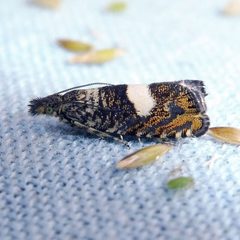
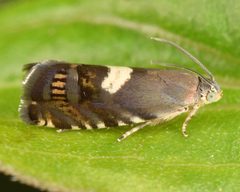
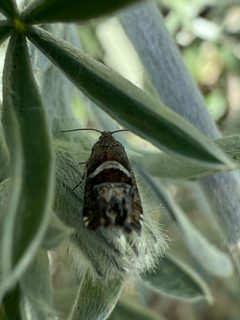
15Grapholitini is a tribe of tortricid moths comprising approximately 1200 described . The tribe contains numerous economically significant agricultural pests that damage fruits and seeds. Molecular phylogenetic analyses have resolved the tribe into two major lineages—a Dichrorampha clade and a Cydia clade—with the Grapholita found to be polyphyletic. The tribe likely originated in the Nearctic, Afrotropical and Neotropical regions during the middle Eocene (ca. 44.3 Ma).
Pronunciation
How to pronounce Grapholitini: /ɡræfəˈlaɪtɪnaɪ/
These audio files are automatically generated. While they are not always 100% accurate, they are a good starting point.
Images
Habitat
Members occur across diverse from lowland to montane regions, with Neotropical collected at altitudes ranging from 5 to 1100 m. Specific microhabitat preferences vary by and species.
Distribution
distribution including Nearctic, Neotropical, Afrotropical, Palearctic, Oriental and Australian regions. Documented from North America (Florida to Brazil), Africa, Australia (northern Queensland, Atherton Tableland), Rica, and Europe.
Diet
Larvae of many are internal feeders in fruits and seeds. Fabaceae-feeding represents the ancestral plant association for the tribe, with most groups originating from monophagous or oligophagous ancestors on this .
Host Associations
- Acacia mangium - of Cryptophlebia caulicola in northern Queensland
- Acronychia spp. - native Rutaceae; native of Thaumatotibia zophophanes
- Macadamia - pest Proteaceae; damaged by Thaumatotibia zophophanes on Atherton Tableland
- Avocado - pest Lauraceae; damaged by Thaumatotibia zophophanes
- Castanea sativa - pest Fagaceae; chestnut fruits damaged by Pammene and Cydia in Italy
- Fabaceae - ancestral Ancestral for tribe-wide diversification
Life Cycle
Complete with , larva, pupa and stages. Larval development occurs internally within tissues for many . Specific developmental details vary considerably among and remain undocumented for most species.
Behavior
Larvae of numerous exhibit internal feeding , tunneling within fruits, seeds and twigs. Some species are documented as borers in woody plant tissues. are frequently collected at light.
Ecological Role
Significant agricultural pests causing damage to fruit and nut crops. Larval feeding reduces nut quality and commercial value in chestnut, macadamia and avocado production. Some serve as native herbivores on wild plants.
Human Relevance
Contains multiple economically important pest affecting cultivated fruits and nuts. Notable pests include Thaumatotibia zophophanes (macadamia and avocado pest in Australia), Pammene fasciana and related species (chestnut pests in Europe), and various Cydia species. Damage occurs through larval tunneling in fruits and seeds, reducing crop quality and yield.
Similar Taxa
- TortriciniAnother tribe within Tortricidae; Grapholitini distinguished by molecular phylogenetic position within Olethreutinae and characteristic larval feeding habits in fruits and seeds
- LarisaFormerly assigned to Grapholitini but excluded based on molecular phylogenetic analysis; not a true member of the tribe
- CorticivoraFormerly assigned to Grapholitini but excluded based on molecular phylogenetic analysis; not a true member of the tribe
More Details
Phylogenetic revision
The Grapholita was found to be polyphyletic and has been split into three genera: Grapholita (sensu stricto), Aspila (formerly a subgenus), and Ephippiphora (formerly a synonym).
Host plant evolution
Biogeographical and ancestral state reconstruction analyses indicate that plant shifts, particularly from Fabaceae to other , have promoted diversification within the tribe.
Sources and further reading
- BugGuide
- Wikipedia
- GBIF taxonomy match
- iNaturalist taxon
- NCBI Taxonomy
- Catalogue of Life
- Systematics and faunistics of Neotropical Grapholitini, 3: Satronia Heinrich, 1926 (Lepidoptera: Tortricidae)
- Four new African species in genus <i>Coccothera</i> Meyrick, 1914 (Lepidoptera: Tortricidae: Grapholitini)
- Cryptophlebia Walsingham, 1900, Thaumatotibia Zacher, 1915, and Archiphlebia Komai & Horak, 2006, in Australia (Lepidoptera: Tortricidae: Olethreutinae: Grapholitini)
- Comments on the morphology and biology of Pammene castanicola Trematerra & Clausi, 2009 (Lepidoptera: Tortricidae: Grapholitini)
- Three new African species in the genus <i>Coccothera<i> Meyrick, 1914 (Lepidoptera: Tortricidae: Grapholitini)
- Description of a new species from Africa in genus <i> Coccothera</i> Meyrick, 1914, with additional taxonomic and faunistic information on two other <i> Coccothera</i> species (Lepidoptera: Tortricidae: Grapholitini)
- Molecular phylogeny, divergence time, biogeography and trends in host plant usage in the agriculturally important tortricid tribe Grapholitini (Lepidoptera: Tortricidae: Olethreutinae)
- Complete mitochondrial genomes of two leafroller moths (Tortricidae: Cydia) and their phylogenetic positions within the tribe Grapholitini.