
Dichrorampha
Guenée, 1845
Species Guides
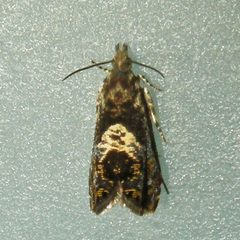
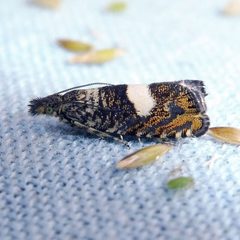
15Dichrorampha is a of small tortricid moths in the Olethreutinae, comprising over 100 described distributed across Europe, Asia, and North America. The genus includes both and species, many associated with mountain and alpine . Several species have been investigated as agents for weeds, including D. aeratana for oxeye daisy and D. odorata for Chromolaena odorata. The genus has been subject to recent taxonomic revision, with cryptic species discovered through integrative approaches combining and molecular data.

Pronunciation
How to pronounce Dichrorampha: //ˌdɪkroʊˈræmfə//
These audio files are automatically generated. While they are not always 100% accurate, they are a good starting point.
Images
Habitat
occur in diverse including mountain meadows, alpine zones, pastures, forest openings, and roadsides. High-elevation species such as D. carpatalpina inhabit north-facing slopes of the highest Carpathian regions. D. velata is locally common in colorful mountain flower meadows.
Distribution
Widespread across the Palearctic region with extensions into North America. Documented from Europe including the Alps, Carpathians, and Scandinavia; eastward through Russia and Central Asia; and in North America with records in eastern North America since 1992. D. velata ranges from Salzburg and Tyrol through southern Switzerland and the Jura to the French and Italian Alps, with isolated records from the Black Forest.
Seasonality
periods vary by and latitude. D. carpatalpina flies from early July to early August. D. aeratana adults emerge in spring (April–June). D. velata is active in spring and early summer, with activity patterns.
Life Cycle
Most appear to be . D. aeratana exhibits a complete : laid on leaves and stems; larvae mine into roots and feed internally and externally on roots, rhizomes, and stem bases through five instars during summer and autumn; overwinter in roots; and pupate in early spring (March). D. carpatalpina larvae develop on Achillea oxyloba schurii.
Behavior
D. carpatalpina fly in morning hours and only in sunny weather. D. aeratana larvae exhibit root-mining , descending from leaves and stems into roots after hatching. Several are , including D. velata.
Ecological Role
Several serve as agents for plants. D. aeratana contributes to suppression of Leucanthemum vulgare through root-feeding damage. D. odorata has been evaluated for control of Chromolaena odorata. Larval feeding by D. aeratana reduces and flower production of target weeds.
Human Relevance
D. aeratana has been proposed for field release in North America and Australia as a agent for the weed Leucanthemum vulgare (oxeye daisy). -range testing indicates minimal risk to non-target , with larvae developing on few economically important plants and no measurable impact on ornamental Shasta daisy.
Sources and further reading
- BugGuide
- Wikipedia
- GBIF taxonomy match
- iNaturalist taxon
- NCBI Taxonomy
- Catalogue of Life
- New alpine moth solves a 180-year-old mystery | Blog
- Alpine Entomology | Blog - Part 2
- moth | Blog
- new species | Blog - Part 16
- New Host and Distributional Record forDichrorampha incanana(Clemens, 1860) (Tortricidae: Olethreutinae)
- Dichrorampha carpatalpina sp. n. (Lepidoptera, Tortricidae), a high mountain species of the Romanian Carpathians
- Host Range and Impact of Dichrorampha aeratana, the First Potential Biological Control Agent for Leucanthemum vulgare in North America and Australia
- Laboratory studies on the biology and host range of Dichrorampha odorata (Lepidoptera: Tortricidae), a biological control agent for Chromolaena odorata (Asteraceae)