
Dichrorampha acuminatana
(Lienig & Zeller, 1846)
Sharp-winged Drill
Dichrorampha acuminatana is a small tortricid with a wingspan of 10–15 mm, found across Europe and the Near East. The exhibits distinctive wing patterns with dark fuscous ground color, purplish tints, and ochreous irroration. are active from May to September, with larvae feeding on Leucanthemum vulgare (oxeye daisy) and Tanacetum vulgare (tansy). The species has been well-documented in Belgium and the Netherlands, with over 2,000 iNaturalist observations.
Pronunciation
How to pronounce Dichrorampha acuminatana: /dɪkroʊˈræmfə əˌkjuːmɪˈnɑːtənə/
These audio files are automatically generated. While they are not always 100% accurate, they are a good starting point.
Identification
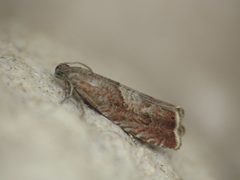
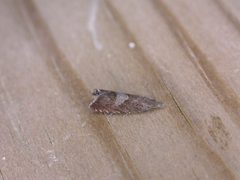
Distinguished from related Dichrorampha by the straighter of the forewings. The combination of dark fuscous purplish-tinged ground color with ochreous irroration, leaden-metallic costal streaks, and the characteristic paler triangular blotch is diagnostic. The three black dots on the termen, though sometimes obsolete, aid identification. The sharply marked white cilia line and straight termen with minimal sinuation separate it from .
Images
Appearance
Small with wingspan 10–15 mm. Forewings with straighter than related ; fold reaches 1/3. Ground color dark fuscous with purplish tinge, obscurely irrorated with ochreous. Costal margin with obscure leaden-metallic streaks. Basal area paler-streaked. Prominent paler broad triangular straight-edged blotch. Three black dots on termen towards middle, sometimes nearly obsolete. Termen straight with very slight sinuation; white cilia line sharply marked. Hindwings light fuscous, darker in females. Larva whitish with light brown ; plate of segment 2 faintly brownish.
Distribution
Europe and the Near East. Well-documented in Belgium (including Brussels-Capital, Flemish, and Walloon regions), the Netherlands, and other parts of continental Europe.
Seasonality
fly from May to September. season data primarily from Belgium and the Netherlands; timing may vary in other parts of the range.
Diet
Larvae feed on Leucanthemum vulgare (oxeye daisy) and Tanacetum vulgare (tansy).
Host Associations
- Leucanthemum vulgare - larval food plantoxeye daisy
- Tanacetum vulgare - larval food planttansy
Similar Taxa
- Dichrorampha alpestranaSimilar wing pattern but D. acuminatana has straighter and distinct triangular blotch
- Dichrorampha montananaHistorically confused ; D. acuminatana distinguished by genitalia and wing pattern details