
Dichrorampha aeratana
(Pierce & Metcalfe, 1915)
Obscure Drill
Dichrorampha aeratana is a small tortricid native to Europe, first described in 1915. The has gained scientific attention as a potential agent for the weed oxeye daisy (Leucanthemum vulgare) in North America and Australia. are active in spring, with larvae feeding internally on plant roots and rhizomes. The moth exhibits strong host specificity, with larval survival negatively associated with increasing ploidy levels in host plants.
Pronunciation
How to pronounce Dichrorampha aeratana: //dɪkˌroʊˈræmfə aɪəˈrɑːtə//
These audio files are automatically generated. While they are not always 100% accurate, they are a good starting point.
Identification
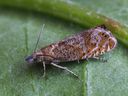
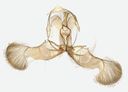
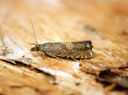
Externally similar to Dichrorampha plumbana; reliable separation requires examination of genitalia. Distinguished from related by the elongated (not round) black spots along the outer forewing edge. The 3–5 silver-grey slashes on the forewing front edge are narrower than in some .
Images
Appearance
Small with wingspan of 11–16 mm. Forewings display 3–5 narrow silver-grey slashes along the front edge, with black spots along the outer edge drawn out to short longitudinal marks. Hindwings brown, not markedly lighter than forewings. Similar in general size and shape to , requiring genital examination for definitive identification.
Habitat
Native European range: pastures, meadows, forest openings, and roadsides. Associated with plants Leucanthemum vulgare and Leucanthemum ircutianum. In North America, found in similar open where oxeye daisy invades. Rearing studies conducted in outdoor gauze-covered field cages and facilities.
Distribution
Native to Europe (including Belgium). Recorded in eastern North America since 1992; not documented in western North America. Proposed for intentional release in North America and Australia as a agent.
Seasonality
emerge and are active in spring, typically April through June. laid on leaves and stems during this period. Larvae present through summer and autumn. occurs in roots. begins early spring, typically March.
Diet
Root-feeding . Larvae feed internally and externally on roots, rhizomes, and stem bases of plants. do not feed.
Host Associations
- Leucanthemum vulgare - primary (target for )oxeye daisy; weed in North America and Australia
- Leucanthemum ircutianum - native presumably includes records previously attributed to L. vulgare
- Leucanthemum × superbum - non-target Shasta daisy; ornamental. Supports complete development but larval feeding has no measurable impact on plant
- Mauranthemum paludosum - non-target creeping daisy; larvae found only in open-field multiple-choice tests
Life Cycle
. emerge spring (April–June). Females lay on leaves and stems. Newly hatched larvae mine down into roots. Five larval instars feed internally and externally on roots, rhizomes, or stem bases through summer and autumn. Overwinter in roots. Pupate early spring (March).
Behavior
Females oviposit on above-ground plant parts; larvae immediately burrow to root system. Strong fidelity demonstrated in choice tests. Larval survival negatively associated with increasing ploidy level in Leucanthemum — hosts strongly preferred over polyploid hosts. No measurable damage to ornamental Shasta daisy despite supporting complete larval development. Impact on target weed enhanced when combined with plant competition.
Ecological Role
Potential agent for oxeye daisy (Leucanthemum vulgare). Expected to contribute to suppression of weed in pastures, meadows, forest openings, and conservation areas in introduced ranges. No anticipated negative effects on economically important ornamentals or native based on extensive -specificity testing.
Human Relevance
Evaluated and proposed for release as a agent against oxeye daisy in North America and Australia. Subject to extensive -range testing (74 non-target tested) to assess safety before field release. No economic importance as a pest; not known to damage crops or ornamental plants of value.
Similar Taxa
- Dichrorampha plumbanaExternally very similar; requires genital examination for certain identification. Both share similar size, wing shape, and general pattern elements.
- Dichrorampha alpestranaRelated with similar wing pattern elements; distinguished by details of forewing markings and genitalia.
More Details
Host-specificity testing
No-choice tests conducted with 74 non-target revealed partial or complete larval development on 11 species. Multiple-choice field cage tests found larvae on five species; open-field multiple-choice tests found larvae only on ornamentals Shasta daisy and creeping daisy.
Ploidy-dependent performance
Larval survival negatively associated with increasing ploidy level in Leucanthemum . Strong preference for L. vulgare over polyploid documented.
Impact assessment
Larval feeding combined with plant competition (Poa pratensis) reduced and flower number of L. vulgare. Larval feeding alone had no measurable impact on Shasta daisy.
Taxonomic history
Originally described as Lipoptycha aeratana by Pierce & Metcalfe in 1915; later transferred to Dichrorampha.
Sources and further reading
- BugGuide
- Wikipedia
- GBIF taxonomy match
- iNaturalist taxon
- NCBI Taxonomy
- Catalogue of Life
- New alpine moth solves a 180-year-old mystery | Blog
- Alpine Entomology | Blog - Part 2
- moth | Blog
- new species | Blog - Part 16
- Host Range and Impact of Dichrorampha aeratana, the First Potential Biological Control Agent for Leucanthemum vulgare in North America and Australia