
Grapholita
Treitschke, 1829
Species Guides
7- Grapholita delineana(Eurasian hemp moth)
- Grapholita edwardsiana(San Francisco Tree Lupine Moth)
- Grapholita fana
- Grapholita hieroglyphana
- Grapholita interstinctana(Clover Head Caterpillar Moth)
- Grapholita lana
- Grapholita tristrigana(three-lined grapholita moth)
Grapholita is a large of tortrix moths comprising approximately 126 recognized . Established by Georg Friedrich Treitschke in 1829, it serves as the type genus for the tribe Grapholitini within Olethreutinae. The genus includes several economically significant agricultural pests, notably the Oriental fruit moth (G. molesta), plum (G. funebrana), and Eurasian hemp borer (G. delineana), which infest fruits and reproductive structures of plants. Species delimitation between Grapholita and the related genus Cydia remains under investigation.
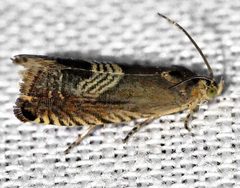
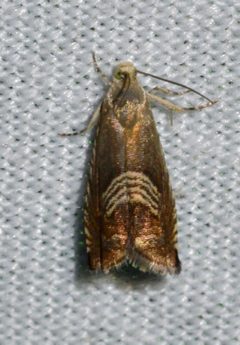
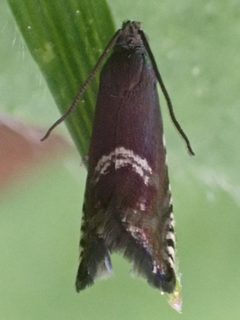
Pronunciation
How to pronounce Grapholita: /ɡræfəˈlaɪtə/
These audio files are automatically generated. While they are not always 100% accurate, they are a good starting point.
Identification
-level identification within Grapholita requires examination of genitalia or molecular methods. Multiplex protocols have been developed to discriminate closely related species such as G. molesta and G. dimorpha based on species-specific amplification products. are small tortricid moths with characteristic wing patterns; however, these patterns vary considerably across species and are not reliable for -level without knowledge.
Images
Habitat
vary by but generally include agricultural orchards, fruit-growing regions, and areas with suitable plants. Specific examples include peach, cherry, and apricot orchards for G. molesta; plum orchards for G. funebrana; and hemp systems for G. delineana.
Distribution
The has a broad distribution with recorded across Europe, Asia, and North America. Specific documented locations include: Korea (G. molesta, G. dimorpha); Çanakkale province, Turkey (G. molesta); Krasnodar Territory, Russia (G. funebrana); China (G. molesta); and California, USA (G. prunivora). GBIF records indicate presence in Denmark, Norway, Sweden, and Vermont, USA.
Seasonality
activity periods vary by and latitude. G. molesta exhibits first adult in early May with continuing until October and 2-3 per season in Turkey. G. funebrana shows multiple peaks during the growing season in southern Russia, with timing influenced by accumulated and interrupted by adverse weather conditions.
Diet
Larvae are internal feeders in fruits and reproductive structures. Documented feeding habits include: fruit tissue of apple, pear, peach, plum, persimmon, and jujube (G. molesta, G. dimorpha); hemp flowers and seeds (G. delineana); and coyote bush (Baccharis pilularis) for G. prunivora larvae.
Host Associations
- Prunus persica (peach) - larval highest for G. molesta in Turkish study
- Prunus spp. (plum) - larval highest for G. dimorpha in Korea
- Prunus avium (cherry) - larval G. molesta in Turkey
- Prunus armeniaca (apricot) - larval G. molesta in Turkey
- Malus domestica (apple) - larval G. molesta, G. prunivora
- Pyrus spp. (pear) - larval G. molesta, G. dimorpha
- Cannabis sativa (hemp) - larval G. delineana; flowers and seeds
- Rosa roxburghii - larval G. molesta association in China
- Diospyros spp. (persimmon) - larval G. molesta, G. dimorpha in Korea
- Ziziphus jujuba (jujube) - larval G. molesta, G. dimorpha in Korea
- Baccharis pilularis (coyote bush) - larval G. prunivora larvae in California
Life Cycle
Complete with , larva, pupa, and stages. Larvae are the destructive stage, feeding internally within fruits. G. molesta has 2-3 per production season with varying by fruit and geographic location. occurs as mature larva or pupa in protected locations. G. funebrana development is temperature-dependent, with specific sums of effective temperatures required for generation completion.
Behavior
are and attracted to ultraviolet light. Larval foraging is mediated by olfactory cues; Odorant-Binding Protein 1 (OBP1) has been identified as mediating -seeking behavior in G. molesta larvae. Adults of G. molesta are captured in traps for monitoring purposes. High ability has been documented in G. dimorpha and G. molesta, with showing no significant genetic structure across spatial or temporal in Korea.
Ecological Role
Major phytophagous pests in orchard . Larval feeding causes direct damage to fruits, rendering them unmarketable. can result in significant economic losses in stone fruit and pome fruit production systems.
Human Relevance
Several are economically important agricultural pests requiring management intervention. G. molesta, G. funebrana, and G. delineana are subject to programs including -based , monitoring with pheromone traps, and agents. No are broadly labeled for hemp pests including G. delineana in the United States, creating reliance on cultural, mechanical, and biological control methods. The is represented in entomological collections and public education events such as Night at the Bohart Museum of Entomology.
Similar Taxa
- Cydia delimitation between Grapholita and Cydia requires further study; historically moved between genera based on morphological revisions
- DichroramphaHistorical taxonomic confusion; type of Grapholita was originally misidentified as Pyralis dorsana, which is actually Dichrorampha petiverella
More Details
Taxonomic History
The type designation involved a complex history of misidentification. Treitschke designated 'Pyralis dorsana' Fabricius, 1775 as type species in 1829, but this was based on Hübner's misidentification. The actual P. dorsana is Dichrorampha petiverella (Linnaeus, 1758). The species Treitschke described was Tortrix lunulana Denis & Schiffermüller, 1775, now Grapholita lunulana.
Molecular Diagnostics
-specific multiplex protocols have been developed for rapid identification of larval Grapholita species in infested fruits, particularly to distinguish G. molesta, G. dimorpha, and Carposina sasakii in Korean orchard systems.
Climate Responsiveness
G. funebrana in Krasnodar Territory show adaptive responses to changing climatic conditions, with altered and effective temperature accumulation patterns observed from 2017-2020 compared to historical averages.
Sources and further reading
- BugGuide
- Wikipedia
- GBIF taxonomy match
- iNaturalist taxon
- NCBI Taxonomy
- Catalogue of Life
- Like a Moth to a Flame: Moth Night at Bohart Museum of Entomology | Bug Squad
- Bohart Museum of Entomology: One Busy Place! | Bug Squad
- Scarab Beetles First to Arrive at UC Davis 'Moth Night' | Bug Squad
- Grapholita delineana Archives - Entomology Today
- IPM in Hemp: Managing Pests in a "New" Crop
- Larval species composition and genetic structures ofCarposina sasakii,Grapholita dimorpha, andGrapholita molestafrom Korea
- Adult Population Development of Grapholita molesta (Busck 1916) (Lepidoptera: Tortricidae) on Different Fruit Species and Locations Farklı Meyve Türlerinde ve Lokasyonlarda Grapholita molesta (Busck 1916) (Lepidoptera: Tortricidae) ‘nın Ergin Popülasyon Gelişmesi
- The Odorant-Binding Protein 1 Mediates the Foraging Behavior of Grapholita molesta Larvae
- Study of the development of the plum moth features Grapholita funebrana Tr. (Lepidoptera : Tortricidae ) in changing climatic conditions of the Krasnodar territory
- Detecting Host-Plant Volatiles with Odorant Receptors from Grapholita molesta (Busck) (Lepidoptera: Tortricidae)
- Comparative Analysis to Damage Reduction of Host Plant by Applying a Mating Disruptor of the Oriental Fruit Moth, Grapholita molesta in Two Different Cultivation Environments of Apple Orchard
- Predicting the potential suitable habitats of Rosa roxburghii and its key pest Grapholita molesta in China using the MaxEnt Model.
- Forecasting model of Grapholita molesta (Lepidoptera: Tortricidae) in apple orchards.