
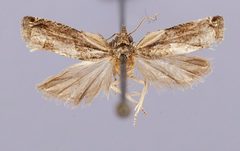
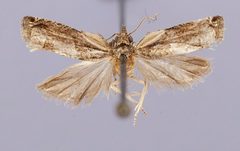
Crocidosema lantana
Busck, 1910
Lantana Flower-Cluster Moth, Lantana Tortricid Moth
Crocidosema is a tortricid native to Mexico and the southern United States, deliberately introduced to Hawaii (1902), Australia (1914), and the Caroline Islands (1948–1949) as a agent for Lantana weeds. The has also been recorded in Yunnan, China and Sri Lanka. It was first described by August Busck in 1910. The larvae develop within pods of Bignonia chrysantha.

Pronunciation
How to pronounce Crocidosema lantana: //krɒsɪˈdoʊsɨmə lænˈtænə//
These audio files are automatically generated. While they are not always 100% accurate, they are a good starting point.
Images
Distribution
Native to Mexico and the southern United States. Introduced to Hawaii (1902), Australia (1914), Caroline Islands (1948–1949). Recorded from Yunnan, China and Sri Lanka. GBIF records indicate presence in Kenya, Madagascar, Mauritius, and Réunion.
Diet
Larvae feed in pods of Bignonia chrysantha.
Host Associations
- Bignonia chrysantha - larval food plantlarvae develop within pods
Ecological Role
agent introduced for management of weeds; effectiveness for this purpose is not documented in the provided sources.
Human Relevance
Introduced deliberately to multiple regions (Hawaii, Australia, Caroline Islands) as a agent targeting camara and related weeds. Part of a broader effort to manage one of the world's most problematic invasive plant .
More Details
Biological control history
The introduction of C. represents early 20th-century efforts at . The was among several agents released against Lantana, though sources note that management of this weed complex has remained challenging due to taxonomic uncertainty within the Lantana camara .
Taxonomic context
The belongs to the tribe Eucosmini within Olethreutinae of Tortricidae. The Crocidosema contains multiple species, some of which are agricultural pests.