
Selenops
Latreille, 1819
Flatties, Crescent-eyed Spiders, Wall Crab Spiders
Species Guides
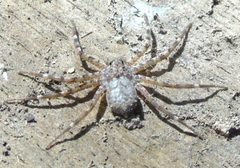
3Selenops is a of spiders in the Selenopidae, commonly known as "flatties" due to their extremely flattened bodies. The genus comprises approximately 132 distributed across arid and semi-arid regions worldwide, including the southwestern United States, Florida, the Caribbean, and tropical regions of Asia, Africa, and the Americas. These spiders are notable for being the first documented arachnids capable of controlled gliding when falling, using their flattened bodies and laterigrade legs to steer toward tree trunks rather than falling to the ground. They exhibit some of the fastest turning movements recorded in terrestrial legged animals when attacking prey from behind.

Pronunciation
How to pronounce Selenops: //sɛˈliːˌnɒps//
These audio files are automatically generated. While they are not always 100% accurate, they are a good starting point.
Identification
Distinguished from other selenopid by arrangement: , median, and anterior lateral eyes align or are slightly recurved. Leg II longer than leg IV. Tibiae I and II have 2-2-2 spines; I-II have 2-2 spines. Most similar to philodromid crab spiders (Philodromidae) and huntsman spiders (Sparassidae), but separable by: extremely flattened body profile; six eyes in one row (vs. eight in two rows for most similar spiders); legs increasingly longer from front to back (vs. second pair longest in Philodromus); laterigrade leg orientation; and notched rear edge of sternum. -level identification requires examination of reproductive structures.
Images
Appearance
Extremely flattened body with laterigrade legs oriented horizontally to the body surface. range 6-23 mm in body length, with legs increasingly longer from front to back (leg formula normally 4321). flattened and subcircular, brown to reddish brown with lateral dark bands or spots. flattened, round to oval, grey or yellowish with brown or black patterns. Six arranged in one row across the , with two additional eyes set back on either side. Rear edge of sternum is notched. Legs with two claws, claw tufts, and scopulae; legs with 4-7 pairs of strong spines on tibiae and .
Habitat
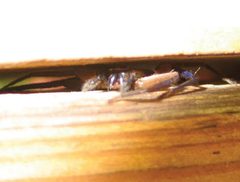
Occupies narrow crevices in rocks, walls, and tree trunks. Found on vertical surfaces including building walls, especially at night. Hides during day under bark, stones, or between leaf bases of dense plants. Different frequently occur sympatrically but occupy different microhabitats. In arid regions, associated with dry bark and rocky substrates; some species extend into cooler and mountainous areas.
Distribution
Widespread in arid regions globally. North America: southern California to western Texas, Florida, and Caribbean islands. South America: Colombia and Neotropical regions. Asia: China (Guangdong), Vietnam. Africa and other tropical regions. Some in cooler and mountainous areas beyond core arid zone distribution.
Seasonality
Nocturnally active year-round in suitable climates. observed on walls and vertical surfaces after dark.
Diet
Active that attack prey approaching from all directions. Prey includes insects and other small arthropods encountered on vertical surfaces.
Life Cycle
sacs are round, flat, and papery, attached to stones or bark. Female S. ab observed guarding egg sac. Development includes egg, spiderling, and stages; specific instar counts not documented for most .
Behavior
forager on vertical surfaces. Capable of steering and gliding when falling, using flattened body and front legs to direct descent toward tree trunks—first documented gliding ability in spiders. Exhibits rapid turning movements when attacking prey from behind, among the fastest recorded for terrestrial legged animals. When disturbed, can sprint with startling speed. Free-living and agile, moving into narrow crevices using flattened body profile. Male courtship involves cautious approach with vibrational signals on female's web in some related .
Ecological Role
controlling insect on vertical surfaces and in narrow crevices. S. radiatus has been used as agent for potato tuber moth (Phthorimaea operculella) in South Africa.
Human Relevance
Occasionally enters human dwellings, found on walls and in mailboxes. Not considered dangerously venomous to healthy humans. S. radiatus employed in agricultural pest management. Subject of scientific interest for unique gliding and rapid predatory movements.
Similar Taxa
- PhilodromusRunning crab spiders share crab-like appearance and wall-dwelling habits, but have second pair of legs longest (not progressively longer), eight in two rows, and lack extreme body flattening.
- SparassidaeHuntsman spiders superficially resemble Selenops in body shape and use, but lack the six in one row, have different eye arrangement, and do not exhibit controlled gliding .
- AgelenopsisFunnel-web weavers may be confused due to similar , but build distinct web structures, have longer , and lack flattened body profile.
Misconceptions
Often mistaken for dangerously venomous spiders due to unfamiliar appearance. Frequently confused with huntsman spiders (Sparassidae) and running crab spiders (Philodromidae). Some sources incorrectly suggest they occur in regions outside their actual range (e.g., Massachusetts), where similar-looking philodromid spiders are present instead.
More Details
Gliding Behavior
First spider documented with controlled aerial descent. When dislodged from vertical surfaces, Selenops can steer and glide toward tree trunks rather than falling to the ground, using their flattened bodies as airfoils.
Taxonomic Complexity
Most of the 132 are difficult to distinguish visually; species-level identification requires detailed anatomical study, particularly of reproductive structures. The is in need of comprehensive revision.
Etymology
Named after Greek moon goddess Selene and -ops '', referring to the moon-like form of the eyes.
Sources and further reading
- BugGuide
- Wikipedia
- GBIF taxonomy match
- iNaturalist taxon
- NCBI Taxonomy
- Catalogue of Life
- Bug Eric: Spider Sunday: Flatties
- Bug Eric: March 2013
- Miridae | Beetles In The Bush
- The flattie spiders of the Selenops isopodus species group (Araneae: Selenopidae) with a review of Selenops records from Colombia
- Two new species of spiders of the genus Selenops Latreille, 1819 (Araneae: Selenopidae) and redescription of Selenops scitus Muma, 1953 from Mexico
- First record of Selenopsab Logunov & Jäger, 2015 (Araneae, Selenopidae) from China, with first description of the female.