
Hololena
Chamberlin & Gertsch, 1929
funnel-web weavers
Species Guides
6- Hololena curta(Corner Funnel Weaver)
- Hololena dana
- Hololena hola
- Hololena nedra
- Hololena santana
- Hololena tentativa
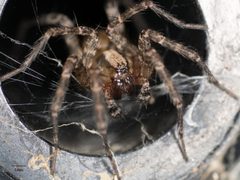
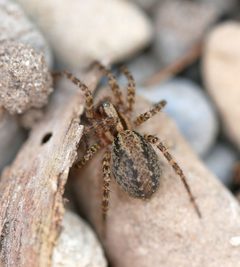
Hololena is a of funnel-web spiders ( Agelenidae) to western North America. The genus contains approximately 30 recognized , though taxonomic revision is needed. These spiders construct flat, sheet-like webs with a funnel retreat and are abundant in human-altered environments. Males exhibit specialized courtship including vibrational signals that induce female catalepsy, reducing sexual risk. Bites to humans have been documented but result in mild, self-limiting .
Pronunciation
How to pronounce Hololena: //hoʊloʊˈleɪnə//
These audio files are automatically generated. While they are not always 100% accurate, they are a good starting point.
Identification
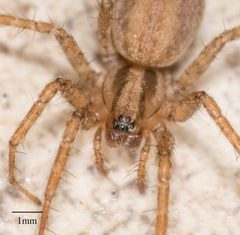
Distinguished from the similar Agelenopsis by length and orientation: Hololena has short spinnerets often directed inward, while Agelenopsis (and Calilena) have long spinnerets held parallel to each other. Hololena is also smaller on average (females 9–12 mm vs. 10–20 mm in Agelenopsis). Definitive identification to requires microscopic examination of genitalia. The genus is restricted to western North America, whereas Agelenopsis occurs more broadly.
Images
Appearance
Medium-sized spiders with females measuring 9–12 mm and males 8–9 mm in body length. bears two parallel or converging dark stripes on a pale background. has a central reddish or brownish longitudinal band, often bordered by pale wavy lines. Legs are annulated with alternating light and dark bands. are short and often directed somewhat inward toward each other—distinguishing them from related .
Habitat
Found in diverse terrestrial environments across the western United States. Common in yards, gardens, and hedges where vegetation provides support for web construction. Also occurs in natural from Washington and Idaho south to southern California and New Mexico. Webs are built close to the ground or on vegetation, with a funnel retreat typically positioned in a sheltered corner.
Distribution
to western North America, ranging from Washington and Idaho south through California to New Mexico. One (H. septata) extends into Mexico. The appears restricted to roughly the western third of the continental United States.
Seasonality
Active throughout the growing season. Mature males wander in search of females from late summer through fall, with observations extending into October and November in Colorado. Juveniles and males may enter buildings year-round. sacs are produced after mating, with spiderlings emerging in favorable weather conditions.
Life Cycle
Females deposit in silk-wrapped sacs. Spiderlings may overwinter within egg sacs, emerging when temperatures become favorable. Males reach maturity and disperse to find mates, often wandering into human dwellings. Females may live longer, maintaining webs in sheltered locations.
Behavior
Construct flat, hammock- or bowl-shaped sheet webs with a funnel-like retreat in one corner. The web is non-sticky; a tangle of threads above the sheet intercepts flying insects, knocking them onto the platform. The spider detects vibrations through the web and rapidly emerges to subdue prey, dragging it back into the retreat. Males court females through stereotyped vibrational signals (1–6 bouts) that induce cataleptic paralysis in receptive females, allowing safe approach and copulation. Males can differentiate webs of virgin from mated females using chemical or tactile cues.
Ecological Role
of flying and crawling insects. Webs may become locally abundant in suitable , with multiple individuals occupying hedges or garden vegetation. Contributes to insect in both natural and anthropogenic environments.
Human Relevance
Frequently encountered in and around human dwellings, particularly in the western United States. Juveniles and mature males commonly wander indoors. Documented bites are rare; three verified cases involved mild to moderate including pain, swelling, headache, and vomiting (4-hour duration in two cases), with full recovery without medical intervention. One case (female bite) resulted in very mild reaction. Not considered medically significant.
Similar Taxa
- AgelenopsisLarger body size (10–20 mm females), long held parallel to each other, broader geographic distribution across North America. Both construct similar funnel webs and share general color pattern.
- CalilenaAlso has long held parallel, distinguished from Hololena by spinneret orientation and presumably geographic distribution.
More Details
Taxonomic Status
The is considered to be in need of revision by arachnologists; boundaries and relationships remain poorly resolved.
Winter Activity
Light snowfall in late October can accumulate on webs, making them visible when they would otherwise be cryptic. Dew condensation on early mornings similarly reveals web abundance.