
Agelenidae
C. L. Koch, 1837
funnel weavers, grass spiders
Subfamily Guides
2- Ageleninae(Typical Funnel Weavers)
- Coelotinae
Agelenidae is a large of araneomorph spiders comprising approximately 100 and 1,694 as of January 2026. Members are commonly known as funnel weavers for their distinctive web architecture: flat, non-sticky sheet webs with a funnel-shaped retreat. The family includes well-known genera such as Agelenopsis (grass spiders), Eratigena (including the giant house spider and hobo spider), and Hololena. Agelenids are exceptionally fast runners, with some species documented at speeds exceeding 0.5 m/s. Most species are harmless to humans, though the hobo spider (Eratigena agrestis) has been implicated in medically significant bites with necrotic potential, a matter still subject to scientific debate.
Pronunciation
How to pronounce Agelenidae: /ˌædʒəˈlɛnɪˌdiː/
These audio files are automatically generated. While they are not always 100% accurate, they are a good starting point.
Identification
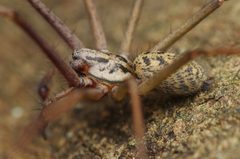
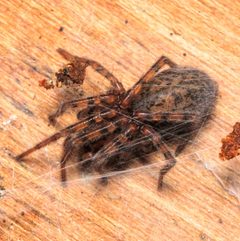
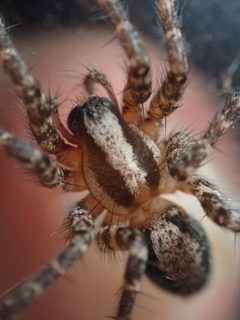
Agelenids are distinguished by eight arranged in two horizontal rows of four, with the narrowing anteriorly toward the eye region. The is typically oval and patterned with two rows of lines and spots; some display longitudinal lines on the cephalothorax while others lack them. length varies by : Agelenopsis and Calilena possess long, parallel spinnerets, whereas Hololena has short spinnerets directed somewhat inward. Body size ranges from 4 mm to 20 mm in body length, with leg spans reaching 5–10 cm in large species such as Eratigena atrica.
Images
Habitat
Agelenids occupy diverse environments including grasslands, scrubland, forest edges, and human structures. Many construct webs in open vegetation rather than under bark or rocks. Some are specifically associated with human dwellings: Eratigena species occur in houses, Hololena builds webs in gardens and hedges, and Coras inhabits basements, cellars, and crevices in stonework. The genus Agelena includes parasocial species in Africa that construct complex communal webs.
Distribution
Worldwide distribution on every continent except Antarctica. The Hololena is restricted to the western third of North America (Washington and Idaho to southern California and New Mexico). Coras occurs principally east of the Mississippi River in North America (southeast Canada to Florida, west to Wisconsin and Louisiana). Malthonica is found in the Iberian Peninsula. The is well-represented in temperate regions of Europe, North America, and Asia.
Seasonality
Activity patterns vary by and climate. Coras are found in summer and fall, with sacs likely produced in autumn; both adults and juveniles hibernate in silken retreats under rocks during winter. Mature males of outdoor species such as Agelenopsis and Agelena may enter houses in September. Some temperate species overwinter as adults or immatures. Spring activity has been documented for agelenids in early March in temperate regions.
Diet
Agelenids prey primarily on insects. Hunting occurs on the sheet web: the spider detects vibrations from entangled prey, rushes out at high speed, delivers a paralyzing venomous bite, and drags the victim back to the funnel retreat to feed. Prey includes grasshoppers and other insects that fall onto the horizontal web. The web's entangling filaments catch on prey body projections, and the springy web structure aids prey capture.
Life Cycle
sacs are produced in autumn in some (e.g., Coras). Juveniles and of some species hibernate in silken retreats during winter. Males of some species die after the period; in Tegenaria atrica, males experience dramatic metabolic changes post-reproduction, losing 45% bodyweight between August and October. The parasocial African species Agelena consociata exhibits communal web-building, cooperative prey capture, and communal rearing of young, though without true eusociality (no , all females reproductive).
Behavior
Agelenids are among the fastest-running spiders, with Eratigena atrica documented at 0.53 m/s. They are highly sensitive to vibrations and light changes, retreating rapidly when shadows approach. Males of some are less successful ambushers than females and more likely to roam in search of prey or mates. Courtship in Hololena involves males creating vibrational signals (1–6 bounces) on the female's web; receptive females enter cataleptic paralysis, allowing males to approach, grasp their hind legs, and drag them into the retreat for mating. Males may be chased off if females recover prematurely.
Ecological Role
Agelenids function as of insects in terrestrial . Their sheet webs capture flying and jumping insects that would otherwise escape ground-level webs. In some , they contribute to local diversity as both predators and prey. The parasocial Agelena consociata represents a rare example of cooperative among spiders, potentially influencing local insect through communal prey capture.
Human Relevance
Most agelenids are harmless to humans and provide free pest control by capturing insects. Some , particularly Eratigena atrica (giant house spider), are notable for their size and speed, which can cause alarm despite their harmlessness. The hobo spider (Eratigena agrestis) has been associated with necrotic bites, though this remains scientifically disputed. Hololena bites have been documented to cause headaches and vomiting in some cases, though victims recover without medical intervention. Historically, Coras medicinalis webs were used in the 1800s to make tinctures for fever relief.
Similar Taxa
- AmaurobiidaeCoras and Wadotes were moved to Amaurobiidae in 1986 based on perceived affinities, then returned to Agelenidae; amaurobiids possess a cribellum (a plate-like silk-spinning organ) that agelenids lack.
- HahniidaeCalymmaria was once classified in Agelenidae and resembles agelenids in general form, but constructs unique inverted cone webs rather than funnel-sheet webs; microscopic examination required for definitive separation.
- Dipluridae and Hexathelidae (funnel-web tarantulas)These mygalomorph are sometimes called 'funnel-web spiders' but are unrelated to agelenids; they possess different arrangements, body plans, and medically significant venoms (e.g., Australian funnel-web spiders).
Misconceptions
Agelenids are frequently confused with dangerous Australian funnel-web spiders (Atracidae/Hexathelidae), leading to unwarranted fear. The 'funnel-web tarantula' or 'funnel-web spider' names applied to mygalomorph cause additional confusion. The hobo spider's reputation for causing necrotic wounds has been challenged, with evidence suggesting its venom may not be medically significant; early reports of may have been misattributed. Male spiders entering houses in autumn are often seeking mates, not establishing permanent .
Sources and further reading
- BugGuide
- Wikipedia
- GBIF taxonomy match
- iNaturalist taxon
- NCBI Taxonomy
- Catalogue of Life
- Spider Alert! Guess Who's Coming to UC Davis? | Bug Squad
- Bug Eric: Spider Sunday: Spring Spiders
- Bug Eric: One Night, One House, Seventeen Spider Species
- Bug Eric: Spider Sunday: Coras
- Bug Eric: Spider Sunday: Hololena Funnel-web weavers
- Bug Eric: Basket-web Weavers
- Lebensweise und jahreszyklische Ver�nderungen des Stoffbestandes der SpinneTegenaria atrica C. L. Koch (Agelenidae) Life cycle and annual variations in body constituents of the spiderTegenaria atrica C. L. Koch (Agelenidae)
- Systematics and natural history of Barronopsis (Araneae: Agelenidae), with description of a new species
- The genus Malthonica Simon, 1898 in the Iberian Peninsula (Araneae: Agelenidae)
- A new species of Coelotes Blackwall, 1841 (Araneae, Agelenidae, Coelotinae) from Huaping National Nature Reserve, northeast Guangxi, southern China.
- The genome sequence of the house spider, Eratigena atrica (C.L.Koch, 1843) (Araneae: Agelenidae).