
Eratigena agrestis
(Walckenaer, 1802)
Hobo Spider
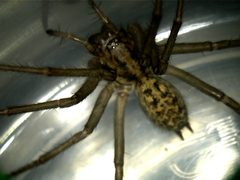
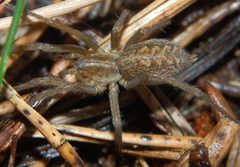
Eratigena agrestis, commonly known as the hobo spider, is a funnel-web spider native to Europe that was introduced to the Pacific Northwest of North America in the early 20th century. It constructs characteristic funnel-shaped webs and lies in wait at the narrow end to capture prey. The medical significance of its bite remains poorly understood and debated. Spiderlings emerge in spring, contrasting with the fall of the closely related E. atrica.
Pronunciation
How to pronounce Eratigena agrestis: /ɛˈræ.tɪˌdʒiː.nə əˈɡrɛs.tɪs/
These audio files are automatically generated. While they are not always 100% accurate, they are a good starting point.
Identification
Eratigena agrestis can be distinguished from the co-occurring Eratigena atrica by : E. agrestis spiderlings emerge in spring, while E. atrica spiderlings emerge in fall. It is a funnel-web spider ( Agelenidae) and should not be confused with the Australian funnel-web spiders (family Hexathelidae).
Images
Habitat
Two study sites in British Columbia, Canada have been documented; the is established and spreading in the Pacific Northwest of North America. Native range includes Europe to Central Asia.
Distribution
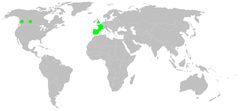
Native to Europe and Central Asia. Introduced and established in the Pacific Northwest of North America (USA and Canada) since the early 20th century. Present in Belgium.
Seasonality
Spiderlings emerge in spring. active during warmer months.
Life Cycle
Spiderlings emerge in spring. differs from the co-occurring Eratigena atrica, which has fall .
Behavior
Constructs funnel-shaped webs of silk sheeting and lies in wait at the small end of the funnel for prey to blunder onto the web. Sometimes aggregates with heterospecifics; such may provide benefits that offset costs associated with competition.
Human Relevance
The medical significance of its bite is poorly understood and debated. Often confused with more dangerous spiders, leading to misidentification and unnecessary concern.
Similar Taxa
- Eratigena atricaCo-occurs in Pacific Northwest; distinguished by fall of spiderlings versus spring emergence in E. agrestis
- Australian funnel-web spiders (Hexathelidae)E. agrestis is often confused with these medically significant spiders due to similar , but belongs to different (Agelenidae) with different and venom composition
Misconceptions
The has been mistakenly considered medically significant in North America, though evidence for dangerous bites is debated and poorly substantiated. It is not closely related to the Australian funnel-web spiders despite similar common naming.
More Details
Taxonomic History
Formerly placed in Tegenaria; transferred to Eratigena based on phylogenetic studies. Original basionym Aranea agrestis Walckenaer, 1802.
Research Context
data from British Columbia study (2016) found that presence of western black widow (Latrodectus hesperus) and varying densities of E. atrica had little effect on E. agrestis life history, suggesting low competition pressure or equivalent /heterospecific effects.
Sources and further reading
- BugGuide
- GBIF taxonomy match
- iNaturalist taxon
- NCBI Taxonomy
- Catalogue of Life
- Spider Alert! Guess Who's Coming to UC Davis? | Bug Squad
- Grasshoppers of Colorado
- Grasshoppers of Colorado
- Species Records and Accounts
- Meloidae Holdings | Entomology Research Museum
- Encyrtid Holdings | Entomology Research Museum
- Life-history data for the funnel weavers Eratigena agrestis and Eratigena atrica (Araneae: Agelenidae) in the Pacific Northwest of North America