
Eratigena
Bolzern, Burckhardt & Hänggi, 2013
funnel weaver spiders
Species Guides
3- Eratigena agrestis(Hobo Spider)
- Eratigena atrica(Giant House Spider)
- Eratigena duellica(Giant House Spider)
Eratigena is a of funnel weaver spiders (Agelenidae) erected in 2013 from previously placed in Tegenaria and Malthonica. The genus name is an anagram of Tegenaria. It includes medium to large spiders that frequently inhabit human dwellings, notably Eratigena agrestis (hobo spider) and Eratigena atrica (giant house spider), both native to Europe and introduced to North America.
Pronunciation
How to pronounce Eratigena: /ˌɛrəˈtɪdʒəˌnæ/
These audio files are automatically generated. While they are not always 100% accurate, they are a good starting point.
Identification
Eratigena can be distinguished from Malthonica by un-notched on legs III and IV (notched in Malthonica). It differs from Tegenaria in having six or more teeth on the rear margin of the , with teeth closer to the body being smaller; Tegenaria has three to six large teeth of roughly equal size. Within the , of the E. atrica group (E. atrica, E. duellica, E. saeva) are morphologically identical in overall appearance and require examination of palp and epigyne structures for separation.
Images
Appearance
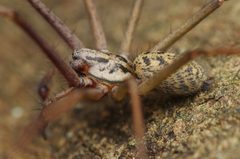
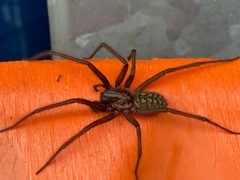
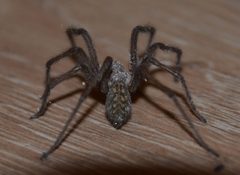
Medium to large spiders with body lengths of 10–16 mm in . bears two symmetrical dark bands, which may be serrated or reduced to three or four conspicuous triangles. (feathery) hairs present on carapace, legs, and opisthosoma. rows are only slightly curved. displays paler patches that form -facing chevrons toward the rear. Mature females have legs approximately twice their body length; males have legs roughly three times their body length.
Habitat
Frequently associated with human habitation, building webs in and around dwellings. Also thrives in natural settings under stones and logs, in tree cavities, and beneath overhanging earth banks.
Distribution
Native to Europe and Central Asia; introduced and established in North America. Core in Britain centered in Newcastle upon Tyne area and Perth/Dundee region of eastern Scotland.
Seasonality
Mature appear in August and September. Spiderling timing varies by : E. atrica emerges in fall, E. agrestis in spring.
Life Cycle
Overwinters as half-grown juveniles. Matures the following August/September. Mating occurs in the female's web. Females overwinter with stored sperm and commence laying sacs in spring, each containing 60–80 eggs. Males live approximately 18 months; females typically two years or more, with some surviving a third winter.
Behavior
Constructs funnel-shaped webs. Males may cohabit briefly in the female's web after mating. Sudden appearance of mature spiders during late summer and autumn frequently noted by homeowners.
Human Relevance
Frequently encountered in human dwellings due to habits. E. agrestis (hobo spider) has been the subject of medical concern in North America, though the validity of its venomous reputation remains disputed. E. atrica (giant house spider) is notable for its large size and rapid movements, often causing alarm despite being generally harmless.
Similar Taxa
- TegenariaHistorically contained now placed in Eratigena; differs in having three to six large, equal-sized teeth on rear margin of versus six or more teeth of unequal size in Eratigena
- MalthonicaAlso historically contained Eratigena ; differs in having notched on legs III and IV versus un-notched in Eratigena
- AterigenaAnother anagram-derived from Tegenaria; phylogenetically related but morphologically distinct based on established generic characters
Misconceptions
Eratigena agrestis has been widely reputed as a medically significant spider in North America (the 'hobo spider'), but this characterization lacks robust scientific support and is considered questionable by arachnological authorities.
More Details
Taxonomic History
The was established in 2013 following a comprehensive phylogenetic study of the 'Tegenaria-Malthonica complex' using morphological and molecular data. The name Eratigena is an intentional anagram of Tegenaria.
Sources and further reading
- BugGuide
- Wikipedia
- GBIF taxonomy match
- iNaturalist taxon
- NCBI Taxonomy
- Catalogue of Life
- Life-history data for the funnel weavers Eratigena agrestis and Eratigena atrica (Araneae: Agelenidae) in the Pacific Northwest of North America
- The genome sequence of the house spider, Eratigena atrica (C.L.Koch, 1843) (Araneae: Agelenidae).