
Tegenaria
Latreille, 1804
Barn Funnel Weavers, Barn Funnel Weavers and allies
Species Guides
2- Tegenaria domestica(Barn Funnel Weaver)
- Tegenaria pagana(Rural Funnel-web Spider)
Tegenaria is a of fast-running funnel-web spiders in the Agelenidae. The genus was first described by Pierre André Latreille in 1804 and occupies much of the Northern Hemisphere except for Japan and Indonesia. Many historically placed in Tegenaria have been reclassified, with the majority moved to the genus Eratigena, including the giant house spider and the hobo spider. The genus currently contains approximately 139 species.
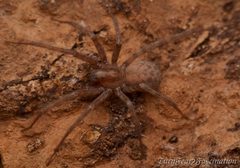
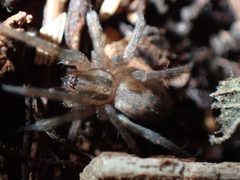
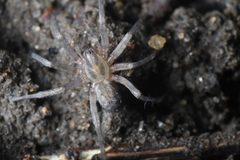
Pronunciation
How to pronounce Tegenaria: /tɛɡəˈnɑːriə/
These audio files are automatically generated. While they are not always 100% accurate, they are a good starting point.
Identification
Tegenaria can be distinguished from similar funnel-web spiders, particularly Eratigena, by examining the cheliceral retromargin: Tegenaria possesses 3 to 7 large teeth, whereas Eratigena has 6 or more teeth with teeth smaller than teeth. Additionally, the in Tegenaria is broader than long, while in Eratigena it is as long as or longer than wide. Members have eight arranged in two straight or nearly straight rows. body length ranges from approximately 10 to 20 millimeters, excluding legs.
Images
Habitat
construct typical non-sticky funnel webs with flat, open sheet-like areas, usually positioned in dark corners and commonly in outbuildings. Webs are typically built in sheltered locations such as beneath loose bark, in rock crevices, under stones, or on building exteriors. Some species are troglomorphic cave-dwellers.
Distribution
Widespread across much of the Northern Hemisphere. Notably absent from Japan and Indonesia. Records include Europe, North America, and parts of the Mediterranean region including southern Turkey. Some , such as T. ariadnae, are restricted to the Eastern Mediterranean (Crete, northern Libya, southern Turkey).
Seasonality
Mating has been observed during summer months. spiders are found in summer and fall.
Behavior
Constructs funnel-shaped webs with a flat sheet-like area leading to a retreat. Spiders are fast-running and typically occupy the funnel portion of the web, darting out to capture prey that contacts the sheet. In at least one documented case, Tegenaria domestica has shown colonial in a chemoautotrophic cave environment, coexisting with Prinerigone vagans without —a behavior not previously recorded for this .
Human Relevance
Commonly encountered in human structures such as barns, cellars, and outbuildings, leading to frequent human-spider interactions. Tegenaria domestica, the barn funnel weaver, is frequently found in showers and bathtubs, where individuals may become trapped by smooth surfaces. The has been subject to taxonomic confusion with Eratigena, leading to misidentification of such as the hobo spider (now Eratigena agrestis) as dangerous—a claim that remains disputed.
Similar Taxa
- EratigenaHistorically conflated with Tegenaria; many including the giant house spider and hobo spider were moved to this . Distinguished by cheliceral tooth arrangement and proportions.
- CorasBoth are funnel-web builders in Agelenidae with similar overall . Coras has multiple retreats in its web and larger than anterior lateral eyes, whereas Tegenaria typically has a single retreat.
- WadotesSimilar funnel-web and preferences. Formerly classified together in Amaurobiidae before both were returned to Agelenidae.
Misconceptions
The hobo spider (formerly Tegenaria agrestis, now Eratigena agrestis) has been incorrectly attributed to Tegenaria and falsely labeled as dangerously venomous. Native European are harmless; North American populations have been implicated in necrotic wounds, though secondary bacterial may be responsible rather than venom.
More Details
Taxonomic History
The has undergone extensive revision. First described by Latreille in 1804, it originally contained many now placed elsewhere. The majority were moved to Eratigena. The genus Coras was originally placed in Tegenaria by Hentz in 1821 before being separated by Simon in 1898.
Cave Adaptation
At least one , T. lazarovi from southern Turkey, is a dedicated cave-dweller with troglomorphic features. A remarkable colony of T. domestica in Sulfur Cave (Albania/Greece) represents the first documented colonial in this species, with over 69,000 individuals coexisting in a 100+ square meter communal web sustained by chemoautotrophic bacteria.
Sources and further reading
- BugGuide
- Wikipedia
- GBIF taxonomy match
- iNaturalist taxon
- NCBI Taxonomy
- Catalogue of Life
- Bug Eric: Spider Sunday: Coras
- Bug Eric: Basket-web Weavers
- Bug Eric: Shower Spiders
- Spider megacolony study breaks publicity records at Pensoft
- Bug Eric: Spider Sunday: Top Spider Hoaxes, Urban Legends, and Myths
- Bug Eric: July 2013
- Description of a new Tegenaria Latreille, 1804 from southern Turkey with remarks on the Tegenaria ariadnae species-complex (Arachnida, Araneae)