
Tegenaria domestica
(Clerck, 1757)
Barn Funnel Weaver, Domestic House Spider
Tegenaria domestica is a funnel-web spider in the Agelenidae, native to Europe but now distributed nearly worldwide through human introduction. It is one of the smaller in its , with females averaging 7.5–11.5 mm and males 6–9 mm in body length. The species is notable for building characteristic funnel-shaped webs and for recently documented colonial in a unique cave environment in Greece/Albania, where thousands of individuals cooperatively maintained a communal web exceeding 100 square meters.
Pronunciation
How to pronounce Tegenaria domestica: //ˌtɛdʒəˈnɛriə dəˈmɛstɪkə//
These audio files are automatically generated. While they are not always 100% accurate, they are a good starting point.
Identification
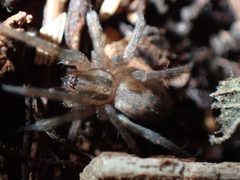
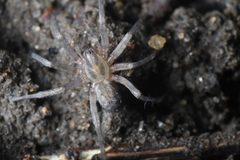
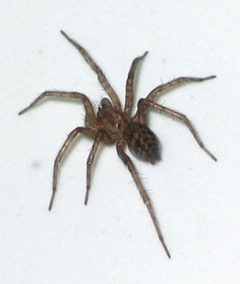
Distinguished from similar Tegenaria/Eratigena by smaller size, distinct abdominal chevron pattern, and two black longitudinal cephalothoracic stripes. Males identifiable by elongated and swollen . Previously confused with Giant House Spider (now Eratigena atrica group), which is substantially larger and has different abdominal patterning.
Images
Habitat
Highly adaptable; found in and around human structures including basements, cellars, attics, storage rooms, barns, and sheds. Also occurs in natural rocky , caves, and forest edges. In the unique Sulfur Cave environment (Greece/Albania), occurs in complete darkness in a chemoautotrophic sustained by sulfur-oxidizing bacteria.
Distribution
Native to Europe, North Africa, parts of the Middle East and Central Asia. Introduced to the Americas (from maritime Canada to southern United States), Australia, and New Zealand. In Europe, ranges from Scandinavia to Greece and the Mediterranean. Present on Azorean islands (Faial, Flores, Graciosa, Pico, São Jorge).
Seasonality
Males peak in abundance during June and July, indicating primary mating period. may be present year-round in sheltered indoor locations; females regularly survive winter.
Diet
Active capturing insects and other small arthropods that disturb its web. Prey detected through vibrational signals transmitted via silk threads.
Life Cycle
hatch from egg sacs; nymphs develop to maturity within approximately one year. Males typically die in autumn after mating, rarely living beyond one year. Females may survive multiple years (reportedly up to seven years in undisturbed indoor locations), producing multiple egg sacs. Females sometimes consume males after mating.
Behavior
Builds funnel-shaped web with flat sheet of stressed silk threads and retreat tunnel in corner or sheltered area; waits at funnel back for prey vibrations, then rushes out to attack and drag prey back to retreat. Moves in short, precise intervals rather than continuous gait. Phototactic observed—moving toward or away from light depending on circumstances. Not aggressive; retreats when confronted, huddling into ball or fleeing if web is disturbed. Colonial behavior documented in Sulfur Cave, where thousands of individuals cooperatively maintained communal web—first recorded instance of coloniality in this .
Ecological Role
of small arthropods in human-modified and natural environments. In the Sulfur Cave , represents apex predator supported by chemoautotrophic production, with estimated 69,000 individuals in documented colony. Genetic divergence from surface suggests role as model for studying to extreme isolated environments.
Human Relevance
Frequent inhabitant of human dwellings, particularly damp basements and cellars; generally considered beneficial as of insects. Not medically significant—bites rare and unlikely to break skin; retreats rather than attacks when disturbed. Subject of recent high-profile scientific discovery regarding colonial in caves, generating substantial public interest in spider .
Similar Taxa
- Eratigena atrica (Giant House Spider)Previously considered congeneric and closely related; substantially larger (body length 10–18 mm), with different abdominal pattern lacking distinct chevrons
- Tegenaria giganteaLarger body size and different preferences
- Tegenaria parietinaSimilar web architecture but different coloration and markings
Misconceptions
Often confused with medically significant spiders; however, T. domestica is not dangerous to humans and bites are extremely rare. The name 'domestic house spider' sometimes causes confusion with other spider .
More Details
Sex Chromosome System
Males possess an unusual X,X₂X₃O system. During , the three sex chromosomes pair via a common nucleolar organizing region forming a pseudotrivalent, then segregate with variable patterns producing with differing complements.
Sulfur Cave Colony
In 2025, a colony of approximately 69,000 T. domestica individuals was documented in Sulfur Cave (Greece/Albania), sharing a 100+ square meter communal web with 42,000 Prinerigone vagans individuals. This represents the first documented colonial in the and first colonial web-building in a chemoautotrophic cave environment. The normally predatory T. domestica did not prey on the smaller P. vagans, hypothesized to result from darkness and abundant alternative food resources.
Sources and further reading
- BugGuide
- Wikipedia
- GBIF taxonomy match
- iNaturalist taxon
- NCBI Taxonomy
- Catalogue of Life
- Bug Eric: Shower Spiders
- Bug Eric: July 2013
- Spider megacolony study breaks publicity records at Pensoft
- Zookeys | Blog - Part 2
- Pensoft Editorial Team | Blog - Part 7
- Herpetozoa | Blog
- Ultrastructural analysis of the x, X2X3O sex chromosome system during the spermatogenesis of Tegenaria domestica (arachnida)