
Agelenopsis aperta
(Gertsch, 1934)
Desert Grass Spider, Funnel-web Spider
Agelenopsis aperta, commonly known as the desert grass spider, is a medium-sized funnel-web weaver native to arid regions of the southwestern United States and northwestern Mexico. It constructs characteristic non-sticky funnel-shaped webs in crevices and vegetation, where it waits to ambush prey. The exhibits notable territorial and complex courtship rituals involving abdominal swaying and release that induces a temporary cataplectic state in females.
Pronunciation
How to pronounce Agelenopsis aperta: /əˌd͡ʒɛlɪˈnɒpsɪs əˈpɜːrtə/
These audio files are automatically generated. While they are not always 100% accurate, they are a good starting point.
Identification
Distinguished from other Agelenopsis by geographic range (desert Southwest). Long held parallel distinguish it from Hololena (short, inward-directed spinnerets). The two dark stripes on pale and two black stripes on tan are characteristic of funnel-web weavers generally. Mature males wander and may enter buildings; females remain with webs.
Images
Appearance
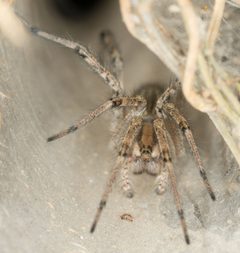
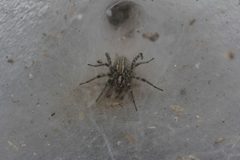
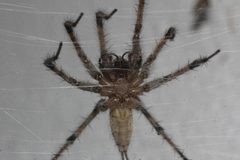
Body length 13–18 mm (females larger than males). tan to gray with two longitudinal brown stripes. tan with two black stripes. Legs relatively long, annulated with alternating light and dark bands. prominent, long, and extend posteriorly from abdomen. Eight arranged in two rows forming an arc. Overall coloration gray, brown, and black.
Habitat
Dry and arid regions including desert grassland, lava beds, rangeland, and shrubland. Webs constructed in crevices between rocks, on bushes, in tall grass patches, or in building corners. In grasslands: placed in tall grass patches. In lava beds: associated with shrubs or depressions at lava bed outskirts. Occasionally found indoors in undisturbed corners.
Distribution
Southwestern United States (southern California to Texas) and northwestern Mexico.
Seasonality
Active year-round in suitable conditions; most active at night for foraging. Mature males wander seeking females into fall (observed into late October).
Diet
Insects captured on webs, primarily grassland insects including grasshoppers and aphids; also other spiders. Prey captured on flat web surface, then dragged into funnel for feeding.
Life Cycle
Spiderlings initially occupy a communal web, then disperse to build individual webs nearby. Spiderlings exhibit competitive over food resources.
Behavior
hunting activity. Constructs non-sticky funnel-shaped webs with sheet platform and tubular retreat; waits in tube sensing vibrations, then rapidly emerges to capture prey. Can escape through bottom funnel opening if web damaged. Territorial: defends web sites against intruders through agonistic interactions; more combative individuals maintain larger territories. Courtship involves male abdominal swaying, web flexing, and release inducing female cataplexis (temporary paralysis).
Ecological Role
of insects and other spiders in arid grassland . Contributes to nutrient cycling through prey consumption. Serves as prey for birds, particularly in woodland where risk is higher.
Human Relevance
Bites to humans considered generally harmless and not medically significant, though a few cases in Southern California reported (headache, weakness, disorientation, pallor, lethargy). Venom contains agatoxins (omega-agatoxin IVA and IVB) that block calcium channels; extensively researched for neurobiological applications. Occasionally enters buildings but does not establish indoor .
Similar Taxa
- Hololena spp.Also funnel-web weavers in western North America; distinguished by short directed inward vs. long parallel spinnerets in Agelenopsis
- Agelenopsis pennsylvanicaEastern grass spider with overlapping ; distinguished by geographic range (eastern vs. southwestern North America)
- Eratigena agrestis (hobo spider)Close relative with similar web structure; distinguished by geographic range and slightly different abdominal patterning
Misconceptions
Despite 'funnel-web spider,' it is not related to the medically significant Australian funnel-web spiders ( Atractaspididae/Atracidae). Bites are generally harmless to humans, contrary to concerns based on venom research applications.
More Details
Low-temperature tolerance
Can withstand very low temperatures without cold hardening; likely compensates by moving to protected microhabitats during extreme cold periods.
Web site quality and fitness
Spiders occupying optimal web sites (prey-rich, thermally favorable) achieve larger body size and higher relative ; site quality is a major determinant of individual success.
Habitat selection trade-offs
Laboratory studies show individuals prioritize either preferred temperature range or prey availability when both cannot be satisfied simultaneously, rather than compromising on both.
Sources and further reading
- BugGuide
- Wikipedia
- GBIF taxonomy match
- iNaturalist taxon
- NCBI Taxonomy
- Catalogue of Life
- Bug Eric: Spider Sunday: Hololena Funnel-web weavers
- Alien land snail species are increasing exponentially | Blog
- Archive — Bug of the Week
- ANALYSIS OF COURTSHIP SUCCESS IN THE FUNNEL-WEB SPIDER AGELENOPSIS APERTA
- Genetic analyses of two behavioural traits linked to individual fitness in the desert spider Agelenopsis aperta
- A test for correlations among fitness-linked behavioural traits in the spider Agelenopsis aperta (Araneae, Agelenidae)
- Levels of predation and genetically based anti-predator behaviour in the spider, Agelenopsis aperta
- Decisions in Multiple Goal Contexts: Habitat Selection of the Spider, Agelenopsis aperta (Gertsch)
- Patterns of Spider Distribution (Agelenopsis aperta (Gertsch)) in Desert Grassland and Recent Lava Bed Habitats, South-Central New Mexico