
Agelenopsis
Giebel, 1869
American grass spiders, grass spiders, funnel weavers
Species Guides
11- Agelenopsis aperta(Desert Grass Spider)
- Agelenopsis emertoni(Emerton's Grass Spider)
- Agelenopsis kastoni
- Agelenopsis longistyla
- Agelenopsis naevia(Dark-legged Grass Spider)
- Agelenopsis oklahoma
- Agelenopsis oregonensis
- Agelenopsis pennsylvanica(Pennsylvania Grass Spider)
- Agelenopsis potteri(Potter's Grass Spider)
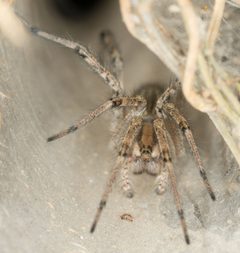
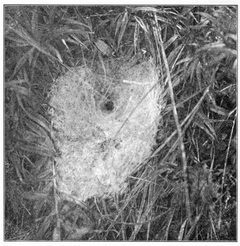
Agelenopsis is a of funnel-web spiders native to North America, commonly known as American grass spiders. They construct distinctive sheet webs with a funnel-shaped retreat at one edge, using non-sticky silk that relies on the spider's rapid speed to capture prey. The genus includes fourteen recognized as of 2025, with body lengths ranging up to approximately 19 mm. They are characterized by eight arranged in three rows (two, four, two) and two prominent held parallel to each other.
Pronunciation
How to pronounce Agelenopsis: //ˌæɡɪlɪˈnɒpsɪs//
These audio files are automatically generated. While they are not always 100% accurate, they are a good starting point.
Identification
Agelenopsis can be distinguished from the related European Agelena by two quasiparallel dark lines running from the to the beginning of the on the , whereas Agelena has curved, irregular lines that often meet at the end. Females can be further distinguished by the length of the front leg row. From the western genus Hololena, Agelenopsis differs by having long usually held parallel to each other, versus Hololena's short spinnerets directed somewhat inward. The eye arrangement—two eyes in the top row, four in the middle, and two in the bottom row spaced wider than the top pair—is diagnostic for the genus.
Images
Habitat
Found in diverse including grasslands, meadows, lawns, gardens, and shrubbery. In desert regions, occupies desert grassland and scrub habitats. Often abundant in urban and suburban environments, where they construct webs on vegetation, hedges, and low plants. In eastern Ukraine, occupy urbanized environments including cities, towns, and nature reserves.
Distribution
Native to North America, ranging from southern Canada through the United States to northern Central America. Individual have more restricted ranges: A. pennsylvanica occurs in the northeastern and mid-Atlantic United States; A. aperta inhabits desert regions of the southwestern United States and northern Mexico; A. potteri has been introduced to Europe, with established in Ukraine (detected in 19 of 25 administrative regions as of 2025), Italy, and the United Kingdom.
Seasonality
are primarily active from late spring through autumn. In temperate regions, peak activity occurs during summer months. In Ukraine, show adult activity from June to October, with peak numbers in August and September; last observations of single females extend into November.
Diet
Feeds on small insects that blunder onto the web sheet, including flies, small , and other arthropods. Relies on speed rather than sticky silk to capture prey, dashing out from the funnel to subdue victims and drag them back to the retreat.
Life Cycle
Development includes , spiderling, and stages. Spiderlings construct webs and may disperse by ballooning on silk threads. Sexual maturity is reached within one season in most of the range; some southern may have two annually. In desert-adapted , timing correlates with seasonal prey availability and temperature conditions.
Behavior
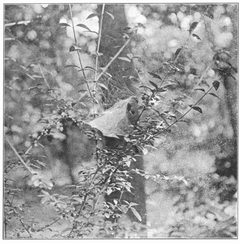
Constructs horizontal sheet webs 8-12 inches across with a funnel-shaped retreat at one edge. The web lacks adhesive properties; prey capture depends on the spider's extreme sensitivity to vibrations and rapid running speed. When threatened, the spider retreats into the funnel with remarkable speed. Males wander in search of females and may enter homes. Courtship involves male vibratory displays on the female's web, including lateral swaying and web flexing; successful males induce cataleptic paralysis in females before mating. Sexual has been documented, with hungry and aggressive females consuming mates; cannibalistic females produce heavier with increased hatching success.
Ecological Role
of small insects in grassland, garden, and shrubland . Contributes to structure in desert grasslands and lava bed . Serves as prey for birds, larger spiders, and other arthropod predators. In invaded European habitats, integrates into local spider communities without documented major ecological disruption.
Human Relevance
Generally harmless to humans; bites are extremely rare and medically insignificant. Often noticed in gardens and yards during foggy mornings when dew condenses on webs. Occasionally enters homes when males wander seeking mates. One , A. potteri, has become established in Europe through human-mediated transport. The serves as a model organism for behavioral research, particularly regarding selection, courtship , and .
Similar Taxa
- HololenaAlso Agelenidae with similar sheet-and-funnel webs, but has short directed inward rather than long parallel spinnerets; restricted to western North America.
- AgelenaEuropean funnel-web spiders with curved, irregular cephalothoracic lines that often meet at the end, versus Agelenopsis's quasiparallel lines.
- Eratigena (hobo spider)Formerly Tegenaria; larger Agelenidae with different arrangement and more robust body; medically significant bite reputation (though often overstated).
Sources and further reading
- BugGuide
- Wikipedia
- GBIF taxonomy match
- iNaturalist taxon
- NCBI Taxonomy
- Catalogue of Life
- Spider Alert! Guess Who's Coming to UC Davis? | Bug Squad
- Spiders in the mist: Funnel weaving spider, Pennsylvania Grass Spider, Agelenopsis pennsylvanica — Bug of the Week
- Spider webs in the mist – Funnel weaving spider, Pennsylvania Grass Spider, Agelenopsis pennsylvanica — Bug of the Week
- Bug Eric: March 2013
- Bug Eric: Spider Sunday: Hololena Funnel-web weavers
- Archive — Bug of the Week
- THE ADVENTITIOUS SPIDER SPECIES AGELENOPSIS POTTERI (BLACKWALL, 1846) IN UKRAINE
- ANALYSIS OF COURTSHIP SUCCESS IN THE FUNNEL-WEB SPIDER AGELENOPSIS APERTA
- Field Studies on Reproduction in the Funnel-Web Spider Agelenopsis Potteri (Araneae: Agelenidae)
- A new species of grass spider, Agelenopsis riechertii, from the Southwestern USA, with notes on its courtship behavior (Araneae: Agelenidae)
- Genetic analyses of two behavioural traits linked to individual fitness in the desert spider Agelenopsis aperta
- A test for correlations among fitness-linked behavioural traits in the spider Agelenopsis aperta (Araneae, Agelenidae)
- Levels of predation and genetically based anti-predator behaviour in the spider, Agelenopsis aperta
- Decisions in Multiple Goal Contexts: Habitat Selection of the Spider, Agelenopsis aperta (Gertsch)
- Patterns of Spider Distribution (Agelenopsis aperta (Gertsch)) in Desert Grassland and Recent Lava Bed Habitats, South-Central New Mexico