
Agelenopsis potteri
(Blackwall, 1846)
Potter's Grass Spider
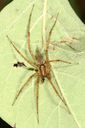
A funnel-web spider native to North America that has been introduced to Ukraine, Russia, Kyrgyzstan, and China. It is easily identified by structural features and has established stable breeding in urban environments across 19 of 25 Ukrainian administrative regions as of 2025. The exhibits typical summer-autumn with activity peaking in August and September. Unlike many spiders, it cannot disperse via aerial ballooning and spreads through human-mediated transport.
Pronunciation
How to pronounce Agelenopsis potteri: /ˌædʒɛləˈnɒpsɪs ˈpɒtəri/
These audio files are automatically generated. While they are not always 100% accurate, they are a good starting point.
Identification
Easily identified by structural features including the funnel-web architecture; detailed morphological diagnostic characters not provided in available sources. Distinguished from other Agelenopsis by specific structural traits visible in research-grade photographic records.
Images
Habitat
Urban environments including large cities, district and regional centers, towns, and non-urban settlements outside urban agglomerations. In eastern Ukraine, also occurs in nature reserves and various types. Absent from southern Ukrainian regions (Mykolaiv, Odesa, Kherson, Crimea) and Vinnytsia and Khmelnytsky regions, possibly due to sensitivity to low humidity.
Distribution
Native to North America; introduced and established in Ukraine (19 of 25 administrative regions), Russia (European part and Far East), Kyrgyzstan, and China. In Ukraine, most observations from Kyiv (44), Rivne (38), and Kharkiv (34) regions. Stable breeding confirmed in Zdolbuniv (Rivne region), Shkarivka (Bila Tserkva district, Kyiv region), and Prydniprovske (Zolotonosha district, Cherkasy region).
Seasonality
Summer-autumn . occur from June to October, with peak activity in August and September. Last observations of single females recorded in November.
Behavior
Unable to disperse via air currents using silk; spread occurs exclusively through human-mediated transport such as goods transportation and extensive transport networks.
Ecological Role
Component of spider in nature reserves in eastern Ukraine; role in native North American not documented in available sources.
Human Relevance
Adventitious spread through international trade and transport networks. Subject of citizen science monitoring through iNaturalist, GBIF, and UkrBIN platforms with approximately 250 verified observations in Ukraine as of January 2025.
Sources and further reading
- BugGuide
- Wikipedia
- GBIF taxonomy match
- iNaturalist taxon
- NCBI Taxonomy
- Catalogue of Life
- Valley Grasshopper
- Flabellate Grasshopper
- Striped Grasshopper
- Whitewhiskered Grasshopper
- Spottedwinged Grasshopper
- Snakeweed Grasshopper
- THE ADVENTITIOUS SPIDER SPECIES AGELENOPSIS POTTERI (BLACKWALL, 1846) IN UKRAINE
- Field Studies on Reproduction in the Funnel-Web Spider Agelenopsis Potteri (Araneae: Agelenidae)