
Agelenopsis naevia
(Walckenaer, 1841)
Dark-legged Grass Spider
Agelenopsis naevia is a of funnel-web spider in the Agelenidae, commonly known as the Dark-legged Grass Spider. It is found in the United States and Canada. Like other members of its , it constructs flat, sheet-like webs with a funnel-shaped retreat where the spider waits to ambush prey. The species was first described by Walckenaer in 1841.
Pronunciation
How to pronounce Agelenopsis naevia: /ˌæɡəˌlɛˈnɒpsɪs ˈniːviə/
These audio files are automatically generated. While they are not always 100% accurate, they are a good starting point.
Identification
Distinguished from Hololena by long held parallel to each other (Hololena has short spinnerets directed inward). Differs from Calilena by spinneret orientation and geographic range. Separated from other Agelenopsis by subtle morphological details of genitalia and coloration patterns, particularly the dark leg coloration that gives this species its . The flat, horizontal web with a funnel retreat at one end is characteristic of the but not unique to this species.
Images
Appearance
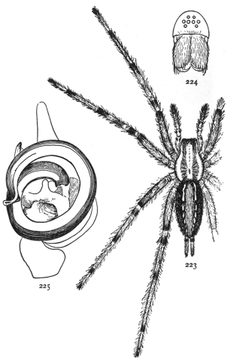
Medium-sized spider with body length typically 10-20 mm for females, slightly smaller for males. bears two parallel or converging dark stripes on a pale background. displays a central reddish or brownish band running its length, often bordered by pale, wavy lines. Legs are annulated with alternating bands of light and dark coloration. are notably long and held parallel to each other, a key distinguishing feature from the related Hololena.
Habitat
Occurs in grassy areas, lawns, gardens, and shrubbery where it can construct its sheet webs close to the ground or vegetation. Webs are often built in protected locations among plants, rocks, or debris. Juveniles and mature males may wander and enter human structures.
Distribution
United States and Canada. Distributed across North America with records from multiple U.S. states and Canadian provinces.
Diet
. Preys on small insects and other arthropods that blunder onto its web.
Behavior
Constructs flat, hammock- or bowl-shaped sheet webs with a funnel-like retreat in one corner. The web lacks sticky capture threads; instead, a tangle of threads above the sheet intercepts flying insects, knocking them onto the platform. The spider detects vibrations through the web and executes rapid attacks to subdue prey, dragging victims back into the funnel to feed. When threatened, the spider retreats rapidly down the funnel. Sexual has been observed in the , with females consuming males after mating, particularly when hungry or aggressive, resulting in increased weight and hatching success.
Ecological Role
of small insects and arthropods. Serves as prey for larger predators including birds and other arthropods. Contributes to of insect in grassy and garden .
Human Relevance
Generally harmless to humans; bites are rare and typically result only in mild, transient . May enter homes as wandering juveniles or mature males, causing occasional alarm but posing no significant threat. Webs become conspicuous on foggy mornings when dew condenses on silk, revealing the abundance of these spiders in residential landscapes.
Similar Taxa
- Hololena spp.Also Agelenidae with similar web architecture, but distinguished by short, inward-directed versus long, parallel spinnerets in Agelenopsis. Hololena is restricted to western North America.
- Agelenopsis pennsylvanicaCongeneric grass spider with overlapping range; distinguished by subtle differences in coloration and genital , with A. naevia having darker leg coloration.
- Calilena spp.Western Agelenidae with long , but spinneret orientation and geographic distribution differ.
More Details
Web Structure
The web architecture is specialized for interception rather than adhesion. Non-sticky sheet webs rely on the spider's speed and venom rather than passive capture.
Sources and further reading
- BugGuide
- Wikipedia
- GBIF taxonomy match
- iNaturalist taxon
- NCBI Taxonomy
- Catalogue of Life
- Spiders in the mist: Funnel weaving spider, Pennsylvania Grass Spider, Agelenopsis pennsylvanica — Bug of the Week
- Spider webs in the mist – Funnel weaving spider, Pennsylvania Grass Spider, Agelenopsis pennsylvanica — Bug of the Week
- Bug Eric: Spider Sunday: Hololena Funnel-web weavers
- Archive — Bug of the Week