
Agelenopsis pennsylvanica
(C. L. Koch, 1843)
Pennsylvania Grass Spider, Pennsylvania Funnel-web Spider
Agelenopsis pennsylvanica is a funnel-web spider native to the United States, recognized by its characteristic funnel-shaped retreat web. Females are larger than males and exhibit notable sexual during mating, a that has been extensively studied in this . The spider is an ambush that relies on vibration detection to capture prey. Its distribution spans at least 21 states, with highest abundance in areas with high humidity and water availability.
Pronunciation
How to pronounce Agelenopsis pennsylvanica: //ˌædʒɪləˈnɒpsɪs ˌpɛnˌsɪlˈvænɪkə//
These audio files are automatically generated. While they are not always 100% accurate, they are a good starting point.
Identification
Distinguished from other Agelenopsis by male genitalia: embolus makes complete circle with tip perpendicular to cymbium. Long held parallel to each other separate Agelenopsis from Hololena (short, inward-directed spinnerets). Distinguished from A. potteri (closest relative) by specific genitalic structures. arrangement typical of : eyes largest, median smallest; anterior eyes less than apart, posterior eyes equidistant.
Images
Appearance
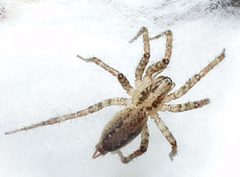
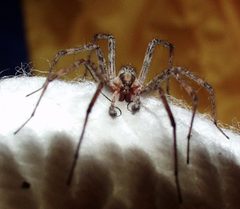
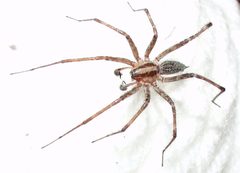
Medium-sized spider with females 9–14 mm in body length, males 7–12 mm. displays dark markings that are often faded. Sternum is yellow-orange with a large dark V-shaped mark, or entirely black in darker individuals. has similar patterning, with speckled sides and pale venter with broad dusky black area. Hind have segment about twice as long as basal segment. Females possess skull-shaped bursa opening with spermathecae nested vertically. Males are distinguished by coiling embolus that makes a full circle with pointed tip perpendicular to cymbium.
Habitat
Open grassy , floodplain forests, and areas near bodies of water. Correlated with high water availability and humidity. Found on ground, in understory vegetation, trees, old field lawns, and around houses. Web placement varies seasonally.
Distribution
Widespread across United States. Documented in Colorado, Connecticut, Idaho, Illinois, Kansas, Louisiana, Massachusetts, Michigan, North Dakota, Ohio, Oregon, Pennsylvania, Tennessee, Utah, West Virginia, and at least 6 additional states. Most common from New England and Great Lakes states westward to Nebraska and eastern Colorado, south to Arkansas, Mississippi, and northern Georgia. Disjunct in Washington and Oregon.
Seasonality
Sexual maturity occurs late August to September. sacs produced October to November. Females remain with egg sacs until death. stages show boldness and aggressive foraging correlated with instar in wild individuals.
Diet
; feeds on insects captured in web including hemipterans (true bugs), homopterans, coleopterans (beetles), hymenopterans (bees, ants, , ), dipterans (true flies), and orthopterans (grasshoppers, locusts, crickets).
Life Cycle
or short-lived. laid in large conical egg sacs (18–236 eggs) enclosed in thin silk sac covered by debris layer. Females exhibit maternal care, remaining with egg sacs until death. Multiple females may aggregate under tree bark with touching or overlapping egg masses. Sexual maturity in late summer/early fall; stage not explicitly documented but likely eggs or early instars.
Behavior
Ambush that waits at funnel entrance, using high-velocity movements to subdue prey contacting web. Exhibits sexual : females commonly cannibalize males during mating. Pre-copulatory cannibalism occurs in ~36% of virgin females; females that consume first male before copulation show increased reproductive success with heavier sacs and higher hatching success. Boldness and foraging aggression in juveniles are phenotypically plastic responses to environmental conditions, not observed in laboratory-reared individuals. Males approach females cautiously, creating vibrational signals; receptive females enter cataleptic paralysis. Males depart web before female awakens to avoid cannibalism.
Ecological Role
controlling insect in grassy . Serves as prey for other spiders including Parasteatoda tepidariorum (common house spider) and Phidippus audax (bold jumper). Cuticular interactions with environmental bacteria influence and potentially .
Human Relevance
Bites cause localized including itching, swelling, redness, and occasionally back pain; symptoms persist 1–10 days. Used extensively in research on sexual , pre-copulatory cannibalism, boldness, aggressive foraging , and microbial influences on and mating. Occasional indoor visitor, particularly juveniles and mature males.
Similar Taxa
- Agelenopsis potteriClosest relative; distinguished by genitalic and geographic distribution
- Hololena spp.Also Agelenidae with funnel webs; Hololena has short, inward-directed vs. long parallel spinnerets in Agelenopsis; Hololena restricted to western third of U.S.
- Agelenopsis naeviaSimilar sac ; distinguished by genitalic features and coloration patterns
- Agelenopsis oklahomaSimilar size, coloration, , and copulatory ; potentially capable of interspecific mating but mutual indifference or aggression observed in encounters
More Details
Microbial Interactions
Environmental microbes significantly influence and . Exposure to Dermacoccus nishinomiyaensis and Staphylococcus saprophyticus decreases foraging aggressiveness by over 10-fold. Bacterial exposure alters courtship timing: males take four times longer to begin courtship with bacteria-exposed females. Pseudomonas aeruginosa is horizontally transmitted during mating and shows confirmed in related spiders.
Research Significance
Important model organism for studying aggressive spillover hypothesis (ASH) regarding pre-copulatory ; however, ASH alone cannot explain cannibalism patterns. Demonstrates that pre-copulatory cannibalism results from both aggressive spillover and foraging strategy/hunger state, with adaptive consequences for female reproductive success.
Web Structure
Funnel web consists of non-sticky sensory sheet and funnel retreat. Web includes aerial threads above platform to intercept flying insects. Spider positions with first two leg pairs in nest, enabling rapid response to or prey. Relies on high burst speeds for prey capture; compromised locomotor performance from reduces foraging and territorial defense abilities.
Sources and further reading
- BugGuide
- Wikipedia
- GBIF taxonomy match
- iNaturalist taxon
- NCBI Taxonomy
- Catalogue of Life
- Grasshopper Collections and Survey
- Archive — Bug of the Week
- Bug Eric: Spider Sunday: Hololena Funnel-web weavers
- Synchronous Fireflies in Pennsylvania are Rare and Unusual
- Bug Eric: Firefly Tag
- Dispelling Urban Myths With Science Can Save Your Ash