
Parasteatoda tepidariorum
(C. L. Koch, 1841)
Common House Spider, American House Spider, Domestic Spider, Common Gray House Spider
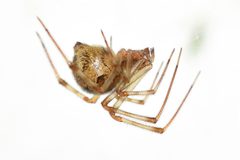
Parasteatoda tepidariorum, the common house spider, is a small cobweb-weaving spider native to the Americas that has achieved distribution through human commerce. It is strongly , rarely found outside human-built structures. Females measure 5–8 mm in body length, males 3.8–4.7 mm, with variable coloration from tan to nearly black. The constructs irregular three-dimensional webs in dark corners of buildings and has become a model organism for developmental research due to its short lifecycle, ease of laboratory culture, and accessible embryology.
Pronunciation
How to pronounce Parasteatoda tepidariorum: //ˌpærəˌstiːəˈtoʊdə ˌtɛpɪˌdɛəriˈɔːrəm//
These audio files are automatically generated. While they are not always 100% accurate, they are a good starting point.
Identification
Distinguished from widow spiders (Latrodectus spp.) by the absence of a red or orange hourglass marking on the underside of the . Similar in body shape and web type to Steatoda (false widows), but P. tepidariorum typically shows more variable and less distinct abdominal patterning. Distinguished from the triangulate cobweb spider (Steatoda triangulosa) by larger size and lack of the distinctive paired wavy longitudinal lines on the abdomen. The tan, papery, pear-shaped sacs suspended in the web are characteristic. Web structure—irregular, tangled, three-dimensional cobweb with sticky traplines anchoring to substrate—differs from flat orb webs of Araneidae or sheet webs of Linyphiidae.
Images
Appearance
Small cobweb-weaving spider with highly variable coloration ranging from tan to nearly black, often with patterns of differing shades on the body. Females measure 5–6 mm in body length (up to 8 mm), males 3.8–4.7 mm. With legs outspread, individuals can reach 25 mm or more across. Females have a bulbous, globular ; males are more slender with a less bulbous abdomen. The body shape resembles that of widow spiders (Latrodectus), but lacks the red or orange hourglass marking on the underside of the abdomen that characterizes widow spiders. Average female body mass is approximately 37.7 mg. Fine hairs cover the body, aiding camouflage against backgrounds.
Habitat
Strongly ; almost exclusively found in association with human dwellings. Constructs webs in dark, sheltered corners of buildings: under eaves, in window wells, between loose walls, behind open doors, in rock retaining walls, tree holes, and similar protected locations. In South Africa, has been recorded at elevations of 1246–1513 m in Fynbos, Nama Karoo, and Savanna biomes, but still in human-modified environments. Seldom encountered in natural, undisturbed .
Distribution
distribution achieved through human-mediated transport. Native to the Americas, with suspected origins in South America. Introduced and established across Canada, USA, South America, Europe, Morocco, Turkey, the Caucasus, Russia (European Far East), Saint Helena, South Africa (Gauteng, Eastern Cape, Western Cape including Mountain Zebra National Park and Robben Island), Seychelles, New Zealand, Hawaii, and Myanmar. Absent or rare in the interior of continents where human habitation is sparse.
Seasonality
Active year-round in protected indoor environments. In temperate regions, may overwinter in sheltered locations. Females produce sacs from late spring through late summer. Multiple per year possible in favorable conditions. In laboratory conditions at 25°C, eggs hatch in 7 days; juveniles reach sexual maturity in 2–3 months. occurs under short-day conditions.
Diet
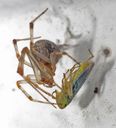
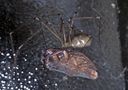
Opportunistic of small arthropods. Prey consists primarily of household insects and other small , including flies, mosquitoes, ants, beetles, and other spiders. In laboratory settings, fed live Drosophila melanogaster twice weekly to juveniles and , with live crickets as additional food for adult females. The spider detects prey through vibrations transmitted along the web, approaches, and wraps it in silk before delivering a paralyzing bite. If prey is too agile, the spider may shoot silk at it from a distance before pulling the thread toward itself. Larger females have been observed to attract small vertebrate prey (baby skinks) by leaving fly remains hanging in the web.
Life Cycle
stage: spherical eggs (~0.59 mm diameter, ~0.12 mg each) deposited in tan, papery, pear-shaped egg sacs containing 100–600 eggs (mean ~149–300 per sac); females produce multiple sacs (up to ~10) from late spring through late summer. Embryonic development: eggs hatch in ~7 days at 25°C. Post-embryonic development: spiderlings remain in mother's web for several days after emerging from egg sac, then disperse. Juveniles undergo several before reaching adulthood. time: approximately 2–3 months from hatching to sexually mature at 25°C. Adult longevity: females can live more than one year after reaching maturity. Multiple generations per year possible under favorable conditions.
Behavior
Web-building: constructs large, irregular, three-dimensional cobwebs with sticky traplines anchoring to ground or substrate; web appears haphazard and tangled but is an effective prey-capture structure. Prey capture: detects vibrations along web threads, approaches prey, wraps in silk, then delivers venomous bite. Defensive : prioritizes escape over confrontation; retreats to secure hiding place when disturbed; if cornered, may feign death as last resort. Bites humans only in self-defense when grabbed and squeezed. Social : males and females may share the same web for extended periods; multiple females often build webs in close proximity, though females may fight when encountering each other directly. occurs, including juveniles cannibalizing each other and consuming intruding spiders. Mating: female web-twanging behavior appears to advertise receptivity; males actively walk while females remain on web nest. Low re-mating rates observed; most females mate once or not at all. Poor vision: cannot detect movement more than 7–10 cm away.
Ecological Role
of household arthropods, including potential pest such as flies, mosquitoes, and other insects. Serves as prey for various spider predators including pirate spiders (Mimetus spp.), jumping spiders (Phidippus variegatus, Platycryptus undatus), and the assassin bug Stenolemus lanipes. for Zatypota albicoxa. In urban , contributes to of insect and supports higher . -infested urban trees support higher populations of this species, which in turn may contribute to pest suppression in nearby vegetation.
Human Relevance
Beneficial: controls household insect pests without posing significant danger to humans. Not considered dangerously venomous; bites are less severe than those of other theridiids and are not known to be dangerous to humans. Bites occur only in self-defense when spider is grabbed and squeezed. Frequently misidentified as brown widow spider (Latrodectus geometricus), causing unnecessary concern. Model organism for developmental and evolutionary research due to short lifecycle, ease of laboratory culture, and accessible embryology. sequenced, revealing whole genome duplication within chelicerates. Research applications include studies of axis formation, segmentation, self-regulatory capabilities of embryonic fields, and evolution of developmental mechanisms.
Similar Taxa
- Latrodectus spp. (widow spiders)Similar body shape, web type, and size; distinguished by red/orange hourglass marking on (absent in P. tepidariorum) and more dangerous venom
- Steatoda triangulosa (triangulate cobweb spider)Smaller size (3.5–5.9 mm), distinctive paired wavy longitudinal lines on , more restricted distribution; builds similar cobweb structure
- Steatoda grossa/grossa group (false widows)Similar web architecture and body form; often with more distinct abdominal patterning; some have medically significant bites
- Achaearanea spp.Formerly congeneric; P. tepidariorum was placed in Achaearanea by some authorities; distinguished by subtle morphological and genetic differences
Misconceptions
Frequently misidentified as the brown widow spider (Latrodectus geometricus) due to similar size, coloration, and web type, causing unnecessary alarm. The absence of the hourglass marking distinguishes P. tepidariorum from widow spiders. Not dangerously venomous to humans despite being in the same (Theridiidae) as widow spiders. Does not aggressively bite humans; defensive prioritizes escape and death-feigning over confrontation.
More Details
Taxonomic History
Originally described as Theridion tepidariorum by C.L. Koch in 1841. Transferred to Parasteatoda by A.F. Archer in 1946, then to Achaearanea by H.W. Levi in 1955, and returned to Parasteatoda based on subsequent molecular and morphological studies. One of two Parasteatoda in North America; 46 species worldwide in the .
Model Organism Status
Emerging model for evolutionary developmental . Advantages include: relatively short lifecycle, year-round availability of embryonic stages, cellular embryonic field from early stages, self-regulatory capabilities in development, sequenced revealing whole genome duplication in chelicerates. Techniques established include parental interference, microinjection, multicolor fluorescence in situ hybridization, laser ablation, and primary culture.
Mating System
Characterized by low female mating rates. Most females mate once or not at all, regardless of whether paired with same male (monandry) or different males (). Female web-twanging appears to advertise receptivity. High mating costs for males and limited female receptivity shape this mating system. No advantage to double-mating detected in laboratory studies.
Sources and further reading
- BugGuide
- Wikipedia
- GBIF taxonomy match
- iNaturalist taxon
- NCBI Taxonomy
- Catalogue of Life
- Bug Eric: Spider Sunday: Common House Spider
- Bug Eric: March 2012
- Bug Eric: One Night, One House, Seventeen Spider Species
- Scale Insects on Urban Trees Benefit Spiders, Other Natural Enemies in Plants Below
- Bug Eric: Spider Sunday: Triangulate Cobweb Weaver
- Archive — Bug of the Week
- The common house spider Parasteatoda tepidariorum
- Evolutionary crossroads in developmental biology: the spiderParasteatoda tepidariorum
- Primary cell culture from embryos of the common house spider Parasteatoda tepidariorum
- The mating system of the common house spider Parasteatoda tepidariorum
- Female mating rates and their fitness consequences in the common house spider Parasteatoda tepidariorum
- Seasonal Life Cycle ofZatypota albicoxa(Hymenoptera: Ichneumonidae), an Ectoparasitoid ofParasteatoda tepidariorum(Araneae: Theridiidae), in Southwestern Japan
- Distribution and development of the external sense organ pattern on the appendages of postembryonic and adult stages of the spider Parasteatoda tepidariorum