
Steatoda triangulosa
(Walckenaer, 1802)
Triangulate Cobweb Spider, Triangulate Combfoot, Triangulate Bud Spider
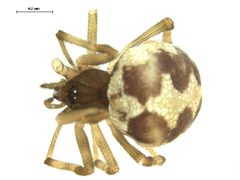
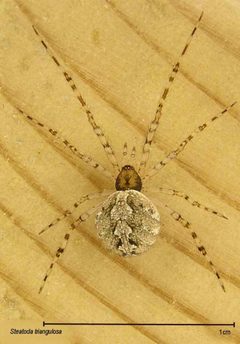
Steatoda triangulosa is a small cobweb spider in the Theridiidae, frequently encountered in human-made structures across North America and Europe. measure 3.5–5.9 mm in body length, with females larger than males. The is recognized by the distinctive triangular pattern on its . It is , thriving in basements, garages, and cellars, and has been introduced to North America from the Palearctic region. The species is not considered dangerously venomous to humans.
Pronunciation
How to pronounce Steatoda triangulosa: //stiəˈtoʊdə traɪˌæŋɡjuˈloʊsə//
These audio files are automatically generated. While they are not always 100% accurate, they are a good starting point.
Identification
Distinguished from black widows (Latrodectus spp.) by smaller size, lack of black coloration, and the distinctive triangular pattern rather than an hourglass or spots. Differs from Steatoda grossa (false black widow) by the triangular abdominal pattern versus the more uniform or spotted pattern of S. grossa. Separated from Parasteatoda tepidariorum (common house spider) by smaller size and more defined abdominal markings; P. tepidariorum has a larger body and less distinct patterning. The dark reddish-brown and banded legs are additional distinguishing features.
Images
Appearance
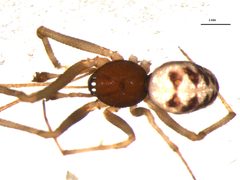
Small-bodied cobweb spider with females 3.6–5.9 mm and males 3.5–4.7 mm in body length. has a dirty white or beige background with a pair of bold, wavy, rusty to purplish-brown longitudinal lines forming a triangular pattern. is dark reddish-brown. Legs are pale brown to yellowish with dark bands at the joints. Males have a more slender, leggy build compared to females. The overall leg span does not cover a U.S. dime or penny.
Habitat
Strongly , occupying dark, sheltered recesses in human-made structures. Frequently found in basements, cellars, garages, water meter boxes, window frames, and under bridges or in culverts where webs are protected from weather. Prefers locations with access to crevices for retreat when disturbed. In southern parts of its native range, occurs in natural ; in colder regions, restricted to human-associated environments.
Distribution
Native to central and southern Europe, the Mediterranean region, and southern Russia through Central Asia, China, and Korea. Introduced to North America, where established from Massachusetts to Nebraska, Colorado, Utah, Oregon, and California, with gaps in the southwest and Florida. Also recorded from southern Ontario, Canada; Argentina; Canary Islands; and South Africa. Recently confirmed as established in Poland.
Seasonality
Mating occurs from late spring through early autumn. may be encountered year-round in protected indoor environments. Activity appears continuous in suitable microhabitats without pronounced seasonal dormancy.
Diet
Preys on a variety of insects. Documented to capture Red Imported Fire Ant (Solenopsis invicta) in the southern United States, though not considered effective for . Accepts small flies, beetles, and other arthropods that contact the web.
Life Cycle
Females deposit approximately 30 per sac, wrapped in an opaque white spherical sac with sheer fabric through which eggs are visible. Females may produce six or more egg sacs in their lifetime. Spiderlings emerge from egg sacs and disperse to build independent webs. Development and have been documented under laboratory conditions, though specific instar counts and developmental durations are not detailed in available sources.
Behavior
Constructs irregular, tangled cobwebs with a more-or-less sheet-like central platform. Hangs upside down in the web. Web construction occurs over multiple nights, involving stereotyped : spiders move along structural threads, drop to attach to lower substrate, and coat the lowest portion with viscid silk on return, creating gumfooted lines. Constructs gumfooted lines in bouts with regular intervals between bouts. When disturbed, drops from the web and seeks in nearby crevices. Tolerates proximity to webs of other cobweb weavers, cellar spiders, and even brown recluse spiders. Males court females in response to a ternary blend of contact on female webs.
Ecological Role
of small insects and other arthropods in human-modified environments. Serves as prey for larger spiders and other predators. Documented as cohabitating with other spider without aggression, though individual observations suggest occasional intraspecific .
Human Relevance
Common household spider that reduces of nuisance insects including fire ants. Not recognized as dangerously venomous; bites are unlikely to puncture human skin due to small size. Bites, when they occur, cause mild pain that subsides quickly. Occasionally mistaken for black widows, causing unnecessary concern. Sometimes kept as pets by hobbyists.
Similar Taxa
- Latrodectus spp. (black widows)Larger size; black coloration; hourglass or spot patterns rather than triangular lines; medically significant venom
- Steatoda grossa (false black widow)More uniform purple-brown to black coloration with variable spotting; lacks distinct triangular abdominal pattern
- Parasteatoda tepidariorum (common house spider)Larger body size (~6–20 mm); less defined, more variable abdominal pattern; similar web structure but larger overall
Misconceptions
Frequently mistaken for black widow spiders due to relationship and dark coloration, but lacks dangerous venom and is too small to effectively bite humans. The triangular pattern is distinctive and not shared with widow spiders.
More Details
Pheromone chemistry
identified as a ternary blend of three contact components: N-4-methylvaleroyl-O-isobutyroyl-L-serine, N-3-methylbutyryl-O-isobutyroyl-L-serine, and N-3-methylbutyryl-O-butyroyl-L-serine. Hydrolysis products butyric acid and isobutyric acid also function as mate-attractants. This was the first application of non-targeted metabolomics to spider pheromone identification.
Web construction research
Laboratory studies demonstrate that gumfooted line construction involves stereotyped not homologous to sticky elements of orb-weaver webs. Web construction proceeds over multiple nights with regular bout intervals.
Interaction with invasive species
In experimental pairings, brown widow spiders (Latrodectus geometricus) cohabitated with S. triangulosa in 80% of trials and killed them in only 10%, suggesting S. triangulosa is relatively tolerant of and tolerated by this aggressive .
Sources and further reading
- BugGuide
- GBIF taxonomy match
- iNaturalist taxon
- NCBI Taxonomy
- Catalogue of Life
- Bug Eric: Spider Sunday: Triangulate Cobweb Weaver
- Bug Eric: City Nature Challenge 2023 Recap
- Bug Eric: City Nature Challenge 2024 Recap
- Brown Widow Spiders' Aggression Likely Driver of Black Widow Decline
- Where is the Noble False Widow settling next? | Blog
- Do Chestnut, Lemon, or Peppermint Scents Repel Spiders?
- Development and reproduction in the synanthropic spiders Steatoda bipunctata and S. triangulosa (Araneae: Theridiidae)
- New data on the occurrence of Steatoda triangulosa (Walckenaer, 1802) (Araneae: Theridiidae) in Poland.
- Untangling the Tangle-Web: Web Construction Behavior of the Comb-Footed Spider Steatoda triangulosa and Comments on Phylogenetic Implications (Araneae: Theridiidae)
- Non-targeted metabolomics aids in sex pheromone identification: a proof-of-concept study with the triangulate cobweb spider, Steatoda triangulosa