
Steatoda grossa
(C. L. Koch, 1838)
Cupboard spider, Dark comb-footed spider, Brown house spider, False black widow
Steatoda grossa is a cobweb spider in the Theridiidae, native to Europe and temperate Asia and introduced globally. It constructs irregular three-dimensional webs in dark, sheltered locations and is frequently mistaken for venomous black widows (Latrodectus spp.) due to its similar body shape and coloration, though it lacks the distinctive red hourglass marking. Bites to humans are rare and generally minor, causing localized pain and blistering with occasional .
Pronunciation
How to pronounce Steatoda grossa: /stiːəˈtoʊdə ˈɡrɒsə/
These audio files are automatically generated. While they are not always 100% accurate, they are a good starting point.
Identification
Distinguished from black widows (Latrodectus spp.) by lack of bright red hourglass or other vivid markings; coloration is uniformly dark with subdued light patterning. Separated from Steatoda triangulosa by abdominal pattern—S. grossa lacks the paired wavy rusty or purplish-brown lines on pale background characteristic of S. triangulosa. Distinguished from Steatoda borealis by larger size and ventral rather than abdominal markings.
Images
Appearance
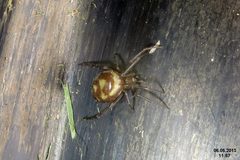
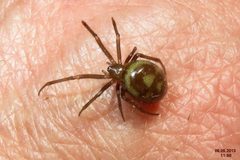
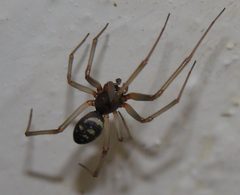
Female 6–10.5 mm in body length, male 4.1–10.0 mm. Body dark purplish-brown to black with round, bulbous . Light-colored markings present but no bright red hourglass or distinctive pattern. Male thinner than female with lighter, more reddish legs at sexual maturity. Both sexes similarly colored overall. Spiderlings shed up to six times (instars) before maturity.
Habitat
Constructs three-dimensional cobwebs in dark, sheltered locations including cupboards, basements, garages, cellars, and under bridges or culverts. Prefers protected microhabitats where webs are shielded from elements.
Distribution
Native to Europe and much of temperate Asia. Introduced to North and South America, Macaronesia, Africa (Grassland, Fynbos, Nama Karoo, and Savanna biomes), New Zealand, and Hawaii. in human-associated .
Diet
Preys on insects and other small arthropods. Has been reported to prey on black widows (Latrodectus spp.) in some accounts. Can survive several months without feeding if water is available.
Life Cycle
Female produces three or more sacs annually when well-fed, each containing 40–100 eggs. Eggs hatch within approximately one month at normal household temperature and humidity. Spiderlings independent from hatching. Female guards egg sacs, remaining near them for hours to days as eggs near hatching. Female lifespan up to six years; male lifespan 1–1.5 years, often dying shortly after mating.
Behavior
Constructs irregular, tangled cobwebs with sticky silken fibers. Relies on web vibrations rather than vision to detect prey or threats. Not aggressive; defensive bites occur when spider is accidentally squeezed or pinched. Ordinarily flees from large intruders. Female recognizes and selects web sites based on physical architecture and chemical cues from and heterospecific webs.
Ecological Role
of small arthropods. May influence local spider structure through on other spiders including potentially competitive .
Human Relevance
Frequently encountered in human dwellings due to habits. Bites are minor with localized pain and blistering; rare include fever, nausea, sweating, and malaise lasting several days. Latrodectus antivenom has been used effectively for severe cases. Popular culture: used in 2002 film Spider-Man (painted with red and blue makeup).
Similar Taxa
- Latrodectus spp. (black widows)Similar body shape and dark coloration, but distinguished by bright red hourglass or other vivid markings and more potent venom
- Steatoda triangulosaSmaller size (3.6–5.9 mm females), paired wavy rusty or purplish-brown lines on pale abdominal background, rather than pattern emphasis
- Steatoda borealisSmaller size, colder climate preference, colored markings on rather than
- Steatoda nobilis (Noble False Widow)Larger size, more robust build, different geographic distribution and invasion patterns
Misconceptions
Frequently misidentified as black widow due to 'false black widow' and superficial resemblance, leading to unnecessary alarm. Not dangerously venomous to humans despite widow-like appearance.
More Details
Web recognition behavior
Females recognize and settle on webs based on physical architecture and chemical cues, responding to both and heterospecific (Parasteatoda tepidariorum) webs. Plastic webs in cobweb-like arrangement can prompt settling , indicating that web structure rather than silk chemistry alone mediates site selection.
Repellent response
In laboratory choice tests, S. grossa did not show significant avoidance of chestnut, peppermint oil, or lemon oil—unlike Latrodectus geometricus and Araneus diadematus which avoided chestnut and peppermint oil.
Sources and further reading
- BugGuide
- Wikipedia
- GBIF taxonomy match
- iNaturalist taxon
- NCBI Taxonomy
- Catalogue of Life
- Do Chestnut, Lemon, or Peppermint Scents Repel Spiders?
- Bug Eric: Wasp Wednesday: Pepsis grossa
- Where is the Noble False Widow settling next? | Blog
- Bug Eric: Spider Sunday: Triangulate Cobweb Weaver
- Bug Eric: Spider Sunday: Hammock Spiders
- Brown Widow Spiders' Aggression Likely Driver of Black Widow Decline
- Female false black widow spiders,Steatoda grossa,recognize webs based on physical and chemical cues