
Latrodectus mactans
(Fabricius, 1775)
Southern Black Widow, Black Widow, Shoe-button Spider
Latrodectus mactans is a highly venomous cobweb spider native to the southeastern United States. females are recognized by their black bodies and distinctive red hourglass marking on the . The constructs large, irregular three-dimensional webs with exceptionally strong silk and occupies sheltered retreats such as rodent burrows or rock crevices. Despite their notorious reputation, bites to humans are rare and fatalities in healthy adults are exceedingly uncommon. The species has experienced declines in parts of its range due to aggressive displacement by the introduced brown widow (Latrodectus geometricus).
Pronunciation
How to pronounce Latrodectus mactans: //ˌlæ.tɹəˈdɛk.təs ˈmæk.tænz//
These audio files are automatically generated. While they are not always 100% accurate, they are a good starting point.
Identification
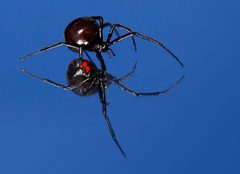
Distinguished from other North American Latrodectus by the complete, unbroken red hourglass on the (western black widow L. hesperus often has an hourglass that is separated or incomplete; northern black widow L. variolus typically shows a row of red spots or a broken hourglass dorsally and ventrally). The web structure—large, three-dimensional tangles of exceptionally strong silk with a funnel-like retreat—provides a strong indicator of presence even when the spider is hidden. Juveniles of all three are difficult to separate visually.
Images
Appearance
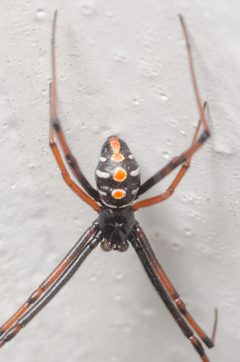
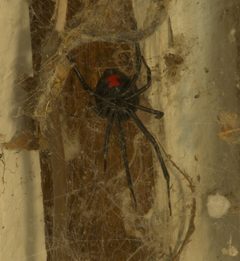
Females are shiny black with a red hourglass-shaped marking on the surface of the rounded ; some individuals also display a red or orange patch above the dorsally. Mature females measure 8–13 mm in body length, with gravid females reaching over 12 mm in abdominal diameter. Males are smaller (3–6 mm), with purple coloration or -like patterning. Juveniles are grayish to black with white stripes across the abdomen and yellow-orange spotting. Legs are long relative to body size. The of mature females are approximately 1 mm in length, sufficient to penetrate human skin.
Habitat
Occupies sheltered microhabitats including rodent burrows, rock crevices, hollow logs, and cavities under debris. Webs are constructed in dark, undisturbed locations such as barns, sheds, garages, woodpiles, and outdoor privies. Prefers dry to mesic environments and is particularly abundant in sandy or loamy substrates suitable for web anchor points and retreat construction.
Distribution
Native to the southeastern United States, ranging north to Ohio and west to Texas. Introduced established in the Dominican Republic, Mexico (where range overlaps with L. hesperus and L. geometricus), and the Hawaiian Islands. Historical taxonomic confusion prior to 1970 resulted in misattribution of western and northern black widow records to this .
Seasonality
are present year-round in southern portions of the range; peak activity and occur during warmer months. Spiderlings emerge from sacs after 20–30 days of incubation, with cohorts produced from spring through summer. Females may produce 4–9 egg sacs annually.
Diet
Preys primarily on insects, including beetles, , and other arthropods. Larger individuals have been documented capturing small vertebrates such as hatchling lizards. Prey is subdued by envenomation after being entangled in the web; the spider wraps the victim in silk and administers digestive before consumption.
Life Cycle
Females deposit in spherical silken sacs containing 100–400 eggs each. Incubation lasts 20–30 days. Spiderlings undergo and suffer mortality from desiccation and , with typically fewer than 100 surviving to first and approximately 30 reaching maturity. Development from to reproductive maturity requires 2–4 months under optimal conditions, with full maturation at 6–9 months. Females may live up to three years; males live 3–4 months.
Behavior
; remains concealed in retreat during daylight, emerging at night to occupy the web. Constructs large, irregular three-dimensional cobwebs with trip threads extending to the substrate; these threads break and rebound when disturbed, hoisting prey into the web. Flee rapidly into retreat when threatened by large animals. Sexual of males by females has been documented but occurs primarily under laboratory conditions with constrained space; in natural settings it appears associated with male inability to escape rather than active female .
Ecological Role
of insects and other arthropods, including pest . Serves as prey for specialized predators including the blue mud dauber (Chalybion californicum), which provisions nests with paralyzed spiders. sacs are parasitized by the scelionid wasp Baeus latrodecti and chloropid flies in the Pseudogaurax. by these and predators may be significant.
Human Relevance
Bites cause latrodectism, a neurotoxic characterized by severe pain, muscle cramping, abdominal rigidity, and autonomic ; priapism has been reported in rare cases. Symptoms typically resolve within several days; antivenom is available but reserved for severe cases due to risks of serum reaction. Fatalities in healthy are exceedingly rare with modern medical care. Bites are preventable through simple precautions: avoiding placing hands or feet into unseen spaces, inspecting clothing and footwear left outdoors, and shaking out items stored in sheds or garages. The is not aggressive and bites only defensively when pressed against skin.
Similar Taxa
- Latrodectus hesperus (Western Black Widow)Overlaps in range in southwestern U.S. and Mexico; distinguished by larger size (14–16 mm females), often incomplete or separated hourglass marking, and preference for drier . Mature females typically lack red markings other than the hourglass.
- Latrodectus variolus (Northern Black Widow)Overlaps in middle Atlantic states; distinguished by row of red spots or broken hourglass pattern on both and , and more northern distribution.
- Latrodectus geometricus (Brown Widow)Introduced aggressively displacing L. mactans in urban ; distinguished by tan to brown coloration with variable orange or white markings, and banded legs. Less toxic to humans but poses greater threat to co-occurring black widows through direct .
- Steatoda spp. (False Widows)Cobweb spiders in same lacking red hourglass marking; generally less robust with different abdominal patterning; not dangerously venomous to humans.
Sources and further reading
- BugGuide
- Wikipedia
- GBIF taxonomy match
- iNaturalist taxon
- NCBI Taxonomy
- Catalogue of Life
- Brown Widow Spiders' Aggression Likely Driver of Black Widow Decline
- Brown Widow Spider Reported for the First Time in Tahiti
- Bug Eric: Spider Sunday: Western Black Widow
- Bug Eric: Wasp Wednesday: Blue Mud Dauber, Chalybion californicum
- Bug Eric: August 2010
- Bug Eric: October 2014
- LIFE HISTORY OF LATRODECTUS MACTANS
- Priapism associated with Latrodectus mactans envenomation
- Southern black widow Latrodectus mactans (Fabricius) (Arachnida: Araneae: Theridiidae)