
Latrodectus variolus
Walckenaer, 1837
Northern Black Widow, Northern Widow
Latrodectus variolus is a venomous spider in the Theridiidae, native to northeastern North America. It is closely related to the southern black widow (L. mactans) and western black widow (L. hesperus). The is medically significant due to its neurotoxic venom, though bites are rarely fatal to healthy . It has been observed expanding its range northward beyond previously documented boundaries.
Pronunciation
How to pronounce Latrodectus variolus: //ˌlætrəˈdɛktəs ˌvɛəriˈoʊləs//
These audio files are automatically generated. While they are not always 100% accurate, they are a good starting point.
Identification
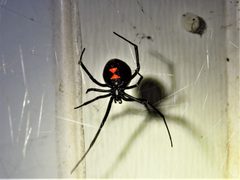
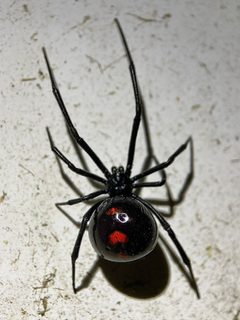
Distinguished from Latrodectus mactans by the disconnected or incomplete hourglass pattern on the (L. mactans has a complete, connected hourglass). Separated from L. hesperus by geographic range and subtle differences in abdominal patterning. The builds webs in elevated positions in natural forest , whereas ground-level web construction may indicate human-modified environments.
Images
Appearance
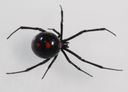
have a globose black with red or orange markings on the surface. The distinguishing feature is a disconnected or broken hourglass pattern on the underside of the abdomen, in contrast to the complete hourglass of L. mactans. The body length is approximately 1.5 inches. Females are larger than males and possess the characteristic warning coloration; males are smaller with less conspicuous markings.
Habitat
In natural settings, occupies mesic to xeric deciduous forests where it constructs webs high in trees. In human-modified landscapes, has been observed in pine plantations and around downed fence posts, building webs close to the ground and in small burrows.
Distribution
Northeastern North America. Core range includes Middle Atlantic states (New Jersey, Delaware, Connecticut, Maryland). Seasonal northward movement along the coast to Massachusetts during summer months. Documented occurrences in southern Ontario, southern Quebec, Michigan, and parts of Wisconsin. The has expanded north of its historically known range.
Seasonality
Mating season occurs April–May. During this period, individuals have been observed traveling northward along coastal areas. Activity extends through summer months in northern extensions of the range.
Behavior
Constructs irregular, tangled webs (cobwebs) typical of the Theridiidae. Web placement varies by : elevated in trees within natural forests, reduced in height or subterranean in human-modified environments. Females guard sacs within the web. Not aggressive; bites occur primarily when the spider is harassed, pinched, or accidentally contacted.
Ecological Role
Venomous ; represents a documented human health concern throughout its range. expansion into new areas may increase encounter rates with humans.
Human Relevance
Bites cause latrodectism, a condition resulting from neurotoxic venom containing alpha-latrotoxin. include localized pain, muscle cramps, abdominal rigidity, nausea, vomiting, sweating, and elevated blood pressure in some cases. Onset of serious symptoms typically occurs 30 minutes to 2 hours post-bite, peaking around 3 hours. Bites are rarely fatal to healthy ; highest risk groups include infants, elderly individuals, and those with cardiovascular . Unlike L. mactans, no antivenom was available as of 2015. Medical attention is advised for severe or spreading symptoms.
Similar Taxa
- Latrodectus mactansOverlapping geographic range in some areas; distinguished by complete, connected red hourglass pattern on versus disconnected hourglass in L. variolus
- Latrodectus hesperusSimilar body form and coloration; separated primarily by geographic distribution (western North America) and subtle pattern differences
Misconceptions
Despite the 'black widow,' females do not invariably consume males after mating. In some Latrodectus , males have been observed bringing food to females.
More Details
Venom toxicity
LD50 measured in mice as 1.20–2.70 mg; individual spiders contain approximately 0.254 mg of venom. The small quantity injected during defensive bites contributes to low fatality rates despite high per unit mass.
Sources and further reading
- BugGuide
- Wikipedia
- GBIF taxonomy match
- iNaturalist taxon
- NCBI Taxonomy
- Catalogue of Life
- There's a Black Widow Spider in the Parade! | Bug Squad
- Hissers: Big, Bold and Beautiful | Bug Squad
- Bohart Museum Open House on 'Many Legged Wonders': How Many Legs Does an Isopod Have? | Bug Squad
- A Birthday Visit to the Bohart | Bug Squad
- Beautiful but dangerous: Black Widow Spiders, Latrodectus spp. — Bug of the Week
- Widow watch - Black Widow Spider, Latrodectus mactens — Bug of the Week
- Predicting the distribution of poorly-documented species, Northern black widow (Latrodectus variolus) and Black purse-web spider (Sphodros niger), using museum specimens and citizen science data