
Latrodectus hesperus
Chamberlin & Ivie, 1935
Western black widow, Western black widow spider, Western widow
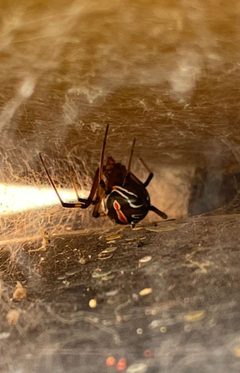
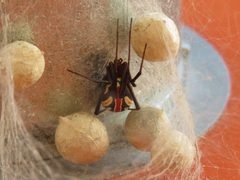
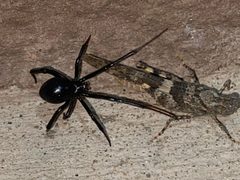
Latrodectus hesperus is a venomous cobweb spider native to western North America. females are 14–16 mm in length, black with a distinctive red hourglass marking on the ; males are approximately half the size, tan to beige with pale abdominal striping. The constructs irregular, three-dimensional webs with gumfoot threads that capture ground-dwelling prey. Females possess potent neurotoxic venom (α-latrotoxin) that causes latrodectism in humans, though fatalities are extremely rare. The species exhibits facultative group living in fall and winter, with females forming tolerant of 2–8 individuals, then reverting to solitary during spring and summer oviposition.
Pronunciation
How to pronounce Latrodectus hesperus: //ˌlætrəˈdɛktəs ˈhɛspərəs//
These audio files are automatically generated. While they are not always 100% accurate, they are a good starting point.
Identification
Females are reliably identified by the combination of black coloration and red hourglass marking on the lower ; this marking may rarely be yellow or white, and can occasionally be broken or absent. Mature females lack other red markings. Males are tan with pale abdominal striping and swollen . spiders begin life with pale coloration and spots/stripes, darkening with successive . Males mature faster and retain some pale markings. The web architecture is diagnostic: large, irregular, three-dimensional cobwebs with extremely strong, elastic threads that can be plucked like guitar strings without breaking. A funnel-like retreat is typically present.
Images
Habitat
Occurs in diverse including deserts, prairies, and coastal areas; particularly abundant in drier environments but can persist in damp situations. Constructs webs in sheltered locations: rodent burrows, beneath stones and rubble, wood piles, cluttered basements, sheds, garages, and cavities requiring substantial force to access. In urban settings, occupies protected microhabitats with abundant prey. In British Columbia coastal , exhibits seasonal sociality with females forming groups in fall and early winter, living solitarily during spring and summer oviposition.
Distribution
Native to western North America: southwestern Canada (British Columbia to Manitoba), Pacific Coast states, and throughout Texas, Oklahoma, and Kansas in the U.S., extending south into Mexico. Introduced established in Israel, Korea, and parts of Europe; accidental introductions documented in Ireland and Slovakia.
Seasonality
Peak prey capture and female reproductive activity occurs May through October, coinciding with sac production and offspring development. signaling by females peaks during summer when males are most abundant. Seasonal sociality observed in some : group formation in fall and early winter, solitary living during spring and summer oviposition period.
Diet
of arthropods from at least eight orders. In British Columbia, primarily consumes Coleoptera (darkling beetles, weevils, ground beetles) and Hymenoptera (ants, , bumblebees), with peak hymenopteran consumption May through September. Opportunistic cannibal of conspecifics when alternative prey is scarce, when very hungry, or in self-defense during antagonistic encounters. Sibling occurs in spiderlings, with timing varying from 2 days to 3 weeks post-hatching depending on and maternal investment level.
Sources and further reading
- BugGuide
- Wikipedia
- GBIF taxonomy match
- iNaturalist taxon
- NCBI Taxonomy
- Catalogue of Life
- There's a Black Widow Spider in the Parade! | Bug Squad
- Hissers: Big, Bold and Beautiful | Bug Squad
- Bohart Museum Open House on 'Many Legged Wonders': How Many Legs Does an Isopod Have? | Bug Squad
- UC Davis Picnic Day: Let's Go on an Insect Scavenger Hunt! | Bug Squad
- A Birthday Visit to the Bohart | Bug Squad
- Bug Eric: Spider Sunday: Western Black Widow
- Priapism After Western Black Widow Spider (Latrodectus hesperus) Envenomation
- Defensive behavior of the black widow spider Latrodectus hesperus (Araneae: Theridiidae)
- Family Affects Sibling Cannibalism in the Black Widow Spider,Latrodectus hesperus
- First record of Latrodectus hesperus Chamberlin & Ivie, 1935, Western Black Widow (Araneae, Theridiidae), in Slovakia
- Ontogeny of defensive behaviors in the western black widow spider (Latrodectus hesperus)
- Learn to hear your prey: The role of associative learning on web building and hunting behaviour in black widow spiders ( Latrodectus hesperus )
- Web Vibrations in Intraspecific Contests of Female Black Widow Spiders,Latrodectus hesperus
- A history of accidental widow spider (genus Latrodectus ) introductions on the island of Ireland with a new irish record for Latrodectus hesperus (Chamberlin and Ivie, 1935), and additional records of Latrodectus geometricus (C.L. Koch, 1841).
- Identification and seasonal abundance of web- and air-borne sex pheromone components of western black widow spiders, Latrodectus hesperus
- 265. Poke but Don't Pinch: Risk Assessment and Defensive Behaviors of the Western Widow Spider (Latrodectus hesperus)
- Chemical prey cues influence the urban microhabitat preferences of Western black widow spiders, Latrodectus hesperus
- Predators and parasitoids of egg sacs of the widow spiders, Latrodectus geometricus and Latrodectus hesperus (Araneae: Theridiidae) in southern California
- Urban heat island conditions experienced by the Western black widow spider (Latrodectus hesperus): Extreme heat slows development but results in behavioral accommodations
- Habitat use by western black widow spiders (Latrodectus hesperus) in coastal British Columbia: evidence of facultative group living
- Repeatability but no short‐term plasticity in the web architecture ofLatrodectus hesperuswestern black widow spiders (Araneae: Theridiidae)