
Baeus
Haliday, 1833
micro-flea wasp
Baeus is a of minute in the Scelionidae, remarkable for extreme . Females are wingless, highly compact, and -like in appearance with reduced or body segments, while males possess wings and a more typical scelionid . All are endoparasitoids of spider , developing inside the (egg sacs) of diverse spider families. The genus has a distribution across all continents except Antarctica, with greatest documented along the eastern seaboard of Australia.
Pronunciation
How to pronounce Baeus: /ˈbae.ʊs/
These audio files are automatically generated. While they are not always 100% accurate, they are a good starting point.
Identification
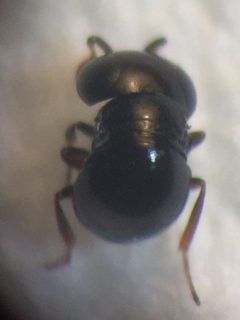
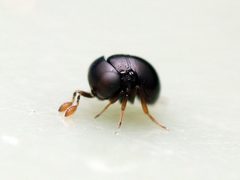
Females are distinguished from other Scelionidae by the combination of winglessness, highly compact rounded body, and reduced or abdominal segments creating a distinctive 'micro-' appearance. Males require examination of antennal , wing venation patterns, body coloration, and pilosity for -level identification. The is distinguished from related baeine genera by female morphology and male genitalic structure. Species identification relies on detailed morphological examination including habitus, antennal segment proportions, and microscopic sculpturing patterns.
Images
Appearance
Females are minute (typically under 2 mm), wingless, and highly compact with a rounded, humpbacked, -like habitus; body segments are reduced or , giving a pseudosac-like appearance. Males are larger, winged, and possess a more typical slender with visible body segmentation and normal antennal structure. Both sexes have reduced wing venation when wings are present.
Habitat
Associated with supporting spider , including above-ground vegetation and cryptobiotic such as leaf litter. Collections indicate presence in diverse terrestrial environments from coastal regions to montane areas. Specific microhabitat determined by host spider ; have been reared from sacs found in vegetation and ground-level substrates.
Distribution
distribution recorded on all continents except Antarctica. Documented from: Australia (eastern seaboard including Tasmania, greatest diversity), Brazil (southeastern region, multiple new ), USA (southeastern Idaho), Angola, Cameroon, and additional regions with sparse records. Distribution records remain incomplete due to small size and collection difficulty.
Seasonality
Activity period corresponds with spider reproductive season. In southeastern Idaho, of Pardosa sacs documented from June through September. In Brazil, collections span multiple months indicating extended activity periods matching local spider breeding cycles.
Host Associations
- Alpaida veniliae - endoparasitoidAraneidae; for B. metazygiae
- Anelosimus studiosus - endoparasitoidTheridiidae; for B. anelosimus
- Anelosimus jabaquara - endoparasitoidTheridiidae; for B. jabaquara
- Cyclosa morretes - endoparasitoidAraneidae
- Latrodectus - endoparasitoidTheridiidae; for B. latrodecti
- Pardosa moesta - endoparasitoidLycosidae
- Pardosa sternalis - endoparasitoidLycosidae
Life Cycle
Endoparasitoid development occurs entirely within spider sacs (). Larvae feed on spider eggs, with of from the egg sac. Developmental timing synchronized with host egg maturation. Specific details of egg, larval, and pupal stages remain undocumented.
Behavior
Females are wingless and possess a saltatorial (jumping) capability suggested by the 'micro-' and compact body form adapted for moving through leaf litter and vegetation. Males are winged and presumably engage in and mate-location . rates of 14.6% have been observed in wolf spider , with parasitism occurring throughout the -carrying season.
Ecological Role
Specialized regulating spider through sac . As endoparasitoids, they contribute to top-down control of spider dynamics and may influence spider reproductive success and population structure. Their small size and specificity suggest role in fine-tuned regulation of local spider .
Human Relevance
B. latrodecti has been documented as a of widow spiders (Latrodectus), suggesting potential interest for venomous spider management. No economic importance otherwise established. Research value in studies of extreme evolution and parasitoid- .
Similar Taxa
- Other Baeini generaFemales of related (e.g., Parabaeus) may appear similar; distinguished by detailed female and male genitalic structure. Angolobaeus and Paraneurobaeus have been synonymized with Baeus based on morphological reanalysis.
- Other ScelionidaeWinged males may resemble other scelionid ; Baeus males distinguished by combination of wing venation patterns and antennal . Wingless females are highly distinctive within the .
More Details
Taxonomic History
The has undergone recent taxonomic revision with African genera Angolobaeus (type Parabaeus machadoi) and Paraneurobaeus (type species P. arachnevora) synonymized under Baeus. Australian fauna revised from 3 to 20 species, indicating substantial undescribed diversity globally.
Collection Challenges
distribution records remain scarce due to minute size (typically under 2 mm), wingless female habit, and cryptic lifestyle within spider sacs. Most records derive from reared specimens rather than field collection, creating sampling toward regions with active arachnological research.
Sexual Dimorphism Significance
The extreme dimorphism—among the most pronounced in Hymenoptera—represents an evolutionary where females are specialized for location and exploitation within confined spaces (leaf litter, vegetation), while males maintain capability. This divergence has resulted in females historically being misidentified or overlooked in surveys.
Sources and further reading
- BugGuide
- Wikipedia
- GBIF taxonomy match
- iNaturalist taxon
- NCBI Taxonomy
- Catalogue of Life
- Two new species of Baeus (Hymenoptera: Scelionidae) from Southeastern Brazil parasitoids of Anelosimus (Araneae: Theridiidae)
- A NEW SPECIES OF BAEUS (HYMENOPTERA: SCELIONIDAE) FROM BRAZIL, PARASITOID OF CYCLOSA MORRETES (ARANEAE: ARANEIDAE)
- LAS ESPECIES DEL GÉNERO BAEUS (HYMENOPTERA: SCELIONIDAE) ENDOPARASITOIDES DE OOTECAS DE ARAÑAS EN LA REGIÓN NEOTROPICAL
- Widow Spider Parasitoids Philolema latrodecti (Fullaway) (Insecta: Hymenoptera: Eurytomidae) and Baeus latrodecti Dozier (Insecta: Hymenoptera: Platygastridae)
- Systematics, distribution and biology of the Australian 'micro-flea' wasps, Baeus spp. (Hymenoptera: Scelionidae): parasitoids of spider eggs
- Five new species of <i>Baeus</i> Haliday, 1833 (Hymenoptera: Platygastroidea: Scelioninae) from Brazil with an updated key to Neotropical species
- Occurrence of Parasitoid Wasps, <em>Baeus</em> sp. and <em>Gelis</em> sp., in the Egg Sacs of the Wolf Spiders <em>Pardosa moesta</em> and <em>Pardosa sternalis</em> (Araneae, Lycosidae) in Southeastern Idaho