
Tigrosa annexa
(Chamberlin & Ivie, 1944)
wolf spider
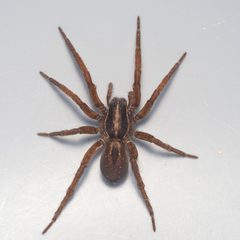
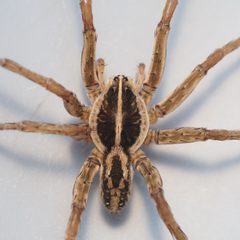
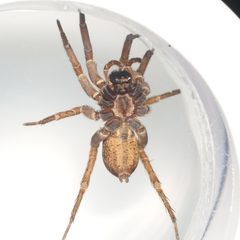
Tigrosa annexa is a wolf spider (Lycosidae) native to eastern North America. Males average 26.17 mm in total length, while females are smaller at approximately 18 mm. The is distinguished by two dark brown to black bars on the with lighter yellowish-gray lines laterally, and two white dashes behind the . It was originally described in the Lycosa, moved to Hogna, and finally placed in Tigrosa when that genus was established in 2012.
Pronunciation
How to pronounce Tigrosa annexa: /tɪˈɡroʊsə æˈnɛksə/
These audio files are automatically generated. While they are not always 100% accurate, they are a good starting point.
Identification
Distinguished from Tigrosa helluo and Tigrosa georgicola by the presence of two white dashes behind the . The bears two distinct dark brown to black bars, often flanked by lighter yellowish-gray lines on each side. Males (21.3–32.1 mm) are substantially larger than females (16.5–20.0 mm), a notable sexual size dimorphism.
Images
Habitat
Most abundant in tropical hardwood hammock forests with xeric or limestone soil, as documented in Everglades National Park. Prefers grass substrates over sand, which provides better camouflage.
Distribution
Eastern North America: Texas east to Florida, and north to Ohio.
Diet
Feeds on small including may beetles (Scarabaeidae) and mole crickets (Gryllotalpidae).
Life Cycle
Females carry sacs suspended from during the pre- stage. Spiderlings emerge after 4–6 weeks when the female tears open the egg sac. Offspring remain on the mother's back for 1–2 weeks before dispersing. Females produce small numbers of relatively large offspring; body mass correlates with both clutch mass and offspring number.
Behavior
Females engage in after copulating. Males exhibit courtship in response to female silk .
Ecological Role
of soil-dwelling insects. Preyed upon by larger spiders and spider wasps (Pompilidae).
Similar Taxa
- Tigrosa helluoLacks the two white dashes behind the present in T. annexa.
- Tigrosa georgicolaLacks the two white dashes behind the present in T. annexa.