
Hogna
Simon, 1885
wolf spiders
Species Guides
14- Hogna ammophila
- Hogna angusta
- Hogna antelucana
- Hogna baltimoriana(Unbanded Wolf Spider)
- Hogna carolinensis(Carolina wolf spider)
- Hogna coloradensis
- Hogna ericeticola(Rosemary Wolf Spider)
- Hogna frondicola(Forest Wolf Spider)
- Hogna lenta(Field Wolf Spider)
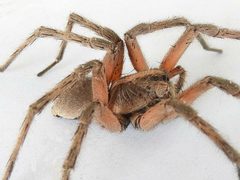
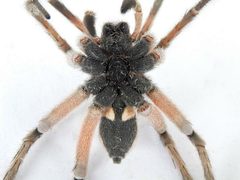
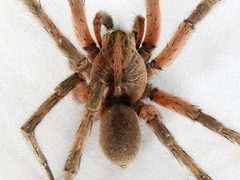
Hogna is a large of wolf spiders (Lycosidae) comprising more than 200 described distributed across all continents except Antarctica. The genus is taxonomically problematic, having never been properly revised even in Europe, and lacks a reliable diagnostic framework. Species are generally large, ground-dwelling hunters that construct open silk-lined burrows rather than using trapdoors. Hogna carolinensis is among the largest wolf spiders in North America, with females reaching 35 mm body length. The genus exhibits notable ecological diversity, with parallel specialization documented in island radiations such as the Galápagos and Madeira.
Pronunciation
How to pronounce Hogna: /ˈhɔɡna/
These audio files are automatically generated. While they are not always 100% accurate, they are a good starting point.
Identification
Reliable identification to is currently difficult due to the lack of a proper taxonomic revision. Potential diagnostic characters include: female epigyne with a very long, relatively narrow longitudinal bar of the central T-shaped structure; color pattern with a central longitudinal pale stripe of the prosoma extending the full length to the ; abdominal pattern with a central mark flanked by two darker longitudinal stripes; and dense scopulae on and of all legs. However, genitalia are highly conservative and closely resemble those of many other lycosine genera, making genitalic alone problematic. Some specimens, particularly African material, show intermediate characters between Hogna and Trochosa.
Images
Habitat
Ground-dwelling; occupies diverse terrestrial including open sandy areas, grasslands, and forest edges. construct open, silk-lined burrows that are not closed with trapdoors. Burrow depth varies: Hogna carolinensis constructs vertical tubes up to 8 inches (approximately 20 cm) deep in sandy substrates.
Distribution
distribution on all continents except Antarctica. Specific regional records include North America (including the United States, with Hogna carolinensis being among the largest wolf spiders there), South America (Colombia), Europe, Africa, Asia, and oceanic islands including the Galápagos and Madeira archipelagos where have undergone parallel specialization.
Diet
Active ; diet includes insects and other arthropods. Hogna helluo has been observed to prey on crickets (Acheta domesticus) and smaller co-occurring wolf spiders (Pardosa milvina). Prey detection involves chemical cues: H. helluo shows preference for chemical cues associated with recent prey, particularly cues from crickets that have fed on plants.
Life Cycle
Maternal care observed in Hogna carolinensis: spiderlings emerge from sacs, climb onto the mother's , and remain there for 5 days until supply is depleted, dispersing on day 6 after . This early contact with maternal parent and siblings affects subsequent development.
Behavior
activity patterns; produce characteristic blue-green reflections when illuminated at night, making individuals detectable with headlamps. Burrow-dwelling habit with open, non-trapdoor entrances. Hogna helluo demonstrates prey-specific chemical cue preferences, showing greater response to cues from recently consumed prey types. Hogna carolinensis spiderlings exhibit enhanced development, improved prey capture for moving prey, and better spatial learning performance when reared with maternal contact and siblings versus in isolation.
Ecological Role
in terrestrial ; contributes to nutrient cycling through . Hogna carolinensis shows sex-based differences in elemental composition and excretion patterns, with males and females differentially cycling micronutrients (Ca, K, Mn, P, Si, Zn). Serves as prey for spider wasps (Pompilidae), including Anoplius aethiops which paralyzes Hogna to provision nests.
Similar Taxa
- ArctosaBoth are large lycosid with similar ground-dwelling habits; Arctosa littoralis is frequently confused with Hogna but occupies sandy littoral and can be distinguished by subtle morphological differences.
- TrochosaGenitalia and somatic characters of some Hogna specimens, particularly African material, appear intermediate between Hogna and Trochosa, indicating close phylogenetic relationship and diagnostic challenges.
- GeolycosaBoth are burrowing wolf spiders, but Geolycosa constructs deeper burrows (averaging 20-25 cm, up to 1 m) with more pronounced turrets of silk and debris, and shows stronger front leg specializations for digging; Geolycosa also has a more elevated .
Sources and further reading
- BugGuide
- Wikipedia
- GBIF taxonomy match
- iNaturalist taxon
- NCBI Taxonomy
- Catalogue of Life
- Bug Eric: Spider Sunday: Burrowing Wolf Spider
- ID Challenge #20 | Beetles In The Bush
- Bug Eric: Wasp Wednesday: Anoplius aethiops
- Miridae | Beetles In The Bush
- not-yet-known not-yet-known not-yet-known unknown Testing for differences in consumer-based nutrient cycling between male and female wolf spiders (Hogna carolinensis)
- Preference for Chemical Cues Associated with Recent Prey in the Wolf Spider Hogna helluo (Araneae: Lycosidae)
- Contact with maternal parent and siblings affects hunting behavior, learning, and central nervous system development in spiderlings of Hogna carolinensis (Araeneae: Lycosidae)
- Effects of Early Contact with Maternal Parent on Locomotor Activity and Exploratory Behavior in Spiderlings of Hogna carolinensis (Araneae: Lycosidae)
- Parallel habitat specialization within the wolf spider genusHognafrom the Galápagos
- Island hoppers: Integrative taxonomic revision of Hogna wolf spiders (Araneae, Lycosidae) endemic to the Madeira islands with description of a new species
- Testing for Differences in Consumer-Based Nutrient Cycling Between Male and Female Wolf Spiders (Hogna carolinensis).