
Scelioninae
Haliday, 1839
Genus Guides
14- Baeus(micro-flea wasp)
- Calliscelio
- Calotelea
- Duta
- Dyscritobaeus
- Exon
- Gryon
- Idris
- Macroteleia
Scelioninae is a large of in the Scelionidae, containing over 3,000 described across approximately 160 . These wasps are exclusively parasitoids, primarily attacking the of insects, spiders, and other arthropods. They are generally idiobionts—parasitoids that prevent further development after attack—and several genera have evolved winglessness or adaptations for aquatic environments, including underwater attack of insect eggs.
Pronunciation
How to pronounce Scelioninae: //ˌsɛliˈoʊnɪni//
These audio files are automatically generated. While they are not always 100% accurate, they are a good starting point.
Identification
Distinguished from other platygastroid by combination of geniculate with 9- or 10-segmented , absence of distinct facial ridges present in Teleasinae, and general body plan. Within Scelioninae, are distinguished by wing presence/absence, structure, and metasomal segmentation. -level identification requires examination of microscopic sculpturing, setation patterns, and genitalic structures.
Images
Appearance
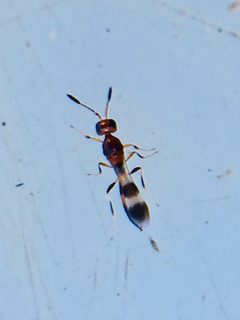
Mostly small ranging 0.5–10 mm in body length. Typically black in coloration with highly sculptured . are geniculate (elbowed) with a 9- or 10-segmented . Some exhibit winglessness. Body form varies from slender to robust depending on genus.
Habitat
Extremely diverse: terrestrial worldwide, with some adapted to intertidal zones and underwater . Found in agricultural including rice fields, forests, grasslands, and maritime shorelines. Several genera are wingless and associated with ground-dwelling .
Distribution
distribution spanning all major biogeographic regions. Particularly diverse in tropical and subtropical areas. Documented from North and South America, Europe, Africa, Asia, Australia, and Pacific islands. Specific show varied patterns: some are widespread (e.g., Scelio), others restricted to particular regions (e.g., Chromoteleia primarily Neotropical with one African relict ).
Host Associations
- insect eggs - primary across orders including Orthoptera, Lepidoptera, Hemiptera
- spider eggs - including maritime spiders in intertidal zones
- butterfly eggs - e.g., hackberry emperor documented
Life Cycle
Development is idiobiont: females lay in eggs, larvae consume host contents, and emerge from the consumed egg. Specific developmental durations vary by and environmental conditions but are generally rapid, with multiple possible annually in favorable climates.
Behavior
Females locate through chemical and tactile cues. Several exhibit winglessness in females, males, or both sexes, correlating with ground-dwelling host association. Some have evolved underwater oviposition, with females submerging to attack aquatic insect eggs. Maritime species such as Echthrodesis lamorali enter torpor when submerged, using a physical gill formed over the body surface.
Ecological Role
Significant regulators of through . Important agents in agricultural systems, particularly against pest Orthoptera and Lepidoptera. In rice of southern India, Scelioninae constitute a major component of diversity. Maritime represent rare examples of intertidal parasitoid wasps.
Human Relevance
Used in classical and programs against agricultural pests. Several are commercially produced or studied for control of grasshoppers, crickets, and pests. Taxonomic research on Scelioninae has clarified species boundaries and resolved synonymies, improving identification for applied purposes.
Similar Taxa
- TeleasinaeFormerly classified together; distinguished by facial ridges and different antennal structure
- PlatygastrinaeRelated in Platygastridae; typically smaller with different wing venation and associations often involving gall midges
- CeraphronoideaSuperficially similar small ; distinguished by wing venation and mesosomal structure
More Details
Taxonomic History
Formerly treated as Scelionidae, reclassified as of Platygastridae in 2021. Previously also treated as subfamily of Platygastridae s.l. before family-level elevation of Scelionidae.
Morphological Diversity
Tyrannoscelio exhibits extraordinary elongate and expanded frontal shelf; Huddlestonium has uniquely 13-merous female ; Aneuroscelio lacks wing entirely.
Conservation Status
Not assessed as a group; individual of conservation concern include Echthrodesis lamorali, effectively conserved within Table Mountain National Park, South Africa.
Sources and further reading
- BugGuide
- Wikipedia
- iNaturalist taxon
- NCBI Taxonomy
- Catalogue of Life
- biodiversity | Blog - Part 35
- synonymy | Blog
- Uncategorized | Blog - Part 37
- Evolution and phylogeny of the parasitoid subfamily Scelioninae (Hymenoptera: Platygastroidea)
- Systematics of Scelioninae (Hymenoptera, Platygastroidea): new synonymy, distribution, and species
- Revision of the Nearctic species of Baryconus (Hymenoptera: Scelionidae, Scelioninae)
- Life history of the maritime platygastrid Echthrodesis lamorali Masner 1968 (Hymenoptera: Platygastridae: Scelioninae)
- Revision of the world species of the genus Fusicornia Risbec (Hymenoptera: Platygastridae, Scelioninae)
- Redescription and revision of the Neotropical genus Pseudoheptascelio Szabó (Hymenoptera, Platygastridae, Scelioninae), parasitoids of eggs of short-horned grasshoppers (Orthoptera, Acrididae)
- Chinese species of egg-parasitoids of the genera Oxyscelio Kieffer, Heptascelio Kieffer and Platyscelio Kieffer (Hymenoptera: Platygastridae s.l., Scelioninae)
- Egg parasitoids from the subfamily Scelioninae (Hymenoptera: Platygastridae) in irrigated rice ecosystems across varied elevational ranges in southern India.
- First record of the genus Scelio (Hymenoptera: Platygastridae, Scelionidae, Scelioninae) egg parasitoids in tomato greenhouses of southeastern Algeria
- Distributional Range of the South African Maritime Spider-Egg Parasitoid Wasp,Echthrodesis lamorali(Hymenoptera: Platygastridae: Scelioninae)
- Five new species of <i>Baeus</i> Haliday, 1833 (Hymenoptera: Platygastroidea: Scelioninae) from Brazil with an updated key to Neotropical species