
Scelio
Latreille, 1805
Species Guides
2Scelio is a large of containing at least 240 and possibly 500 , making it the most diverse genus within the Scelionidae. These wasps are solitary parasitoids of grasshoppers (Acrididae, Orthoptera), including economically important pest locusts such as Schistocerca. They have a distribution and have been studied extensively for their potential as agents against orthopteran agricultural pests.
Pronunciation
How to pronounce Scelio: /ˈsiːli.oʊ/
These audio files are automatically generated. While they are not always 100% accurate, they are a good starting point.
Identification
Identification to level requires examination of microscopic morphological characters and is supported by illustrated keys available in regional monographs. The Scelio can be distinguished from related scelionid genera by a combination of antennal structure, wing venation patterns, and genitalic characters. Six species groups have been established for Afrotropical species: ernstii, howardi, ipomeae, irwini, simoni, and walkeri. The genus Lepidoscelio has been synonymized with Scelio.
Images
Appearance
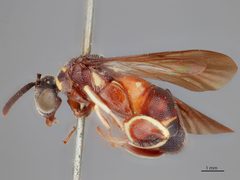
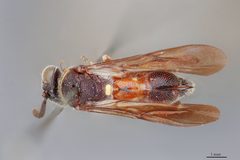
Small , typically measuring 3–10 mm in body length. Many exhibit the black-orange-black (BOB) color pattern: black or dark brown , orange mesosoma, and black metasoma. However, coloration varies considerably across species. has been observed in some related , with males possessing longer than females. Wing varies from fully winged to brachypterous (reduced, non-functional wings) or completely wingless forms.
Habitat
associated with grassland, savanna, and agricultural systems where grasshoppers and locusts occur. Specific microhabitat requirements are poorly documented but are tied to the oviposition sites of host grasshoppers in soil and vegetation.
Distribution
distribution, occurring on all continents except Antarctica. Particularly well-documented from the Afrotropical region, Australia (60 ), and Central and South America. Present in temperate and tropical regions, with concentrated at altitudes below 2,000 meters.
Host Associations
- Acrididae - of short-horned grasshoppers; solitary
- Schistocerca - locusts; economically important pest
Life Cycle
Solitary . Females locate egg pods and deposit a single egg within each egg. The larva develops internally, consuming the host egg contents, and emerges as an . Developmental timing varies with host and environmental conditions.
Behavior
Females actively search for pods in soil or attached to vegetation. -finding involves chemical and tactile cues, though specific mechanisms are not well-documented. are typically collected by sweeping vegetation or using -intercept traps; direct field observation is difficult due to small size.
Ecological Role
Important natural enemies regulating orthopteran . Implicated in suppressing numbers of numerous pest locusts and grasshoppers. Considered potentially valuable agents, though practical implementation has been limited.
Human Relevance
Evaluated for of agricultural and rangeland pests, particularly locusts and grasshoppers that damage crops and pasture. Some have been implemented as biological control agents, though specific successful programs are not detailed in available sources. Research interest focuses on specificity, mass rearing methods, and field release protocols.
Similar Taxa
- ChromoteleiaAlso platygastrid parasitizing orthopteran ; distinguished by larger body size (3–9 mm vs. typically smaller in Scelio), more vivid coloration, and different antennal and genitalic
- HabroteleiaOriental platygastrid also associated with , locust, or ; distinguished by specific morphological characters of the mesosoma and metasoma
- TrimorusFormerly placed in Scelionidae, now in Platygastridae Teleasinae; parasitizes ground beetle (Carabidae) rather than orthopteran eggs, and shows extreme wing and in
More Details
Taxonomic History
The Scelionidae was recently demoted to rank within Platygastridae based on molecular phylogenetic analysis. The Lepidoscelio has been synonymized with Scelio.
Research Significance
A landmark monograph on Australian Scelio (60 , half newly described) provides comprehensive treatment of , , and relationships, serving as a basis for worldwide studies of this economically important group.
Color Pattern Variation
While the black-orange-black (BOB) pattern is common in Scelionidae, Scelio exhibit considerable color variation. The BOB pattern appears most frequently in smaller species and at lower altitudes, but is not universal across the .
Sources and further reading
- BugGuide
- Wikipedia
- GBIF taxonomy match
- iNaturalist taxon
- NCBI Taxonomy
- Catalogue of Life
- Bug Eric: Wasp Wednesday: Trimorus
- Black-Orange-Black Color Pattern Found in 23 Families of Wasps, Bees, and Ants
- Platygastridae | Blog
- Non-native pest-controlling wasp in Canada | Blog
- Figures 25–30 from: Johnson N, Yoder M, Valerio A, Polaszek A, van Noort S, Masner L (2014) Monograph of the Afrotropical species of Scelio Latreille (Hymenoptera, Platygastridae), egg parasitoids of acridid grasshoppers (Orthoptera, Acrididae). ZooKeys 380: 1-188. https://doi.org/10.3897/zookeys.380.5755
- Figures 1–6 from: Johnson N, Yoder M, Valerio A, Polaszek A, van Noort S, Masner L (2014) Monograph of the Afrotropical species of Scelio Latreille (Hymenoptera, Platygastridae), egg parasitoids of acridid grasshoppers (Orthoptera, Acrididae). ZooKeys 380: 1-188. https://doi.org/10.3897/zookeys.380.5755
- Figures 7–12 from: Johnson N, Yoder M, Valerio A, Polaszek A, van Noort S, Masner L (2014) Monograph of the Afrotropical species of Scelio Latreille (Hymenoptera, Platygastridae), egg parasitoids of acridid grasshoppers (Orthoptera, Acrididae). ZooKeys 380: 1-188. https://doi.org/10.3897/zookeys.380.5755
- Figures 13–18 from: Johnson N, Yoder M, Valerio A, Polaszek A, van Noort S, Masner L (2014) Monograph of the Afrotropical species of Scelio Latreille (Hymenoptera, Platygastridae), egg parasitoids of acridid grasshoppers (Orthoptera, Acrididae). ZooKeys 380: 1-188. https://doi.org/10.3897/zookeys.380.5755
- Figures 19–24 from: Johnson N, Yoder M, Valerio A, Polaszek A, van Noort S, Masner L (2014) Monograph of the Afrotropical species of Scelio Latreille (Hymenoptera, Platygastridae), egg parasitoids of acridid grasshoppers (Orthoptera, Acrididae). ZooKeys 380: 1-188. https://doi.org/10.3897/zookeys.380.5755
- Biology, Ecology and Systematics of Australian Scelio
- Figures 217–220 from: Johnson N, Yoder M, Valerio A, Polaszek A, van Noort S, Masner L (2014) Monograph of the Afrotropical species of Scelio Latreille (Hymenoptera, Platygastridae), egg parasitoids of acridid grasshoppers (Orthoptera, Acrididae). ZooKeys 380: 1-188. https://doi.org/10.3897/zookeys.380.5755
- A taxonomic revision of the Old World genus Dichoteleas Kieffer (Hymenoptera, Scelionidae).
- New records of German Scelionidae (Hymenoptera: Platygastroidea) from the collection of the State Museum of Natural History Stuttgart.
- The complete mitochondrial genome of Trissolcus japonicus (Hymenoptera: Scelionidae), the candidate for the biological control of Halyomorpha halys (Hemiptera: Pentatomidae).