
Pardosa moesta
Banks, 1892
Shiny Wolf Spider
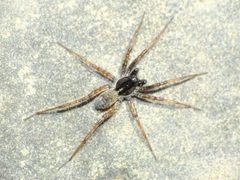
Pardosa moesta is a small to medium-sized wolf spider ( Lycosidae) belonging to the 'moesta group' in the Nearctic region. It is one of the most abundant wolf spiders in North American grasslands, characterized by its 'thin-legged' with long spines nearly perpendicular to the leg axis. The species has an with as subadults, and exhibits maternal care through sac transport. It serves as for including Baeus sp. (Scelionidae) and Gelis sp. (Ichneumonidae), with documented egg sac rates around 14.6%.
Pronunciation
How to pronounce Pardosa moesta: //pɑrˈdoʊsə ˈmɔɪstə//
These audio files are automatically generated. While they are not always 100% accurate, they are a good starting point.
Identification
Distinguished from other wolf spider by the perpendicular leg spines. -level identification requires examination of female or male . Separated from other Pardosa species by genitalic . Often found sympatric with Pardosa mackenziana in central Alberta, with which it shares but differs in specific genitalic structures and subtle phenological differences.
Images
Habitat
Grassland ; also found in open woodlands, forest floors, rocky streambeds, marshy wetlands, lake beaches, field edges, and agricultural plot margins. Occupies some of the highest elevations of any North American spiders. Ground-dwelling; hides in leaf litter, grass tussocks, or debris.
Distribution
Nearctic region: United States and Canada. Documented from Alberta, British Columbia, and southeastern Idaho. Widespread across North America.
Seasonality
present from spring through fall. Overwinters as subadults. sac-carrying season extends from June to September in Idaho . Multiple cohorts observed within a season.
Host Associations
- Baeus sp. - Scelionidae ; of Pardosa moesta
- Gelis sp. - Ichneumonidae ; of Pardosa moesta
Life Cycle
. Overwinters as subadults; matures to adulthood in spring. Females produce sacs in spring and early summer; capable of producing multiple egg sacs. Spiderlings emerge from egg sacs and disperse. In central Alberta, subadults overwinter and resume development in spring.
Behavior
Ground-dwelling wandering hunter; active . Females carry sacs attached to , exposing them to sunlight for incubation—a documented thermoregulatory . Does not balloon (aerial not observed). Maternal care includes transporting spiderlings on back until next .
Ecological Role
in grassland and open . Serves as for egg parasitoid wasps, contributing to food web connectivity between groups.
Similar Taxa
- Pardosa mackenzianaSympatric in central Alberta grasslands; similar size and use; distinguished by genitalic and subtle phenological differences
- Other Lycosidae generaPardosa distinguished by perpendicular leg spines versus shorter, more parallel spines in other wolf spiders
More Details
Parasitism rates
14.6% of 322 examined sacs were parasitized by in southeastern Idaho study
Thermoregulatory behavior
Females seek open areas to expose sacs to sunlight for incubation, documented in Pardosa including P. moesta
Research significance
Subject of detailed studies due to abundance and ecological importance in northern grasslands
Sources and further reading
- BugGuide
- Wikipedia
- GBIF taxonomy match
- iNaturalist taxon
- NCBI Taxonomy
- Catalogue of Life
- Meloidae Holdings | Entomology Research Museum
- Bug Eric: June 2012
- Bug Eric: July 2015
- Bug Eric: New Mexico Dragonfly Blitz - Day 3
- Bug Eric: Wasp Wednesday: Ageniella accepta/conflicta
- Bug Eric: Spider Sunday: Spring Spiders
- LIFE HISTORY OF PARDOSA MOESTA AND PARDOSA MACKENZIANA (ARANEAE, LYCOSIDAE) IN CENTRAL ALBERTA, CANADA
- Occurrence of Parasitoid Wasps, <em>Baeus</em> sp. and <em>Gelis</em> sp., in the Egg Sacs of the Wolf Spiders <em>Pardosa moesta</em> and <em>Pardosa sternalis</em> (Araneae, Lycosidae) in Southeastern Idaho
- THEATRATA,CUBANA,FERRUGINEA,MOESTA,MONTICOLA,SALTUARIA, ANDSOLITUDAGROUPS OF THE SPIDER GENUSPARDOSAIN NORTH AMERICA (ARANEAE: LYCOSIDAE)