
Pardosa mackenziana
(Keyserling, 1877)
Mackenzie's Thin-legged Wolf Spider
Pardosa mackenziana is a of thin-legged wolf spider in the Lycosidae. It is found across the United States and Canada, with confirmed records from Alberta and British Columbia. Like other members of the Pardosa, it is a small to medium-sized ground-dwelling spider. A 2000 study in central Alberta documented its reproductive , including females sunning their sacs to aid incubation.
Pronunciation
How to pronounce Pardosa mackenziana: /pɑrˈdoʊsə mækˈɛnziænə/
These audio files are automatically generated. While they are not always 100% accurate, they are a good starting point.
Identification
As a member of the Pardosa, this can be distinguished from other wolf spiders by its long leg spines that are nearly perpendicular to the leg axis, particularly visible on the hind pair of legs. The is higher than in most other wolf spiders, with nearly vertical sides of the . Species-level identification requires microscopic examination of genitalia: females possess a paired , while males have highly modified resembling small boxing gloves.
Images
Habitat
Found in central Alberta, Canada according to studies. As a Pardosa , it likely occupies diverse including wetlands, rocky streambeds, forest floors, and fields. Some Pardosa species occur at high elevations in mountainous regions.
Distribution
United States and Canada; specifically recorded from Alberta and British Columbia in Canada.
Life Cycle
Females carry sacs attached to their . According to a 2000 study, at least one Pardosa (P. mackenziana or the closely related P. moesta) exhibits sunning where females back out of burrows to expose egg sacs to sunlight for incubation. Spiderlings hatch and climb onto the mother's back, remaining there until their next before dispersing.
Behavior
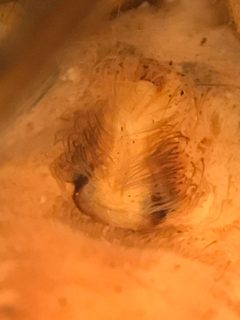
Females have been observed sunning their sacs by backing out of burrow entrances to expose the sac to filtered sunlight, presumably to aid in incubating the eggs. This was documented in a 2000 study of Pardosa in central Alberta.
Similar Taxa
- Pardosa moestaClosely related studied alongside P. mackenziana in the same 2000 research; both occur in central Alberta and share similar and preferences.
- Other Pardosa speciesOver 65 Pardosa occur in the U.S.; microscopic examination of genitalia is required for definitive species-level identification.
More Details
Research significance
The 2000 study by Christopher M. Buddle in the Journal of Arachnology represents one of the few detailed investigations of this , documenting reproductive including the sunning of sacs.
Sources and further reading
- BugGuide
- Wikipedia
- GBIF taxonomy match
- iNaturalist taxon
- NCBI Taxonomy
- Catalogue of Life
- Bug Eric: June 2012
- Bug Eric: July 2015
- Bug Eric: Wasp Wednesday: Ageniella accepta/conflicta
- Bug Eric: Spider Sunday: Spring Spiders
- Adelgidae | Beetles In The Bush
- LIFE HISTORY OF PARDOSA MOESTA AND PARDOSA MACKENZIANA (ARANEAE, LYCOSIDAE) IN CENTRAL ALBERTA, CANADA