
Anelosimus studiosus
(Hentz, 1850)
tangle web spider, cobweb spider, social cobweb spider
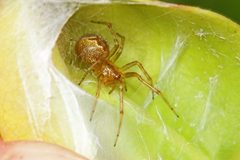
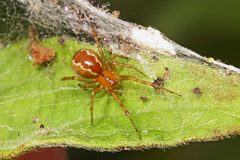
Anelosimus studiosus is a subsocial tangle web spider in the Theridiidae, distributed across much of North and South America from temperate to tropical regions. The exhibits striking social , with two distinct behavioral phenotypes: social spiders that live communally in large cooperative colonies, and asocial solitary individuals that defend individual territories. Social colonies involve multiple females sharing web maintenance, care, and cooperative prey capture without aggression. The frequency of the social phenotype increases at higher latitudes, correlating with colder temperatures where delayed development and maternal mortality risks favor communal living. Despite behavioral differences, the two phenotypes interbreed freely and produce viable offspring.
Pronunciation
How to pronounce Anelosimus studiosus: //ˌænəˈloʊsɪməs stuˈdɪoʊsəs//
These audio files are automatically generated. While they are not always 100% accurate, they are a good starting point.
Identification
Distinguished from solitary theridiids by presence of multiple females cohabiting without aggression in shared web structure. Social colonies can be identified by extensive communal webs covering branches with numerous individuals of varying ages. Distinguished from other Anelosimus by geographic distribution and behavioral phenotype frequencies; genetic analysis may be required for definitive identification where ranges overlap. Previously identified as A. tungurahua in Ecuador, now synonymized.
Images
Habitat
Occurs in diverse environments from temperate to tropical regions. Builds capture webs on vegetation including trees and shrubs. Social colonies occupy extensive web complexes covering branches and foliage. Found in both natural and disturbed where suitable web-building substrates exist.
Distribution
Widespread across the Americas: USA (including Tennessee, Maryland, Texas), through Middle America, to South America including Brazil (Amazonas, Pernambuco, Paraná, Rio de Janeiro, Rio Grande do Sul, São Paulo), Colombia (Magdalena, Meta, Putumayo, Valle del Cauca), Ecuador, Uruguay, and Argentina. Distribution spans tropical and temperate zones with social phenotype frequency increasing northward.
Diet
Captures small flying and crawling insects in webs, including planthoppers and flies. Social colonies achieve higher prey capture than solitary individuals. Cooperative prey capture allows subjugation of larger prey items that single spiders could not handle alone.
Life Cycle
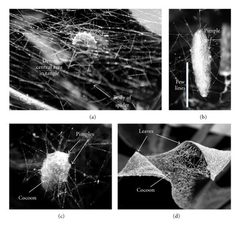
Females encase in tough silk sacs. Spiderlings hatch and remain in maternal nest; delayed is a key trait with timing varying individually. Social colonies: females cooperate to tear egg sacs open, enabling spiderling . Some exhibit matriphagy (consumption of mother by offspring). Offspring may be fed by regurgitation from females in social colonies. development rate varies with temperature, slower in colder climates.
Behavior
Two distinct behavioral phenotypes: (1) Social: multiple females share webs without aggression, cooperate in prey capture, communal web maintenance, and care; more likely to attack prey, less likely to retreat; (2) Asocial: solitary individuals aggressively defend territories, attack intruders, build and maintain individual webs. Behavioral type appears to be conditionally expressed based on environmental factors rather than fixed genetic . Males court and guard subadult females; male-male combat occurs for access to females. Satellite males persist after losing contests. Subadult females may exhibit and receptive postures, potentially as cheating tactic to retain male guards.
Ecological Role
of small insects; social colonies function as extended foraging units with higher per-capita prey capture . Communal webs can become locally abundant, enshrouding entire trees. Reduced aggression in social phenotype correlates with higher vulnerability, creating potential trade-off between short-term reproductive success and long-term persistence.
Human Relevance
Occasionally produces spectacular communal webs that attract public attention, such as the massive web documented at Lake Tawakoni State Park, Texas. Not medically significant to humans. Subject of extensive behavioral research due to social . Serves as model organism for studying evolution of sociality, behavioral , and .
Similar Taxa
- Anelosimus eximiusHighly social spider with similar communal lifestyle, but A. studiosus exhibits social (both social and solitary phenotypes) whereas A. eximius is obligately social.
- Other solitary TheridiidaeA. studiosus solitary phenotype resembles typical cobweb spiders in aggressive territorial , but can be distinguished by identification and context of containing both phenotypes.
More Details
Social Polymorphism Genetics
Social and asocial phenotypes readily interbreed and produce viable offspring, indicating behavioral differences are not due to reproductive isolation. Social spiders within nests are more genetically related than asocial spiders, suggesting lower distances and potential benefits.
Latitudinal Gradient
Social phenotype frequency increases moving northward above 30° latitude, correlating with colder temperatures. This pattern is hypothesized to result from decreased maternal survival and delayed development in colder climates, favoring cooperative care.
Behavioral Syndromes
Within social colonies, individuals exhibit consistent behavioral differences across contexts: aggressive versus docile behavioral types. These have consequences that vary with social context.
Sources and further reading
- BugGuide
- Wikipedia
- GBIF taxonomy match
- iNaturalist taxon
- NCBI Taxonomy
- Catalogue of Life
- Spooky spiders in a big web - Cob-web spiders, Anelosimus studiosus — Bug of the Week
- Anelosimus-darwini - Entomology Today
- Uncategorized | Blog - Part 13
- From Darwin to moramora (‘take it easy’): Ten new subsocial spider species from Madagascar | Blog
- Ten New Spider Species Found in Madagascar
- spiders Archives - Page 2 of 3 - Entomology Today
- Behavioural syndromes and their fitness consequences in a socially polymorphic spider, Anelosimus studiosus
- Phenotypic variation in the social behaviour of the spider Anelosimus studiosus along a latitudinal gradient
- COSTS AND BENEFITS OF FORAGING ASSOCIATED WITH DELAYED DISPERSAL IN THE SPIDER ANELOSIMUS STUDIOSUS (ARANEAE, THERIDIIDAE)
- Pseudocopulation and male-male conflict elicited by subadult females of the subsocial spider Anelosimus cf. studiosus (Theridiidae)
- Spatio-temporal analysis of foraging behaviors of Anelosimus studiosus utilizing mathematical modeling of multiple spider interaction on a cooperative web