
Chalybion californicum
(de Saussure, 1867)
Common Blue Mud-dauber Wasp, Blue Mud Dauber
Chalybion californicum is a solitary mud-dauber with metallic blue coloration, widely distributed across North America. Females are renowned as of black widow spiders and other web-building spiders, using specialized hunting tactics including web vibration to lure prey. Unlike most mud-daubers, this does not construct nests from scratch but instead renovates abandoned mud nests, particularly those of Sceliphron caementarium. The species is not aggressive toward humans and has been introduced to several regions outside its native range.
Pronunciation
How to pronounce Chalybion californicum: //kəˈlɪbiˌɒn ˌkæləˈfɔrnɪkəm//
These audio files are automatically generated. While they are not always 100% accurate, they are a good starting point.
Identification
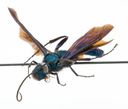
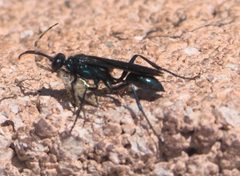
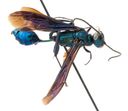
Distinguished from the similar Chlorion aerarium (steel-blue cricket hunter) by smaller size, more subdued metallic coloration, and hairier . Chalybion zimmermanni, a southeastern/southwestern , has white thoracic hairs and smoky rather than violaceous wings. C. californicum nests appear as lumpy, remodeled mud structures rather than the smooth, freshly constructed nests of Sceliphron caementarium. The can be reliably identified by its combination of metallic blue body, violaceous wings, and association with renovated mud nests.
Images
Appearance
Medium-sized with striking metallic blue to blue-violet body coloration. Body is relatively smooth with sparse hair compared to similar . Wings are typically dark with violaceous (violet-purple) tint in most , though some southwestern populations show smoky wing coloration. The petiole (thread-waist) is long and slender. Males and females are similar in coloration, but males lack the stinger (ovipositor). Overall length approximately 15-25 mm.
Habitat
Found in diverse including forests, agricultural lands, urban and suburban areas, and riparian corridors. Frequently nests on human structures such as building eaves, bridges, and barns. Shows particular affinity for areas with abundant web-building spiders and access to water sources for nest renovation. Agricultural landscapes appear to support higher densities than forested areas based on nest collection data from Nebraska.
Distribution
Native to North America, ranging from northern Mexico through the United States to southern Canada. Transcontinental distribution across the contiguous United States. Introduced established in Hawaii, Bermuda, Croatia, and other European countries. Absent from the Pacific Northwest in some historical records but present in most other regions.
Seasonality
Active primarily during warm months; multiple per year in most of range. observed from spring through fall, with peak activity in summer. occurs as pupae within cocoons inside mud , with in spring. Male ("bachelor parties") observed in late afternoon and evening during summer months.
Diet
feed on nectar from flowers including Berberis vulgaris, Daucus carota, and Zizia aurea. Both sexes consume extrafloral nectar, oozing tree sap, and honeydew from aphids and scale insects. Larvae are exclusively , fed paralyzed spiders by the female parent. Documented spider prey includes black widows (Latrodectus mactans), other cobweb weavers (Theridiidae), small orb-weavers (Araneidae), lynx spiders (Oxyopidae), crab spiders (Thomisidae), and jumping spiders (Salticidae).
Host Associations
- Latrodectus mactans - preySouthern Black Widow, primary documented spider
- Sceliphron caementarium - nest /commensalTakes over abandoned or active nests, evicting original occupants
Life Cycle
Females lay single on the first spider placed in each mud . Larvae hatch and progressively consume all cached spiders, leaving only leg fragments as evidence. Mature larvae spin papery silken cocoons within the cell and pupate. Development time varies; some emerge within weeks while others overwinter as pupae and emerge the following spring. chew round exit holes at cell ends to emerge; irregular holes indicate rather than successful development.
Behavior
Females hunt by landing on spider webs without entanglement, then vibrating the web to simulate struggling prey. When the spider approaches, the stings it in a nerve center causing immediate paralysis. The wasp then extracts the spider from the web and transports it to the nest. Females carry water to soften and remodel existing mud nests rather than building new ones. Males gather in ("bachelor parties") in sheltered locations to rest, sometimes numbering in the dozens. Both sexes are docile and flee rather than confront threats.
Ecological Role
Important agent of potentially dangerous spiders, particularly black widows. Acts as through nectar feeding on wildflowers. Serves as for that emerge from mud through irregular exit holes. Contributes to nutrient cycling through spider and provision of carrion-like resources to developing young.
Human Relevance
Generally considered beneficial due to black widow and non-aggressive temperament. Occasionally perceived as nuisance when nesting on buildings or when male startle residents. Not a structural pest; does not damage wood or other building materials. Stings are rare and typically occur only when females are physically grabbed; males cannot sting. No medical significance beyond normal hymenopteran sting reactions.
Similar Taxa
- Chlorion aerariumSimilar metallic blue coloration and body shape, but larger, brighter colored, less hairy, with different antennal placement and structure. Hunts crickets rather than spiders and excavates burrows in soil rather than using mud nests.
- Chalybion zimmermanniSoutheastern and southwestern with white thoracic hairs and smoky rather than violaceous wings; ranges from Tennessee/NC south to Florida and west to Texas/Arizona/Utah.
- Trypoxylon politumPipe organ mud-dauber constructs new linear mud tubes rather than renovating existing nests; often works in male-female pairs with male guarding nest.
Misconceptions
Common misconception that presence of C. californicum indicates nearby black widow ; the is opportunistic and will hunt any available web-building spiders. Another misconception that the are aggressive; they are solitary and non-defensive, with males completely unable to sting. Some sources incorrectly state that females build nests from scratch; they actually require pre-existing mud structures to renovate.
More Details
Hunting Technique
The web-vibration hunting method is highly specialized: the fans its wings to create air currents that vibrate silk threads, plucking the web in patterns that mimic ensnared insect struggles. This lures the spider out of its retreat, expecting captured prey, only to be ambushed by the waiting wasp.
Nest Renovation Behavior
When taking over active Sceliphron nests, females remove the original larva and all cached spiders, then replace with their own and fresh spider prey. The remodeled nest has characteristically lumpy, irregular surface compared to the smooth original construction.
Male Aggregations
male gatherings in door frames, crevices, and other sheltered spots can number 20-50 individuals. These form after afternoon feeding on nectar and honeydew, functioning as communal roosting sites despite the solitary nature of the .
Sources and further reading
- BugGuide
- Wikipedia
- GBIF taxonomy match
- iNaturalist taxon
- NCBI Taxonomy
- Catalogue of Life
- Bug Eric: Wasp Wednesday: Blue Mud Dauber, Chalybion californicum
- Bug Eric: Wasp Wednesday: Chlorion aerarium
- Bug Eric: Wasp Wednesday: Blue Mud Dauber
- Bug Eric: Tiny Wasp Hero Slays Redback Spiders in Australia
- Bug Eric: Spider Sunday: Spider Enemies
- Bug Eric: Mud Masterpieces
- Spiders (Araneae) Collected as Prey by the Mud-Dauber WaspsSceliphron caementariumandChalybion californicum(Hymenoptera: Sphecidae) in Southeastern Nebraska