
Chlorion aerarium
Patton, 1879
steel-blue cricket hunter, aphid wasp
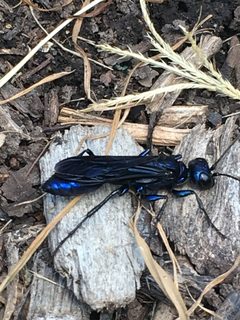
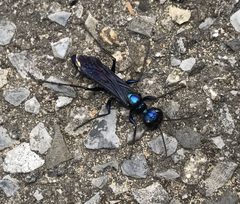
Chlorion aerarium, the steel-blue hunter, is a large, solitary thread-waisted wasp in the Sphecidae. Females hunt crickets (Gryllidae) as prey for their larvae, paralyzing them with venom and caching them in underground burrows. The is frequently mistaken for the similar blue mud dauber (Chalybion californicum), but is generally larger, brighter metallic blue to violet in color, and less hairy. Both sexes feed primarily on fermenting plant sap rather than nectar.

Pronunciation
How to pronounce Chlorion aerarium: //ˈklɔːriˌɒn ɛˈrɛːriˌʊm//
These audio files are automatically generated. While they are not always 100% accurate, they are a good starting point.
Identification
Distinguished from the blue mud dauber (Chalybion californicum) by larger size, brighter and more vivid metallic coloration, reduced hairiness, lower antennal insertion on the , and single-toothed . In the field, size and color intensity are the most reliable indicators: Chlorion aerarium is noticeably larger and more brilliantly metallic. Geographic color variation can confuse identification, as eastern individuals are darker violet while western individuals are brighter teal.
Images
Appearance
Large, robust with striking metallic coloration. Body ranges from vivid teal-blue in western to deep violet-blue in eastern North America. Wings are translucent with blue or violet iridescence. The thread-waisted body form is characteristic of Sphecidae. Generally larger and less hairy than the superficially similar Chalybion californicum. originate lower on the than in Chalybion, and the bears a single tooth (simple in Chalybion).
Habitat
Open including sandy areas, grasslands, and desert scrub. Often found near railroad beds, river corridors, and areas with loose soil suitable for burrowing. Frequently observed at wounded shrubs exuding fermenting sap, particularly Desert Broom (Baccharis sarothroides) in the southwestern United States.
Distribution
Transcontinental in North America, occurring across most of the United States and adjacent southern Canada. Present in Middle America. Range overlaps broadly with Chalybion californicum, particularly in the southwestern United States.
Seasonality
Active primarily during summer months. are most commonly observed from late spring through early autumn, with peak activity in mid-summer.
Diet
feed primarily on fermenting plant sap oozing from wounded shrubs and trees. Only rarely visits flowers for nectar. Females provision nests with paralyzed crickets ( Gryllidae), particularly field crickets, as food for larvae.
Host Associations
- Gryllidae - preyFemales hunt crickets as larval food, paralyzing them with venom
- Baccharis sarothroides - food source congregate at wounded plants to feed on fermenting sap
- Sphecius speciosus - nest associateOften excavates burrows from within entrances of cicada killer burrows
Life Cycle
Solitary nesting . Female excavates burrow, often branching from existing cicada killer burrows, creating multicellular tunnels. Each is provisioned with multiple paralyzed crickets (up to nine reported). A single is laid on one . Larva hatches in about one day, consumes the natal , then feeds on remaining cached crickets. Development completes in less than a week, followed by and of . New adults emerge from pupal cases, exit the burrow, and begin hunting.
Behavior
Females are active hunters, scouring ground and peering into crevices to locate crickets. Upon finding prey, they sting it into paralysis, then fly or carry it to the nest. Both sexes exhibit frenetic activity around sap sources, with dozens sometimes congregating at wounded shrubs. Males gather in groups on vegetation, possibly for roosting or mate-searching. Generally non-aggressive toward humans unless physically handled.
Ecological Role
of crickets, providing of field cricket . Also serves as food source for other organisms. contribute to nutrient cycling through sap-feeding .
Human Relevance
Beneficial insect that reduces , including field crickets that may invade homes. Occasionally mistaken for more dangerous due to large size and striking coloration, but poses minimal sting risk to humans unless directly handled. Non-aggressive temperament makes it safe to observe.
Similar Taxa
- Chalybion californicumNearly identical superficial appearance—both are metallic blue sphecid . Distinguished by smaller size, duller coloration, greater hairiness, higher antennal insertion, and simple in Chalybion. Chalybion also has different prey (spiders) and nesting (reuses mud dauber nests).
Misconceptions
Frequently misidentified as the blue mud dauber due to similar coloration and body form. The name ' ' is misleading, as the does not prey on aphids—this likely derives from feeding on 'honeydew' or sap sources where aphids may also be present.
More Details
Nesting associations
Unusual habit of excavating burrows from within entrances of cicada killer (Sphecius speciosus) burrows, effectively usurping partially completed excavations of a larger relative.
Geographic color variation
Western (Arizona, etc.) tend toward bright teal-blue coloration, while eastern populations are deep violet-blue. This variation has led to confusion in field identification.
Male behavior
Males have been observed in on vegetation, distinct from the more dispersed activity patterns of females.
Sources and further reading
- BugGuide
- Wikipedia
- GBIF taxonomy match
- iNaturalist taxon
- NCBI Taxonomy
- Catalogue of Life
- Bug Eric: Wasp Wednesday: Chlorion aerarium
- Steel-blue cricket-hunters steal lives: Steel-blue cricket-hunters, Chlorion aerarium — Bug of the Week
- Bug Eric: Year-end Wrap-up
- Bug Eric: Wasp Wednesday: Blue Mud Dauber
- Bug Eric: December 2011
- pleasing fungus beetles | Beetles In The Bush
- Nesting Behavior of Chlorion aerarium1