
Gryllus
Linnaeus, 1758
field cricket
Species Guides
23- Gryllus alogus
- Gryllus armatus(Armed Field Cricket)
- Gryllus assimilis(Jamaican field cricket)
- Gryllus brevicaudus(Short-tailed Field Cricket)
- Gryllus cayensis(keys wood cricket)
- Gryllus firmus(Sand Field Cricket)
- Gryllus fultoni(Southern Wood Cricket)
- Gryllus integer(Western Trilling Cricket)
- Gryllus lightfooti(Arboreal Desert Field Cricket)
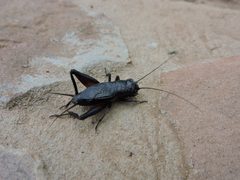
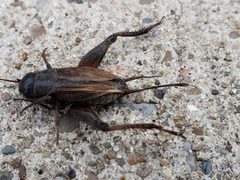
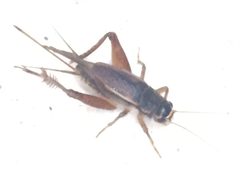
Gryllus is a widespread of field crickets in the Gryllidae, with members found across Africa, the Americas, Europe, and Asia. typically measure 15–31 mm and are darkly colored. in this genus are often difficult to distinguish from related genera based on external alone; male genitalia, particularly the structure of the epithallus, provide more reliable identification characters. The genus has been extensively studied for its , with male calling songs used for mate attraction and territorial defense.
Pronunciation
How to pronounce Gryllus: /ˈɡrɪl.lʊs/
These audio files are automatically generated. While they are not always 100% accurate, they are a good starting point.
Identification
within Gryllus often appear similar to those of other field . Reliable identification typically requires examination of male genitalia. The epithallus in American and European species usually consists of three lobes, with the middle lobe longer and more slender than the lateral lobes. African species show greater variability in this structure, creating more overlap with related genera and making definitive assignment more difficult. Body size (15–31 mm) and dark coloration alone are insufficient for species-level identification.
Images
Habitat
Field crickets in this occupy diverse terrestrial environments including grasslands, agricultural fields, gardens, woodpiles, and tool sheds. Some enter human structures seasonally, particularly in autumn, seeking shelter as temperatures decline. associations vary by species; for example, Gryllus assimilis has been documented in agricultural environments in Brazil where it serves as a biomarker for environmental .
Distribution
Gryllus is one of the most widely distributed globally. It occurs in Africa, North America, South America, Europe, and Asia. Specific distribution records include the southeastern United States, Caribbean, Brazil, and southern Africa. The genus was historically taxonomically confused in eastern North America, where regional variants were formerly lumped under a single name.
Seasonality
Activity patterns vary by and latitude. In temperate regions, are typically active from late summer through autumn, with some species producing that hatch in spring. Chirping frequency and activity levels decline with falling temperatures, ceasing entirely near freezing. The relationship between chirp rate and ambient temperature has been used to estimate outdoor temperatures.
Life Cycle
Development includes , nymph, and stages. Eggs are deposited in soil by females and may undergo over winter. Nymphs emerge in spring and undergo eight or more before reaching adulthood. In Gryllus assimilis, five distinct developmental stages have been characterized from nymphal phase through , each showing different physiological responses to environmental stressors. Winged adults develop after the final molt.
Behavior
Males produce -specific calling songs by rubbing a scraper on one forewing against a file on the opposite forewing. Songs serve multiple functions: attracting females, courtship, and territorial defense against rival males. Females detect songs using tympanal organs on their forelegs and may also assess male quality through courtship dances. Males engage in aggressive interactions involving chirping, jaw snapping, and foreleg grappling. Chirp frequency varies with ambient temperature, increasing in warmer conditions.
Ecological Role
Field crickets function as decomposers and scavengers, consuming decaying plant matter, seeds, and occasionally other insects. They serve as prey for numerous vertebrate and . Some , particularly Gryllus assimilis, are used as biomarker organisms for assessing environmental quality due to their sensitivity to changes and agrochemical . The is also parasitized by (Paragordius varius), which can significantly impact survival and .
Human Relevance
Field crickets are familiar to humans through their distinctive chirping, which has been used as a crude thermometer (counting chirps in 15 seconds and adding 40 approximates temperature in Fahrenheit). They occasionally invade homes in autumn, where their singing may be considered either charming or disruptive. Historically, crickets have been used in Chinese gambling on fights, with handlers employing specific techniques to resuscitate defeated individuals. Some are studied as models for neurophysiology, behavioral , and ecotoxicology.
Similar Taxa
- AchetaHistorically confused with Gryllus; eastern North American field crickets were formerly classified in Acheta before taxonomic revision based on calling song, , and hybridization studies distinguished multiple Gryllus .
- TeleogryllusMorphologically similar field crickets; separation relies on subtle differences in male genitalia structure and acoustic signal characteristics.
- Oecanthus (tree crickets)May be confused due to similar size and chirping ; tree crickets typically have more slender bodies, longer relative to body size, and occupy arboreal rather than ground-level environments.
More Details
Taxonomic History
Until the mid-1950s, native field crickets in eastern North America were assigned to a single , Acheta assimilis. Richard Alexander's revisionary work, building on Fulton's studies of calling songs, recognized five distinct species in the eastern United States based on male calling song, differences, and cross-breeding experiments.
Acoustic Thermometry
The relationship between chirp rate and temperature, first noted by Amos Dolbear, varies slightly among sources: some report adding 40 to the count of chirps in 15 seconds, others suggest adding 37. This variation likely reflects -specific differences in the thermal sensitivity of stridulation.
Parasite Interactions
Gryllus firmus is a documented of the Paragordius varius, a long-lived that grows up to 30 cm inside the host and can persist for 28 days or more, significantly reducing host reproductive even when survival is maintained.
Sources and further reading
- BugGuide
- Wikipedia
- GBIF taxonomy match
- iNaturalist taxon
- NCBI Taxonomy
- Catalogue of Life
- Host and a Parasite: Battle of Sand Field Crickets vs. Horsehair Worms | Bug Squad
- Grasshoppers of Colorado
- Field crickets invade a home with a wake-up call: Fall field cricket, Gryllus pennsylvanicus — Bug of the Week
- Home invaders III - Fall field cricket, Gryllus pennsylvanicus — Bug of the Week
- The troubadour downstairs – fall field cricket, Gryllus pennsylvanicus — Bug of the Week
- What’s all this chirping about? Ask the fall field cricket, Gryllus pennsylvanicus — Bug of the Week
- Ecotoxicological effects of a glyphosate-based herbicide on Gryllus (Gryllus) assimilis (Orthoptera: Gryllidae) ontogeny: A study on antioxidant system, oxidative stress and cholinergic system
- Physiological characterisation of antennal mechanosensory descending interneurons in an insect (Gryllus bimaculatus, Gryllus campestris) brain
- Mating status affects females feeding behavior but does not the encapsulation response in the field cricket, Gryllus (Gryllus) assimilis (Fabricius, 1775)
- The role of the corpora allata in the adult male cricket (Gryllus campestris and Gryllus bimaculatus) in the development and expression of its agonistic behaviour
- Biological activities and safety assessment of Teleogryllus mitratus extracts for skin delivery via nanoemulsion-based systems.