
Ammophila wrightii
(Cresson, 1868)
thread-waisted wasp, caterpillar hunter
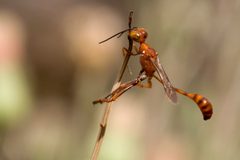
Ammophila wrightii is a of thread-waisted in the Sphecidae, notable for its -mimicking appearance and . It is one of the smaller members of its , measuring under 20 mm, and exhibits a distinct reddish-brown coloration. The species is known for its unusual nesting behavior among Ammophila wasps: females excavate burrows only after capturing prey, rather than before. It specializes in hunting inchworm caterpillars (Geometridae) to provision its nests.
Pronunciation
How to pronounce Ammophila wrightii: /ˌæm.oʊˈfaɪ.lə ˈraɪ.ti.aɪ/
These audio files are automatically generated. While they are not always 100% accurate, they are a good starting point.
Identification
Distinguished from other Ammophila by its small size, uniform reddish-brown coloration, and low flattened pronotal collar. The -mimicking appearance separates it from larger, more boldly patterned like A. procera. Wing venation varies geographically: three submarginal in western , two in eastern populations. Most similar to A. formicoides, with which it shares the ant-mimicry and is grouped in the same species group.
Images
Appearance
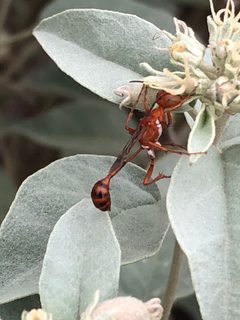
Small thread-waisted , under 20 mm in length. Body is almost uniformly reddish-brown in color. The pronotal collar (base of the 'neck') is low and flattened. Western specimens typically have three submarginal in the front wing, while eastern specimens have only two—a notable geographic variation in wing venation. The overall slender build and coloration mimic harvester ants (Pogonomyrmex).
Habitat
Open areas with sandy or compact soil suitable for nesting. Observed nectaring on flowers of Burroweed (Isocoma tenuisecta). Females are typically encountered crawling on the ground in a manner resembling harvester ants, rather than on vegetation.
Distribution
Western and central North America: California and Nevada east to northern Nebraska, south to the Mexican border. One record from north-central Oregon. The shows geographic variation in wing venation across this range.
Seasonality
Active during warmer months. A specimen was observed nectaring in late September in Arizona. Specific details are poorly documented.
Diet
feed on nectar. Females hunt caterpillars, specifically inchworms (larvae of Geometridae ), to provision nests for their offspring.
Life Cycle
Solitary nesting with a primitive behavioral characteristic among its : the nest burrow is excavated after prey capture, not before. Burrows are vertically oriented. Each nest receives one caterpillar, on which an is laid. Development details otherwise follow typical sphecid pattern: larva feeds on the paralyzed caterpillar, pupates, and emerges as an .
Behavior
Females exhibit -mimicking , crawling on the ground in the manner of harvester ants, making them easily overlooked. This is believed to be a form of protective mimicry. When nectaring, they are relatively approachable. Nesting females are persistent and will return to burrows if disturbed. Males are known to mate opportunistically with females at nectar sources.
Ecological Role
of Geometrid caterpillars, potentially providing of these herbivores. As a nectar-feeder, may contribute to pollination. Subject to by Strepsiptera , which may affect .
Human Relevance
Generally harmless to humans; not aggressive. Ecological interest due to -mimicry and unusual nesting . Potential value in understanding the evolution of behavioral plasticity in nest construction.
Similar Taxa
- Ammophila formicoidesShares -mimicking appearance, similar size, and low flattened pronotal collar; in the same group
- Ammophila proceraMuch larger (25-38 mm), has silver thoracic stripes, and builds burrows before prey capture; not -mimetic
- Pogonomyrmex (harvester ants)Visual and behavioral mimic; A. wrightii females are frequently mistaken for these ants due to convergent appearance and ground-crawling
More Details
Wing venation mystery
The reason for geographic variation in submarginal number (two in eastern specimens, three in western) remains unexplained.
Historical taxonomy
Originally described as Sphex wrightii by C.H. Hicks in 1934; later transferred to Ammophila.
Research opportunities
Field observations have been sparse since Hicks' 1934 publication; much remains to be documented about this ' .
Sources and further reading
- BugGuide
- Wikipedia
- GBIF taxonomy match
- iNaturalist taxon
- NCBI Taxonomy
- Catalogue of Life
- 'When I Grow Up, I Want to Be an Entomologist' | Bug Squad
- Humbled and Honored to Receive ACE Awards | Bug Squad
- Bug Eric: December 2010
- Bug Eric: June 2012
- Bug Eric: Wasp Wednesday: Ammophila procera
- Bug Eric: Ammophila in Action