
Ammophilinae
André, 1886
thread-waisted wasps
Genus Guides
3- Ammophila(Thread-waisted Sand Wasps)
- Eremnophila(thread-waisted wasps)
- Podalonia(Cutworm Wasps)
Ammophilinae is a of thread-waisted wasps in the Sphecidae, containing approximately 6 and over 320 described . Members are solitary characterized by a narrow petiole connecting the and . The group includes well-known genera such as Ammophila and Podalonia, which are notable for their specialized hunting involving caterpillar prey.
Pronunciation
How to pronounce Ammophilinae: /ˌæməˈfɪləˌnaɪ/
These audio files are automatically generated. While they are not always 100% accurate, they are a good starting point.
Identification
Distinguished from other Sphecidae by -level morphological characters. Within Ammophilinae, and require examination of minute characters such as presence/absence for definitive identification. Podalonia females resemble small Sphex species, while Podalonia males resemble Ammophila species. Live specimens in photographs rarely allow species-level determination due to the subtlety of diagnostic characters.
Images
Appearance
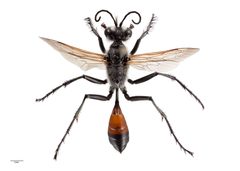
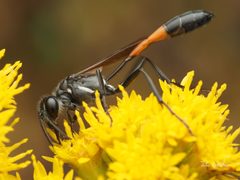
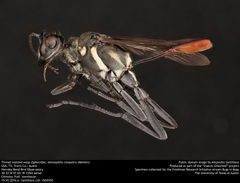
Slender, thread-waisted wasps with a pronounced narrow petiole (thread-like waist) between the and . Body typically elongated with long legs. Females of some resemble small Sphex , while males may resemble Ammophila species. Minute diagnostic characters such as the presence or absence of (tiny pads between tarsal claws) are used for species-level identification.
Habitat
Occurs in diverse terrestrial ; Podalonia are most abundant in the western United States but occur across North America, Central America, Eurasia, and Africa. Species have been observed in montane environments such as the San Jacinto Mountains of southern California.
Distribution
distribution. Podalonia occurs in North America, Central America, Eurasia, and Africa. The as a whole has broad geographic range corresponding to the distribution of its constituent .
Diet
Larval diet consists of paralyzed caterpillars provisioned by females. of both sexes have been observed feeding on flower nectar.
Life Cycle
Solitary nesting . Females hunt soil-dwelling caterpillars (cutworms), paralyze them, then dig a burrow and deposit a single on the prey. Each burrow contains only one caterpillar. The tunnel opening is sealed after provisioning. This sequence—procuring prey before excavating the burrow—differs from the typical behavior of most Sphecidae, which dig burrows first.
Behavior
Females exhibit solitary hunting , seeking soil-dwelling caterpillars as prey. Some aggregate nightly in sheltered spaces; several hundred individuals may cluster together under bark or in similar protected locations. This behavior has been observed in both sexes and may correlate with inclement weather or in females. Mating occurs frequently. Both sexes visit flowers for nectar.
Ecological Role
of caterpillars, including agricultural pest . Serve as agents in gardens and agricultural fields.
Human Relevance
Beneficial insects in agricultural and garden contexts due to on pest caterpillars. Subject of entomological study and photographic documentation. Some videos are available on public platforms.
Similar Taxa
More Details
Aggregation behavior
Nightly of hundreds of individuals in sheltered spaces has been documented in Podalonia , though the and function of this remain incompletely understood.
Nesting sequence
The reversed sequence—hunting prey before digging the burrow—is atypical for Sphecidae and represents a notable behavioral characteristic of the .