
Ammophila
W. Kirby, 1798
Thread-waisted Sand Wasps
Species Guides
13- Ammophila aberti(Abert's Thread-waisted Wasp)
- Ammophila aphrodite
- Ammophila azteca(Aztec Thread-waisted Wasp)
- Ammophila cleopatra
- Ammophila femurrubra
- Ammophila ferruginosa
- Ammophila formicoides
- Ammophila juncea
- Ammophila nigricans(thread-waisted wasp)
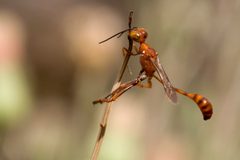
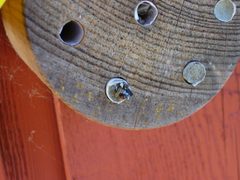
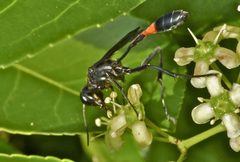
Ammophila is a large, of solitary hunting in the Sphecidae, comprising over 200 distributed across warmer regions of all continents except Antarctica. These thread-waisted wasps are characterized by their elongated, slender petiole connecting the and , and their distinctive nesting involving burrow excavation and caterpillar provisioning. Females construct underground nests in sandy or compact soils, paralyze caterpillars with their sting, and provide this food source for their developing larvae. The genus serves as a for Strepsiptera and is subject to nest by satellite flies and other organisms.
Pronunciation
How to pronounce Ammophila: //ˌæməˈfaɪlə//
These audio files are automatically generated. While they are not always 100% accurate, they are a good starting point.
Identification
Distinguished from similar thread-waisted wasps by the combination of an extremely elongated, thread-like petiole and silver stripes on the side of the present in most . Ammophila procera, the largest eastern North American species, approaches 25–38 mm in length and exhibits particularly prominent silver thoracic markings. The can be separated from the closely related Podalonia by subtle morphological differences in wing venation and body proportions. Species-level identification requires examination of specific structural features and is documented comprehensively in taxonomic references.
Images
Habitat
Open areas with sandy or compact soils are favored nesting sites. Females of Ammophila aberti have been observed nesting in flat areas with hard, baked soil, excavating burrows by literally taking bites out of the earth. Ammophila procera nests in compact sand, including coastal beach environments. The occupies diverse terrestrial across its range, from southern Canada to Guatemala in North America, with adapted to warmer regions globally.
Distribution
distribution across warmer regions of all continents except Antarctica. In North America, documented from southern Canada through the United States to Guatemala. Ammophila aberti ranges throughout western North America, east to Iowa, and south into Mexico. The contains over 200 with greatest diversity in tropical and subtropical zones.
Diet
feed on nectar from flowers such as goldenrod. Females provision nests with paralyzed caterpillars as food for their larvae. Ammophila aberti uses caterpillars from at least five of Lepidoptera: Geometridae, Noctuidae, Pyralidae, Hesperiidae, and Pieridae, averaging about six caterpillars per nest. Ammophila procera preys on caterpillars of the Prominent family Notodontidae, including Nadata gibbosa, Heterocampa manteo, Heterocampa astarte, Schizura ipomoeae, and members of the Datana and Symmerista, with at least one record of Smerinthus cerisyi.
Life Cycle
Solitary ground-nesting . Females excavate burrows varying from slanted to vertical, ending in a single . An is laid on the first caterpillar stored in the cell. Nest provisioning may be extended in duration; females of some initiate multiple nests simultaneously, with documented cases of females starting up to eight or even twelve different burrows, few of which are completed. This has been hypothesized to function as a defense against nest . Females may require extended periods to furnish complete food supplies for offspring, with provisioning duration influenced by weather conditions and prey availability.
Behavior
Females exhibit complex nesting including excavation of burrows, orientation to memorize nest location, and temporary plugging of burrow entrances with pebbles or soil clods when away from the nest. Prey transport involves gripping caterpillars with and middle legs in a manner that renders the prey rigid, enabling agile running; females can also fly with caterpillars oriented beneath the body for aerodynamic . Prey-stealing from conspecifics occurs within nesting , with females attacking returning to wrest caterpillars from them, and some individuals digging open nests of others to pilfer cached prey. Females are persistent in nesting activities and typically return to burrows if frightened away. are not aggressive and will flee from approaching humans; females can sting if physically grabbed but do not exhibit defensive stinging behavior.
Ecological Role
of Lepidoptera caterpillars, potentially contributing to regulation of herbivorous insect . Serves as for Strepsiptera , with maternal transmission documented between females and offspring. Nests are subject to by satellite flies (Sarcophagidae: Miltogramminae, including Senotainia vigilans and Metopia laterallis), which follow prey-laden females to deposit larvae at burrow entrances. Bee flies (Bombyliidae: Thyridanthrax) have been observed hovering over open nests and depositing into tunnels.
Human Relevance
Subject of extensive behavioral research due to complex parental care and nesting strategies. The Bohart Museum of Entomology houses approximately 30,000 specimens from multiple continents, representing a significant research resource. Arnold Menke's monograph "The Ammophila of North and Central America" serves as a definitive taxonomic reference. Not considered dangerous to humans; solitary nature and non-aggressive make encounters benign. Stinging occurs only upon direct physical contact.
Similar Taxa
- PodaloniaRelated of thread-waisted sphecid with similar and nesting ; distinguished by wing venation and body proportion differences.
Sources and further reading
- BugGuide
- Wikipedia
- iNaturalist taxon
- Catalogue of Life
- 'When I Grow Up, I Want to Be an Entomologist' | Bug Squad
- Humbled and Honored to Receive ACE Awards | Bug Squad
- RJ Millena: from Entomology-Focused Kindergartener to Scoring Cover of Journal With Her Research | Bug Squad
- Bug Eric: Wasp Wednesday: Ammophila procera
- Bug Eric: Ammophila in Action
- Bug Eric: Wasp Wednesday: Ammophila aberti
- Chitonospora ammophila .
- Marram Grass. (Ammophila arundinacea, Host.)
- Nest parasitism and nest defense in the solitary ground-nesting wasp Ammophila aberti Haldeman, 1852, with notes on the nesting behavior of Ammophila parkeri Menke, 1964 and Podalonia mexicana (de Saussure, 1867) (Hymenoptera: Sphecidae)
- Bioprospecting for plant resilience to climate change: mycorrhizal symbionts of European and American beachgrass (Ammophila arenaria and Ammophila breviligulata) from maritime sand dunes
- Notes on nesting behaviour and larval development of Ammophila gracilis Lepeletier de Saint Fargeau (Hymenoptera: Sphecidae)
- Reproductive Biology of Ammophila breviligulata
- Remotely Sensed Mapping of Ammophila spp. Distribution and Density at Cape Cod National Seashore