
Podalonia
Fernald, 1927
Cutworm Wasps
Species Guides
6- Podalonia argentifrons(cutworm wasp)
- Podalonia argentipilis(Cutworm Hunter Wasp)
- Podalonia luctuosa
- Podalonia melaena(cutworm wasp)
- Podalonia pubescens(cutworm wasp)
- Podalonia robusta(cutworm wasp)
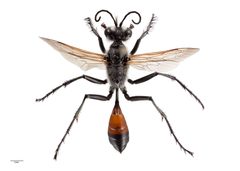
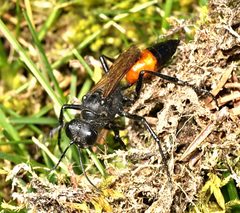
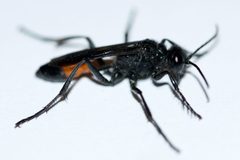
Podalonia is a of solitary, thread-waisted wasps in the Sphecidae, commonly known as . The genus contains approximately 67 described distributed worldwide except South America. Females hunt soil-dwelling caterpillars (cutworms), paralyze them, and provision underground burrows with a single prey item per . Unlike most sphecid wasps, Podalonia females dig their burrow after capturing prey rather than before. The genus is most abundant in western North America.
Pronunciation
How to pronounce Podalonia: //ˌpoʊdəˈloʊniə//
These audio files are automatically generated. While they are not always 100% accurate, they are a good starting point.
Identification
Distinguished from the similar sand wasp Ammophila by the much shorter petiole and slightly more robust . Females look like small Sphex ; males resemble Ammophila . Species-level identification requires examination of minute characters such as (tiny pads between the claws on each foot), which are rarely visible in images of live specimens.
Images
Habitat
Sandy including beaches, dunes, and sandy soils. Nests are excavated in sand or soft soil, often in open areas. Some aggregate nightly in sheltered spaces such as under bark on tree stumps.
Distribution
Worldwide distribution except South America. Most abundant in western United States. Present in North America, Central America, Eurasia, and Africa. Specific collection records include Belarus (Homyel Voblasts), New Zealand (Wanganui), and Denmark and Sweden (GBIF records).
Seasonality
active from spring through summer. Females observed active at temperatures as low as 58°F (14°C) in late February in Colorado. Nightly of adults occur, possibly correlating with inclement weather or .
Host Associations
- Paraxenos sphecidarum - Strepsipteran recorded from Podalonia affinis in Belarus
- Buathra tarsoleuca - Ichneumonid
- Cryptus sp. - possible Possible ichneumonid
- Meringopus calescens - possible Possible ichneumonid
Life Cycle
Solitary ground-nesting . Female digs burrow after capturing prey (reverse of typical sphecid sequence). Single paralyzed caterpillar placed in bottom of burrow; single laid upon it. Tunnel entrance sealed after provisioning. Larva feeds on paralyzed , described as reaching 30-35 mm length and 7-10 mm diameter at maturity. occurs in soil; may overwinter in sheltered .
Behavior
Females hunt soil-dwelling caterpillars, paralyze them with venom, and transport them to newly excavated burrows. Both sexes visit flowers for nectar. Males and females aggregate nightly in sheltered spaces; hundreds of individuals may cluster together under bark or in similar protected sites. Mating occurs frequently at flowers. Intraspecific theft of prey has been observed, with females fighting over captured caterpillars. Females are 'pullers' that carry soil out of burrows in armloads rather than scratching it out behind them.
Ecological Role
of soil-dwelling caterpillars (cutworms), including pest in agricultural and garden settings. agent for larvae. for and strepsipteran .
Human Relevance
Beneficial insects in gardens and agricultural fields due to on pest caterpillars. Generally not aggressive toward humans; stings rare unless are directly handled. Sometimes mistaken for more conspicuous wasps like the Great Black Wasp (Sphex pensylvanicus).
Similar Taxa
- AmmophilaSimilar thread-waisted wasps in same Ammophilinae; distinguished by longer petiole and less robust in Ammophila
- SphexFemales resemble small Sphex ; Sphex species are generally larger with different prey preferences (katydids rather than cutworms)
Misconceptions
Frequently mistaken for Sphex pensylvanicus (Great Black Wasp) by observers, particularly in western North America where Podalonia are common but Sphex pensylvanicus is absent or rare. The 'cutworm wasp' sometimes leads to confusion with other caterpillar-hunting .
More Details
Nesting Sequence
Unlike most sphecid that dig burrows before hunting, Podalonia females capture prey first, then excavate the burrow. This reversed sequence is a distinctive behavioral trait of the .
Species Diversity
Nineteen are known from North America north of Mexico, with 67 described species worldwide. Species identification typically requires examination of microscopic characters and is rarely possible from field photographs.
Prey Theft
Observed in Podalonia: females will fight over captured caterpillars and usurp prey from other females, with the victor dragging the stolen caterpillar to her own burrow.
Sources and further reading
- BugGuide
- Wikipedia
- GBIF taxonomy match
- iNaturalist taxon
- NCBI Taxonomy
- Catalogue of Life
- Bug Eric: Wasp Wednesday: Podalonia
- Bug Eric: Wasp Wednesday: Winter Wasps
- Bug Eric: Wasp Wednesday: Great Black Wasp
- Bug Eric: April 2015
- Bug Eric: Don't Dig Those Dandelions?!
- Bug Eric: June 2012
- Podalonia affinis (W. Kirby, 1798) (Hymenoptera: Apoidea: Sphecidae), a new host species of the strepsipteran Paraxenos sphecidarum (Dufour, 1837) in Belarus
- A Note on Host Detection by Buathra tarsoleuca (Schrank) (Hymenoptera: Ichneumonidae), a Parasite of Ammophila sabulosa (L.) and Podalonia affinis (Kirby) (Hymenoptera: Sphecidae)
- Nesting behaviour ofPodalonia tydei suspiciosa(Smith) (Hymenoptera: Apoidea: Sphecidae; Sphecinae) at Castlecliff Beach, Wanganui, with a description of the mature larva
- Nest parasitism and nest defense in the solitary ground-nesting wasp Ammophila aberti Haldeman, 1852, with notes on the nesting behavior of Ammophila parkeri Menke, 1964 and Podalonia mexicana (de Saussure, 1867) (Hymenoptera: Sphecidae)